Investment casting tooling costs are one of the first expenses buyers encounter when developing custom cast parts. While tooling requires an upfront investment, understanding what influences tooling costs can help reduce unnecessary expenses and improve long-term manufacturing value. This guide explains the key factors that affect investment casting tooling costs and provides practical tips for making more cost-effective sourcing decisions.
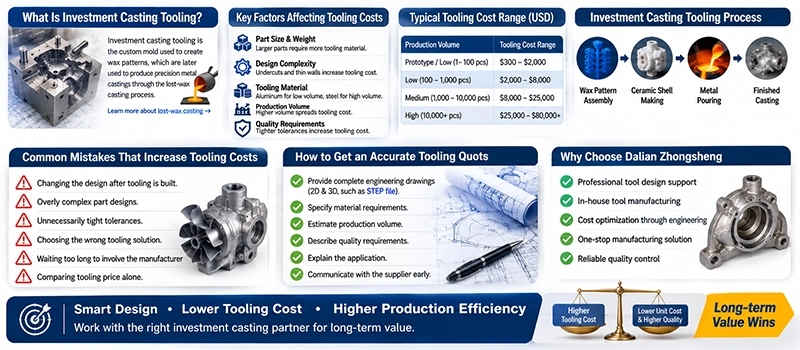
What Is Investment Casting Tooling?
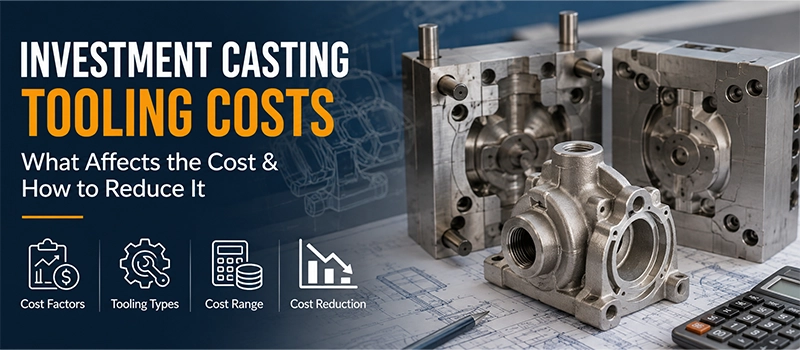
Investment casting tooling is the custom mold used to produce wax patterns during the investment casting process. Every wax pattern begins with a precisely manufactured tool, making tooling one of the most important investments in custom casting production. Because the tool determines the shape, dimensions, and repeatability of every wax pattern, it also plays a major role in determining investment casting tooling costs.
Unlike the ceramic shell or expendable wax pattern, investment casting tooling is a permanent production asset designed for repeated use. Once manufactured, the same tooling can produce thousands or even tens of thousands of identical wax patterns, depending on the tool material, design, and production conditions. This is why investment casting tooling costs are typically considered a one-time upfront expense rather than a recurring production cost.
The Role of Tooling in Investment Casting
The primary function of investment casting tooling is to create consistent wax patterns with accurate dimensions and stable quality. During production, molten wax is injected into the tooling cavity under controlled pressure. After cooling, the wax pattern is removed and assembled into a wax tree before moving through the remaining investment casting process.
Since every final casting originates from a wax pattern, the quality of the tooling directly affects:
- Dimensional accuracy
- Surface finish
- Production consistency
- Casting repeatability
- Overall manufacturing efficiency
Poorly designed tooling can lead to dimensional variation, excessive flash, incomplete wax filling, or difficulties during pattern removal, all of which increase production costs over time.
What Does Investment Casting Tooling Include?
Many buyers assume investment casting tooling refers to a single mold, but a complete tooling system often consists of several components designed to support efficient production.
Depending on the complexity of the part, investment casting tooling may include:
- Wax injection die
- Core inserts
- Sliding mechanisms
- Ejector systems
- Alignment features
- Cooling channels
The complexity of these components is one of the main reasons why investment casting tooling costs vary significantly from one project to another.
Why Tooling Is Custom for Every Project
Unlike standard industrial products, most investment castings are manufactured according to customer drawings. This means each new component usually requires its own dedicated tooling.
Several factors determine how the tooling is designed, including:
- Part geometry
- Overall dimensions
- Wall thickness
- Draft angles
- Production quantity
- Material shrinkage
Even small design changes may require modifications to the tooling or, in some cases, an entirely new tool. For this reason, finalizing the product design before tooling production begins is one of the most effective ways to control investment casting tooling costs.
Tooling Is an Investment, Not Just an Expense
Although investment casting tooling costs represent an upfront investment, they provide long-term value throughout the production lifecycle. High-quality tooling improves production efficiency, minimizes dimensional variation, reduces scrap rates, and supports consistent quality across large production runs.
For buyers planning medium- or high-volume production, investing in well-designed tooling often results in lower unit costs and more stable manufacturing performance over time. Understanding the purpose and structure of investment casting tooling is the first step toward evaluating investment casting tooling costs and making informed sourcing decisions.
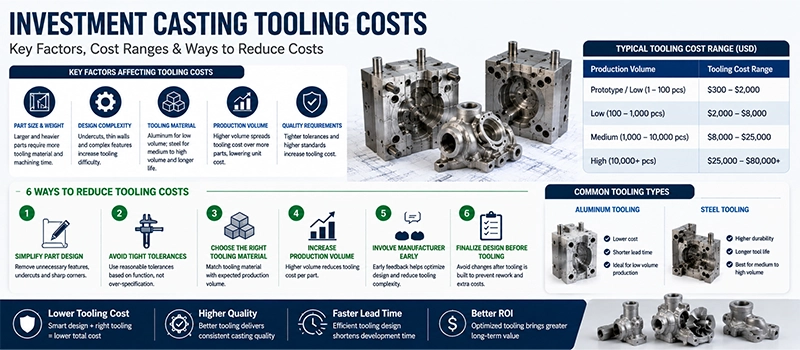
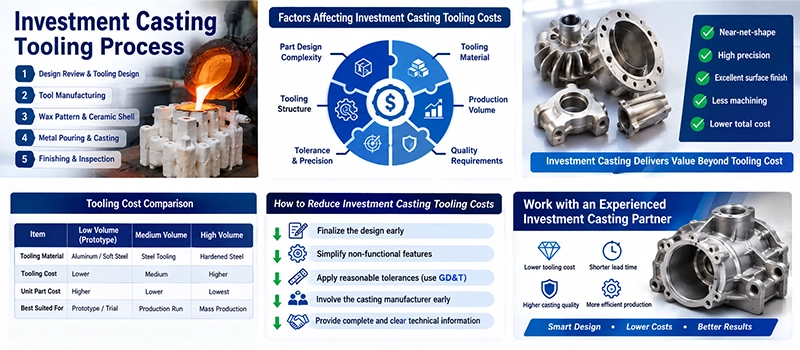
What Affects Investment Casting Tooling Costs?
Investment casting tooling costs can vary significantly from one project to another. Some tooling may cost only a few hundred dollars, while others require several thousand dollars or more. The difference is not determined by a single factor but by the combination of part design, tooling requirements, manufacturing complexity, and expected production volume.
Understanding what drives investment casting tooling costs allows buyers to make informed design decisions before tooling is manufactured. In many cases, small design adjustments made early in the development stage can reduce tooling costs without affecting the performance of the final casting.
Part Size
The overall size of the casting is one of the most direct factors affecting investment casting tooling costs.
Larger components require larger tooling blocks, more machining time, and additional material to manufacture the mold. Large tooling may also require specialized machining equipment and handling during production, increasing the overall tooling investment.
In general, larger castings require:
- More tooling material
- Longer CNC machining time
- Higher manufacturing costs
- Increased maintenance requirements
As a result, tooling costs usually increase as part size increases.
Part Complexity
Complex part geometry is another major contributor to investment casting tooling costs.
Features such as thin walls, deep cavities, sharp corners, undercuts, and intricate internal structures make tooling more difficult to manufacture. These features may require additional inserts, sliders, or special machining operations, increasing both design time and manufacturing costs.
Design characteristics that commonly increase tooling costs include:
- Thin wall sections
- Undercuts
- Deep recesses
- Complex internal cavities
- Multiple intersecting features
- Tight radii
Whenever possible, simplifying the product design can reduce tooling complexity and lower overall costs.
Tool Material
The material used to manufacture the tooling also affects investment casting tooling costs.
For lower production volumes, aluminum tooling is often a cost-effective choice because it is easier to machine and has a lower manufacturing cost.
For medium- and high-volume production, hardened steel tooling is commonly selected due to its longer service life and greater resistance to wear.
Although steel tooling has a higher initial cost, it can provide better long-term value for projects requiring large production quantities.
Number of Cavities
The number of cavities built into the tooling directly influences tooling costs.
A single-cavity tool produces one wax pattern per injection cycle and typically has the lowest manufacturing cost.
A multi-cavity tool produces several wax patterns during each cycle, improving production efficiency but requiring a larger and more complex tooling design.
While multi-cavity tooling increases the initial investment, it can significantly reduce production costs for high-volume orders by improving manufacturing efficiency.
Tolerance and Surface Finish Requirements
Products with tight dimensional tolerances or demanding surface finish requirements often require more precise tooling manufacturing.
Additional machining accuracy, polishing, and quality verification increase the time needed to produce the tooling, resulting in higher investment casting tooling costs.
Requirements that commonly increase tooling costs include:
- Tight dimensional tolerances
- High surface quality
- Precision sealing surfaces
- Complex mating features
- Cosmetic appearance requirements
Before specifying extremely tight tolerances, buyers should evaluate whether they are necessary for the product’s intended function.
Investment casting tooling costs are influenced by many interconnected factors rather than a single design feature. By considering part size, geometry, tooling material, cavity configuration, and quality requirements during the design stage, buyers can better control tooling expenses while maintaining the performance and reliability of the finished casting.
Typical Investment Casting Tooling Costs
One of the most common questions buyers ask is, “How much does investment casting tooling cost?” The answer depends on the size, complexity, and production requirements of the casting. While there is no fixed price for every project, understanding the typical cost range can help buyers estimate their initial investment and plan their manufacturing budget more effectively.
It is important to remember that investment casting tooling costs are generally a one-time expense. Once the tooling has been manufactured, it can be used repeatedly throughout the production lifecycle, making the tooling cost a relatively small portion of the total project cost for medium- and high-volume production.
Typical Tooling Cost by Project Type
Although every project is unique, the following price ranges are commonly used as a general reference.
| Tool Type | Typical Tooling Cost |
|---|---|
| Prototype Tool | USD $300–$1,000 |
| Standard Production Tool | USD $1,000–$5,000 |
| Complex Multi-Cavity Tool | USD $5,000+ |
These figures are intended for reference only. Actual investment casting tooling costs may vary depending on the product design, tooling specifications, and manufacturing requirements.
Why Similar Parts Can Have Different Tooling Costs
Two castings that appear similar in size may have completely different tooling costs.
For example, one component may only require a simple two-piece wax injection die, while another may need multiple inserts, sliding mechanisms, or complex machining to produce intricate features. Although both parts have similar external dimensions, the tooling complexity and manufacturing time can differ significantly.
This is why manufacturers usually review the product drawing before providing a tooling quotation rather than estimating the cost based solely on the overall size of the part.
Tooling Cost Compared with Production Cost
Some buyers are concerned about the initial tooling investment, especially when developing a new product. However, investment casting tooling costs should be evaluated together with the total production volume rather than as an isolated expense.
For example:
- A tooling cost of USD $2,000 may seem high for a prototype order of 20 parts.
- The same tooling cost becomes much less significant when producing 10,000 parts over several years.
As production volume increases, the tooling cost is distributed across more components, reducing the tooling cost per part and improving the overall manufacturing economy.
What Is Usually Included in the Tooling Cost?
When requesting a quotation, buyers should understand what is included in the tooling price. Different manufacturers may provide different quotation structures.
A tooling quotation commonly includes:
- Tool design
- CNC machining of the tooling
- Tool assembly
- Tool fitting and adjustment
- Initial trial or sample production
Some suppliers may quote these items separately, while others include them in a single tooling price. Confirming the quotation scope before placing an order helps avoid misunderstandings later in the project.
Should Buyers Focus Only on the Lowest Tooling Cost?
Choosing the lowest tooling quotation is not always the best decision. Lower tooling costs may result from simplified designs, lower-grade tooling materials, or reduced manufacturing precision, which can affect tool life and production stability.
Instead of comparing price alone, buyers should also consider:
- Tool quality
- Expected tool life
- Manufacturing capability
- Engineering support
- Production consistency
- Long-term manufacturing costs
A well-designed tool may require a slightly higher initial investment, but it can reduce scrap rates, improve dimensional consistency, and lower production costs throughout the life of the project.
Understanding the typical range of investment casting tooling costs allows buyers to evaluate quotations more confidently. Rather than focusing only on the upfront tooling price, it is more valuable to consider how the tooling will support production efficiency, product quality, and long-term manufacturing performance.
How to Reduce Investment Casting Tooling Costs
Although investment casting tooling costs are an unavoidable part of custom casting production, they are not fixed. Many factors that influence tooling costs can be optimized during the design and planning stage. By making informed decisions before tooling is manufactured, buyers can reduce initial investment while maintaining product quality and production efficiency.
The following strategies are commonly used to lower investment casting tooling costs without compromising the performance of the final casting.
Simplify the Part Design
Part complexity has a direct impact on tooling design. Features such as deep cavities, undercuts, sharp corners, and unnecessary geometric details often require additional inserts or more complicated machining operations, increasing tooling costs.
Whenever possible, simplify the design by:
- Reducing unnecessary features
- Using uniform wall thickness
- Avoiding deep undercuts
- Increasing corner radii where appropriate
- Eliminating unnecessary cosmetic details
A simpler design is generally easier to manufacture and results in lower investment casting tooling costs.
Avoid Unnecessarily Tight Tolerances
Many drawings specify tighter tolerances than the application actually requires. While high precision is essential for certain functional areas, applying strict tolerances to every dimension increases tooling complexity and machining requirements.
Before finalizing the design, review whether all specified tolerances are truly necessary. Relaxing non-critical tolerances can reduce both tooling costs and overall production expenses.
Choose the Right Tooling Material
The tooling material should match the expected production volume.
For example:
- Aluminum tooling is often suitable for prototype or low-volume production because it offers lower manufacturing costs and shorter lead times.
- Steel tooling is more appropriate for medium- and high-volume production due to its superior durability and longer service life.
Selecting the appropriate tooling material helps balance the initial investment with long-term production requirements.
Increase Production Volume
Investment casting tooling costs are generally paid once, while the tooling can be used repeatedly throughout production.
As production volume increases, the tooling cost is distributed across more parts, reducing the tooling cost per component.
For example:
- 100 parts → Higher tooling cost per part
- 10,000 parts → Much lower tooling cost per part
If future demand is expected to grow, discussing long-term production plans with the supplier may help optimize tooling design and improve overall cost efficiency.
Involve the Manufacturer Early
One of the most effective ways to reduce investment casting tooling costs is to involve the manufacturer during the product design stage rather than after the design is finalized.
Experienced investment casting manufacturers can review drawings and identify opportunities to simplify tooling without affecting product performance.
Typical engineering recommendations may include:
- Optimizing wall thickness
- Improving draft angles
- Simplifying complex features
- Combining multiple features into a more manufacturable design
- Recommending alternative tooling solutions
Early collaboration often prevents expensive tooling modifications after manufacturing has already begun.
Finalize the Design Before Tooling Production
Design changes after tooling has been manufactured are one of the biggest causes of additional tooling costs.
Even relatively small modifications to dimensions or geometry may require tool rework or, in some cases, completely new tooling.
Before approving tooling production, buyers should confirm:
- Product drawings are finalized
- Material specifications are confirmed
- Critical dimensions are verified
- Functional requirements have been reviewed
Investing extra time during the design review stage is usually far less expensive than modifying tooling later.
Reducing investment casting tooling costs is not simply about choosing the lowest quotation. It involves optimizing product design, selecting appropriate tooling solutions, and working closely with an experienced manufacturer. By making informed decisions early in the project, buyers can control tooling expenses while achieving reliable production quality and long-term manufacturing value.
Is Investment Casting Worth the Tooling Cost?
For buyers developing a new product, paying for tooling can seem like a significant upfront expense. However, investment casting tooling costs should not be evaluated in isolation. The real question is whether the tooling investment creates long-term value by reducing production costs, improving part quality, and increasing manufacturing efficiency.
In many cases, investment casting tooling costs are quickly recovered through lower unit prices, reduced machining, and consistent production quality. Whether the investment is worthwhile depends on the product design, expected production volume, and overall manufacturing objectives.
Best for Medium- and High-Volume Production
Investment casting is particularly cost-effective when the same component will be produced repeatedly.
Because investment casting tooling costs are generally paid only once, the tooling investment is spread across every part manufactured. As production volume increases, the tooling cost allocated to each component becomes significantly lower.
For products with long production runs, investment casting often provides better overall value than manufacturing methods that require extensive machining or fabrication.
Ideal for Complex Parts
Parts with complex geometries are another situation where investment casting tooling costs are often justified.
Components with features such as:
- Thin walls
- Internal passages
- Complex contours
- Multiple mounting features
- Near-net-shape designs
can usually be produced more efficiently through investment casting than by machining the same part from solid metal.
Although the initial tooling investment is higher, the reduction in machining time and material waste often results in lower total manufacturing costs.
Helps Reduce Secondary Machining
Investment casting is well known for producing near-net-shape components with excellent dimensional accuracy and surface finish.
As a result, many features can be cast directly into the part, reducing the amount of machining required after casting.
Less machining can provide several benefits:
- Lower production costs
- Shorter manufacturing lead times
- Reduced material waste
- Improved dimensional consistency
These long-term savings often outweigh the initial investment casting tooling costs.
Not Always the Best Choice
Investment casting is not the ideal solution for every project.
If a component is only required in very small quantities or is likely to undergo frequent design changes, the tooling investment may not provide sufficient economic benefit.
Alternative manufacturing methods may be more suitable for:
- One-off prototypes
- Very low-volume production
- Simple fabricated components
- Frequently revised product designs
In these situations, avoiding dedicated tooling may reduce the initial project cost.
Evaluate Total Cost, Not Just Tooling Cost
When comparing manufacturing methods, buyers should consider the total cost of ownership rather than focusing only on investment casting tooling costs.
A complete evaluation should include:
- Tooling investment
- Unit production cost
- Machining cost
- Material utilization
- Production efficiency
- Product quality
- Expected production volume
A tooling option with a higher initial cost may ultimately deliver a lower overall manufacturing cost over the life of the project.
Ultimately, investment casting tooling costs should be viewed as a long-term investment rather than simply an upfront expense. For projects involving complex geometries, consistent production, and medium- to high-volume manufacturing, the benefits of investment casting often far exceed the initial tooling investment, resulting in greater production efficiency and lower total costs over time.
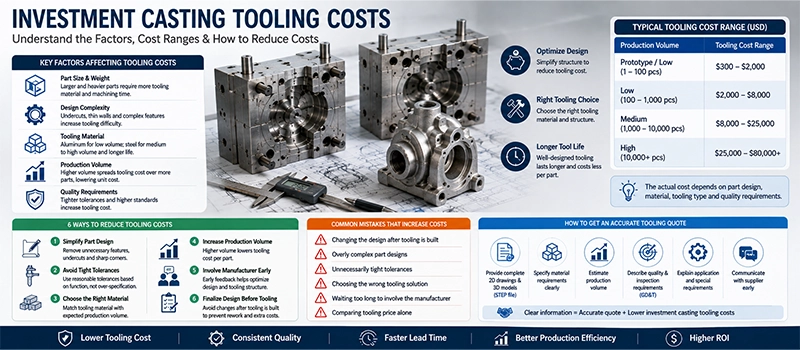
Common Mistakes That Increase Investment Casting Tooling Costs
Many buyers focus on negotiating lower tooling prices, but the biggest increases in investment casting tooling costs often result from avoidable mistakes made before tooling production even begins. Incomplete design information, frequent engineering changes, and unrealistic manufacturing requirements can all lead to additional tooling work, project delays, and higher overall costs.
Understanding these common mistakes helps buyers control investment casting tooling costs while improving communication with manufacturers.
Changing the Design After Tooling Is Built
One of the most expensive mistakes is modifying the product design after the tooling has already been manufactured.
Even small changes—such as adjusting a hole location, changing a wall thickness, or adding a new feature—may require:
- Tool modification
- Additional CNC machining
- New inserts
- Complete tool replacement
These changes not only increase investment casting tooling costs but also extend the project timeline.
Before approving tooling production, buyers should carefully review all drawings and confirm that the design is finalized.
Overly Complex Part Designs
Complex designs often require more sophisticated tooling than buyers initially expect.
Features that commonly increase tooling complexity include:
- Deep undercuts
- Extremely thin walls
- Sharp internal corners
- Complex internal cavities
- Unnecessary decorative features
While these details may seem minor, they often require additional tooling components and longer machining time.
Simplifying non-functional features is one of the easiest ways to reduce investment casting tooling costs.
Specifying Unnecessarily Tight Tolerances
High precision is important only where product performance requires it.
Applying tight tolerances to every dimension increases tooling precision, machining requirements, inspection time, and overall manufacturing costs.
Instead, buyers should identify critical functional dimensions while allowing standard casting tolerances for non-critical features whenever possible.
This approach helps balance product performance with reasonable investment casting tooling costs.
Choosing the Wrong Tooling Solution
Not every project requires the same type of tooling.
For example, investing in hardened steel tooling for a prototype order of only a few dozen parts may not be economically justified. Likewise, selecting low-cost tooling for a long-term production program may result in premature tool wear and higher maintenance costs.
Choosing the appropriate tooling solution based on expected production volume is essential for controlling investment casting tooling costs.
Waiting Too Long to Involve the Manufacturer
Some buyers complete the product design before consulting a casting supplier.
As a result, engineers may later discover that certain design features are difficult or expensive to manufacture, requiring redesign or tooling modifications.
Involving an experienced investment casting manufacturer during the design stage allows potential issues to be identified early, reducing both tooling complexity and development costs.
Comparing Tooling Price Alone
Selecting the lowest quotation without considering quality and engineering capability can lead to higher costs later in the project.
When evaluating quotations, buyers should compare more than just investment casting tooling costs. Important considerations include:
- Engineering support
- Tool design quality
- Manufacturing experience
- Expected tool life
- Production capability
- After-sales technical support
A slightly higher tooling investment often delivers greater long-term value through improved production efficiency and more consistent casting quality.
Avoiding these common mistakes is one of the most effective ways to control investment casting tooling costs. Careful planning, early engineering communication, and realistic manufacturing requirements help ensure that tooling is designed correctly the first time, reducing unnecessary expenses throughout the entire production process.
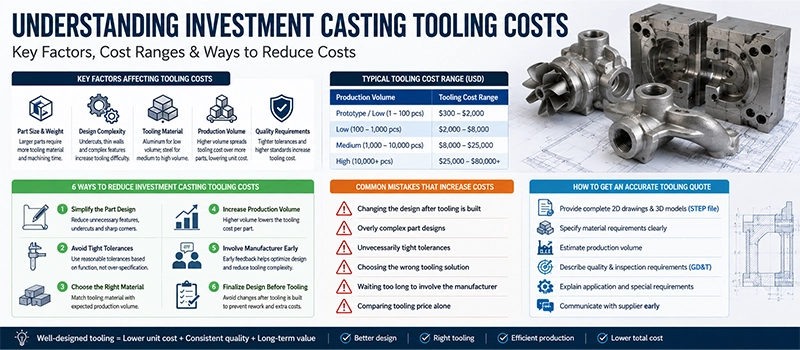
How to Get an Accurate Investment Casting Tooling Quote
Receiving an accurate tooling quotation depends not only on the supplier’s experience but also on the information provided by the buyer. Even the most experienced investment casting manufacturer cannot accurately estimate investment casting tooling costs without complete technical data. Missing drawings, unclear specifications, or incomplete project details often result in estimated prices rather than firm quotations.
To receive a fast and accurate quotation, buyers should prepare all essential project information before submitting an inquiry.
Provide Complete Engineering Drawings
Engineering drawings are the foundation of every tooling quotation. They allow manufacturers to evaluate part geometry, determine tooling complexity, and estimate machining time.
A complete quotation package should include:
- 2D engineering drawings (PDF)
- 3D CAD models (STEP, IGES, or Parasolid)
- Latest drawing revision
- Critical dimensions and tolerances
Providing both 2D and 3D files helps engineers review the design more efficiently and calculate investment casting tooling costs with greater accuracy.
Specify Material Requirements
Material selection can influence tooling design, shrinkage allowance, and production planning. A quotation request should clearly identify the required casting material instead of using general descriptions such as “steel.”
Include information such as:
- Material standard
- Material grade
- Mechanical property requirements (if applicable)
- Special application requirements
Clear material specifications reduce engineering assumptions and improve quotation accuracy.
Estimate Production Volume
Expected production quantity is one of the key factors affecting investment casting tooling costs.
Suppliers should know whether the project involves:
- Prototype production
- Low-volume manufacturing
- Mass production
- Estimated annual demand
Production volume helps determine whether aluminum tooling, steel tooling, or multi-cavity tooling is the most economical solution.
Describe Quality Requirements
Quality expectations should also be included in the quotation request.
Examples include:
- Dimensional tolerances
- Surface finish requirements
- Heat treatment
- Non-destructive testing (NDT)
- Material certification
- Special inspection requirements
Providing these details enables manufacturers to include all required processes in the tooling quotation.
Explain the Application
Although not mandatory, explaining how the casting will be used can help manufacturers recommend a more suitable tooling solution.
Useful information may include:
- Product application
- Operating environment
- Expected service conditions
- Special performance requirements
This allows engineers to evaluate whether the proposed tooling design and manufacturing process are appropriate for the project.
Communicate with the Supplier Early
The quotation process should be viewed as a technical discussion rather than simply requesting a price.
Experienced investment casting manufacturers can often identify opportunities to:
- Simplify tooling
- Improve manufacturability
- Reduce tooling complexity
- Lower production costs
- Shorten lead times
Early communication helps buyers optimize their designs before tooling production begins, preventing costly modifications later.
A complete quotation request benefits both the buyer and the manufacturer. By providing detailed drawings, material specifications, production quantities, and quality requirements, buyers enable suppliers to evaluate projects more accurately and prepare reliable investment casting tooling costs. Clear communication at the beginning of a project often leads to lower development costs, fewer engineering changes, and a smoother transition from design to production.
Why Choose Dalian Zhongsheng for Investment Casting Tooling
Choosing the right investment casting supplier is just as important as controlling investment casting tooling costs. An experienced manufacturer does more than produce tooling—they provide engineering support, optimize product designs, and help customers achieve lower production costs over the entire lifecycle of the project.
At Dalian Zhongsheng Metal Product Co., Ltd., every tooling project begins with a detailed engineering review to ensure that customers receive practical manufacturing solutions, competitive tooling costs, and consistent product quality.

Professional Tool Design Support
Every investment casting project starts with tooling design. Before manufacturing begins, the engineering team carefully reviews customer drawings to evaluate tooling feasibility and identify opportunities for optimization.
This review includes:
- Part geometry analysis
- Draft angle evaluation
- Wall thickness assessment
- Shrinkage allowance calculation
- Tool structure optimization
By identifying potential issues early, Dalian Zhongsheng helps customers avoid unnecessary tooling modifications and better control investment casting tooling costs.
In-House Tool Manufacturing
Dalian Zhongsheng manufactures tooling in-house, allowing better control over quality, lead time, and production scheduling.
In-house tooling capabilities provide several advantages:
- Faster tooling production
- Better dimensional accuracy
- Consistent quality control
- Faster engineering communication
- Reduced project lead times
This integrated manufacturing approach also allows tooling adjustments to be completed more efficiently when required.
Cost Optimization Through Engineering
Lower investment casting tooling costs are not achieved by simply reducing tooling quality. Instead, they result from better engineering decisions.
The engineering team works closely with customers to optimize designs by:
- Simplifying complex features
- Reducing unnecessary tooling complexity
- Recommending suitable tooling materials
- Improving manufacturability
- Minimizing secondary machining
These improvements help reduce tooling investment while maintaining the required product performance.
One-Stop Manufacturing Solution
After tooling is completed, Dalian Zhongsheng provides complete manufacturing services, allowing customers to work with a single supplier throughout the project.
Services include:
- Investment casting
- CNC machining
- Heat treatment
- Surface finishing
- Quality inspection
- Final packaging
This one-stop solution simplifies project management and ensures better consistency from tooling development through mass production.
Reliable Quality Control
Quality is essential for both tooling and finished castings.
Dalian Zhongsheng applies comprehensive quality control throughout the manufacturing process, including:
- Material verification
- Dimensional inspection
- Mechanical property testing
- Non-destructive testing (NDT)
- Final product inspection
Strict quality management helps ensure that every tooling project delivers consistent production performance and reliable castings throughout its service life.
With professional engineering support, in-house tooling capabilities, integrated manufacturing services, and a strong commitment to quality, Dalian Zhongsheng helps customers optimize investment casting tooling costs while delivering reliable solutions for custom investment casting projects.
Conclusion
Investment casting tooling costs are an important part of every custom casting project, but they should be viewed as a long-term investment rather than simply an upfront expense. Factors such as part size, design complexity, tooling material, production volume, and quality requirements all influence the final tooling cost. By understanding these factors and optimizing product designs early, buyers can significantly reduce unnecessary tooling expenses while improving overall manufacturing efficiency.
Working with an experienced investment casting manufacturer is equally important. Professional engineering support, optimized tooling design, and clear communication during the quotation stage can help control investment casting tooling costs, shorten development time, and ensure stable production throughout the life of the project. For buyers seeking high-quality custom investment castings, choosing the right manufacturing partner is one of the most effective ways to maximize the value of their tooling investment.