
Hammer Forging Service
Our hammer forging process delivers dense, high-strength metal components through controlled impact deformation. Ideal for durable industrial parts requiring improved mechanical performance and structural reliability.
About Our Hammer Forging Process
Hammer forging uses repeated impact force to shape heated metal into precise forms while refining the internal grain structure. The process improves density, strength, and fatigue resistance, making it ideal for high-performance industrial components.
We support various steel grades and custom specifications to meet demanding mechanical and structural requirements.
Hammer Forging Capabilities & Advantages
- High Impact Energy Forming
- Enhanced Grain Flow
- Suitable for Medium & Small Components
- Wide Material Compatibility
- Dimensional Consistency
- Improved Fatigue Resistance
- Batch Production Efficiency
- Heat Treatment Available
- Machining Integration
- Strict Quality Inspection
Request a Hammer Forging Quote
Submit your project details to receive a professional forging quotation.
Need Technical Support?
Our forging specialists are ready to provide technical guidance and professional support for your project.
+86 15041192520
marketings@china-casting.com
Why Choose us
High-Impact Forging. Superior Structural Strength.
Hammer forging applies concentrated impact force to refine grain structure and increase material density, resulting in forged components with enhanced strength, durability, and fatigue resistance.
Powerful hammer strikes compress the metal structure, increasing density and reducing internal porosity.
Controlled deformation aligns the grain structure along the component profile, improving mechanical performance.
Ideal for parts subjected to repeated stress, vibration, and heavy loads.
Repeatable hammering parameters ensure consistent part geometry and batch uniformity.
Perfect for shafts, flanges, connectors, and structural industrial parts.
Precise temperature management ensures proper plasticity and structural refinement.
Suitable for stable batch production without the high tooling cost of closed-die forging.
Mechanical testing and dimensional verification guarantee performance reliability.
Our forging engineers provide technical consultation to optimize performance and cost efficiency.
How it works
Controlled Impact. Refined Structure. Reliable Performance.
Our hammer forging process is designed to maximize material density, optimize grain flow, and ensure consistent mechanical strength at every stage.
Technical Evaluation
We review drawings, material grade, load conditions, and mechanical requirements to determine the optimal forging parameters.
Controlled Heating
Steel billets are heated to precise temperatures to achieve proper plasticity for effective impact deformation.
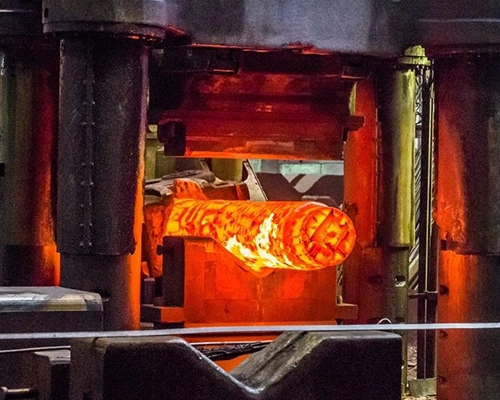
Hammer Forging Forming
High-energy hammer strikes compress and shape the metal, refining internal grain structure and enhancing strength and durability.
Inspection & Mechanical Verification
Dimensional checks and mechanical testing are performed to ensure performance, consistency, and compliance with specifications.
Common Questions
Hammer Forging FAQs
Find answers to common questions about our hammer forging capabilities, material selection, tolerances, and quality control processes.
Hammer forging uses repeated high-energy impact to shape heated metal. It is ideal for parts requiring enhanced grain refinement, improved strength, and superior fatigue resistance.
We forge carbon steel, alloy steel, stainless steel, and selected special alloys depending on mechanical requirements and application conditions.
Hammer forging improves internal structure by eliminating porosity and refining grain flow, resulting in higher strength, toughness, and reliability compared to cast components.
We manufacture small to medium forged components as well as larger custom parts depending on material grade and structural complexity.
Quality is ensured through controlled heating temperatures, monitored hammering parameters, dimensional inspection, and mechanical testing according to project specifications.
