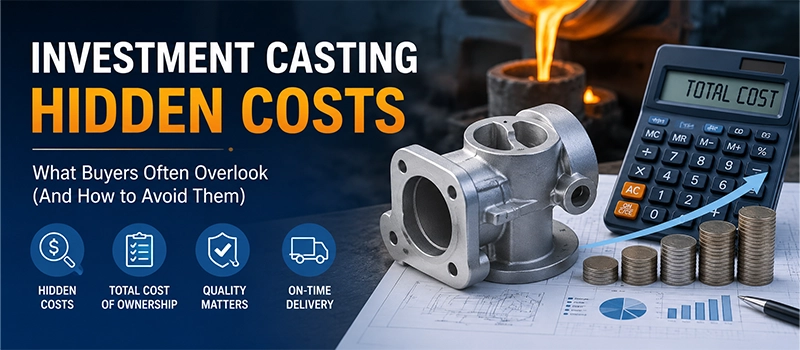
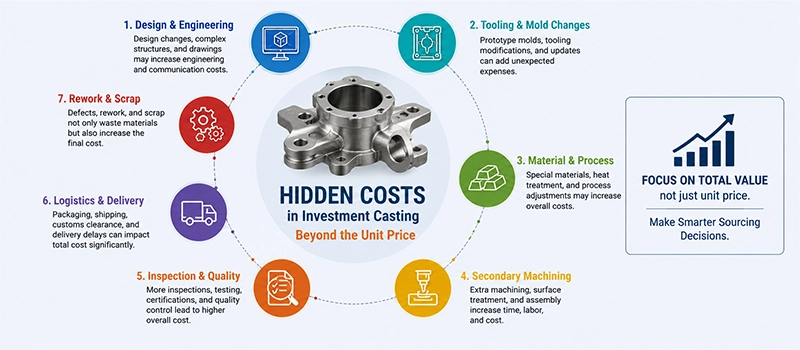
Investment casting hidden costs are the unexpected expenses that occur beyond the quoted unit price, including tooling changes, secondary machining, quality issues, delivery delays, and production risks. While these costs are often overlooked during supplier selection, they can significantly increase the total cost of a project. Understanding where hidden costs arise helps buyers make more informed sourcing decisions and achieve better long-term value.
What Are Investment Casting Hidden Costs?
When you request a quotation for an investment casting project, the unit price is usually the first number you look at. However, that number rarely reflects the total amount you will actually spend. Investment casting hidden costs are the additional expenses that arise throughout the project but are not always included in the original quotation.
These costs can appear at almost any stage of production. A drawing revision, an unexpected machining operation, additional inspections, or a schedule change may all increase your overall project cost. Individually, these expenses may seem small, but together they can have a significant impact on your budget and delivery schedule.
Many buyers assume that choosing the supplier with the lowest quotation will automatically reduce procurement costs. In reality, the opposite is often true. A lower unit price may exclude services or manufacturing requirements that become necessary later, leaving you to absorb costs that were never considered during the quotation stage.
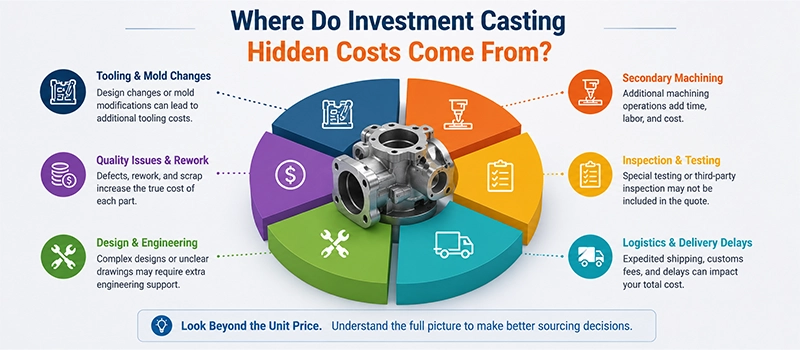
Some of the most common investment casting hidden costs include:
- Tooling modifications after design approval
- Additional CNC machining
- Extra inspection or testing requirements
- Engineering changes during production
- Expedited manufacturing or shipping
- Scrap and rework caused by quality issues
- Production delays that interrupt your schedule
The purpose of understanding investment casting hidden costs is not to avoid low-cost suppliers. Instead, it is to help you evaluate quotations more accurately and understand what is included—and what is not. Once you look beyond the quoted unit price, it becomes much easier to compare suppliers based on the total value they deliver rather than on price alone.
Why the Lowest Unit Price Can Cost More
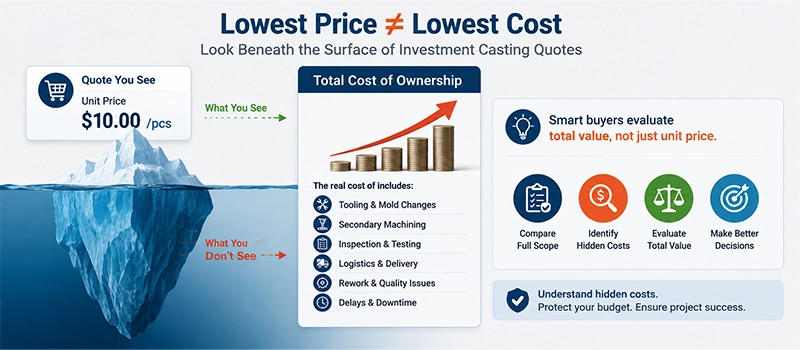
When you compare investment casting quotations, it is natural to focus on the unit price first. After all, a lower price appears to offer immediate savings. However, the lowest quotation does not always result in the lowest overall project cost. In many cases, it is simply the lowest starting price.
Imagine receiving two quotations for the same casting. One supplier offers a noticeably lower unit price, while the other provides a slightly higher quotation. At first glance, choosing the cheaper option seems like the obvious decision. But as production moves forward, additional machining, drawing revisions, quality issues, or delivery delays begin to add costs that were never included in the original quote. By the time the project is complete, the supplier with the higher initial price may actually have delivered the lower total cost.
This happens because quotations are not always based on the same scope of work. One supplier may include engineering support, quality inspections, and machining in the quoted price, while another may price only the casting itself and treat everything else as additional services. Without understanding what is included, comparing unit prices alone can lead to misleading conclusions.
For example, a quotation may exclude:
- CNC machining
- Heat treatment
- Surface finishing
- Non-destructive testing (NDT)
- Dimensional inspection
- Export packaging
These services may become necessary before the product is ready for shipment, increasing your actual project cost beyond the original quotation.
Lead time can also influence the true cost of a project. A lower-priced supplier that delivers several weeks later than expected may create production delays, force expedited shipping, or interrupt your manufacturing schedule. These indirect costs are rarely visible when you first compare quotations, but they can have a significant impact on the final outcome.
When evaluating investment casting quotations, it is helpful to ask a simple question: What does this price actually include? The answer often reveals more about the value of a quotation than the number at the bottom of the page. Looking beyond the unit price allows you to compare suppliers more fairly and understand the real cost of completing your project.
The Hidden Costs You May Be Overlooking
Most hidden costs do not appear on a quotation. Instead, they emerge as your project moves from design review to production and final delivery. Because these expenses are often unexpected, they can gradually increase your total project cost without attracting much attention at the beginning.
The good news is that many of these costs are predictable. Once you know where they typically occur, it becomes much easier to evaluate quotations and avoid unpleasant surprises later.
Tooling Changes
Tooling is usually one of the first investments in an investment casting project. If the product design changes after the tooling has been manufactured, additional modifications may be required. Even small adjustments to dimensions or features can increase both cost and lead time.
Before approving tooling production, make sure your drawings have been fully reviewed and finalized. A stable design helps avoid unnecessary tooling expenses later in the project.
Secondary Machining
Not every casting leaves the foundry as a finished component. Depending on the drawing requirements, additional CNC machining may be needed to achieve critical dimensions, threaded holes, or precision surfaces.
Some suppliers include machining in their quotations, while others price only the raw casting. If machining requirements are not clearly defined during the quotation stage, your actual project cost may be higher than expected.
Quality Issues and Rework
Quality problems rarely end with replacing a defective part. They often lead to production delays, additional inspections, engineering discussions, and repeated manufacturing.
The cost of rework may include:
- Manufacturing replacement parts
- Additional inspection
- Extra shipping expenses
- Production downtime
- Project delays
Although these costs are difficult to estimate in advance, they can quickly exceed the savings gained from selecting the lowest quotation.
Delivery Delays
Delivery time is another cost that is frequently underestimated.
If castings arrive later than scheduled, your production plan may also be delayed. In some cases, companies must arrange expedited shipping or adjust manufacturing schedules to keep customer commitments.
Even when no additional invoice is issued, delayed deliveries can create significant operational costs that are far greater than the original price difference between suppliers.
Communication and Engineering Support
Effective communication is often overlooked because it does not appear as a line item on a quotation. However, it plays an important role throughout every custom casting project.
When technical questions are answered quickly, drawings are reviewed carefully, and potential issues are identified before production begins, many costly mistakes can be avoided.
On the other hand, unclear communication may result in repeated revisions, incorrect assumptions, or manufacturing errors that require additional time and expense to resolve.
Hidden costs are not always caused by manufacturing itself. Many arise from decisions made long before production begins or from details that receive little attention during supplier selection. Looking beyond the quoted unit price allows you to identify these potential risks early and evaluate investment casting quotations with a more complete understanding of the total project cost.
Understanding Total Cost of Ownership (TCO)
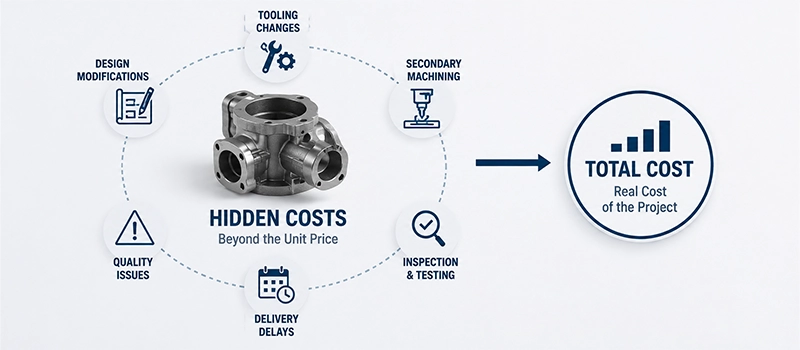
If you only compare quotations based on unit price, you are looking at just one part of the total investment. A more effective approach is to evaluate the Total Cost of Ownership (TCO)—the combined cost of purchasing, manufacturing, delivering, and maintaining a component throughout its lifecycle.
For investment castings, the quoted price is only one element of the overall cost. Decisions made before production begins can influence expenses long after the parts have been delivered. This is why experienced buyers often evaluate the complete project rather than focusing solely on the lowest quotation.
A typical investment casting project may include costs such as:
- Tooling
- Casting production
- CNC machining
- Heat treatment
- Inspection and testing
- Packaging and transportation
- Engineering support
- Quality-related rework
- Production delays
Some of these costs are visible on a quotation, while others only become apparent as the project progresses. Looking at the entire cost structure provides a much clearer picture of the true investment.
For example, imagine two suppliers offering quotations for the same casting.
Supplier A offers the lower unit price, but machining, additional inspections, and engineering changes are billed separately. Delivery is also delayed, requiring expedited shipping to meet your production schedule.
Supplier B provides a slightly higher quotation, but it already includes engineering support, machining, quality inspections, and a realistic delivery plan. The project is completed on schedule without unexpected charges.
Although Supplier A appeared to be the less expensive option at the beginning, Supplier B ultimately delivered the lower total cost because fewer hidden expenses were introduced during production.
This is exactly why evaluating TCO is so valuable. Instead of asking, “Which supplier has the lowest price?”, it encourages you to ask a more important question:
“Which supplier will cost less over the entire project?”
That small change in perspective often leads to better purchasing decisions.
When you begin evaluating quotations through the lens of Total Cost of Ownership, price becomes only one part of the decision. Engineering capability, manufacturing consistency, communication, quality control, and delivery reliability all become measurable contributors to the overall value of your investment.
How to Reduce Investment Casting Hidden Costs
While investment casting hidden costs cannot always be eliminated, many of them can be prevented with better planning and clearer communication. Most unexpected expenses occur long before production begins, often during design review, quotation evaluation, or supplier selection. Taking a few additional steps at the start of a project can help you avoid costly surprises later.
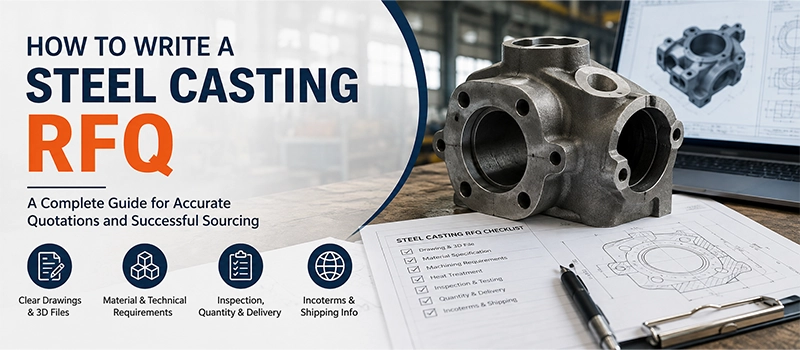
Provide Complete Technical Information
A quotation is only as accurate as the information you provide.
Before requesting a quotation, make sure your supplier receives complete technical documentation, including:
- 2D drawings
- 3D CAD files
- Material specifications
- Tolerance requirements
- Surface finish requirements
- Annual production volume
The more complete your RFQ is, the less likely it is that additional costs will appear after production has started.
Finalize the Design Before Tooling
Design changes are one of the most common causes of unexpected project costs.
Every modification made after tooling has been manufactured may require additional engineering work, tooling adjustments, or even a new tool. Reviewing your design carefully before approving tooling production is one of the most effective ways to control project costs.
If you are still evaluating different design options, it is usually better to complete those discussions before tooling is released for manufacturing.
Confirm What Is Included in the Quotation
Never assume that every supplier is quoting the same scope of work.
Before comparing prices, ask what is actually included in each quotation.
For example:
- Is CNC machining included?
- Is heat treatment included?
- Are inspection reports included?
- Is export packaging included?
- Are tooling modifications covered?
- Are shipping terms clearly defined?
A quotation with a higher unit price may already include services that another supplier charges separately.
Involve Your Supplier Early
An experienced supplier can often identify potential manufacturing challenges before production begins.
Sharing your drawings during the design stage allows engineers to review:
- Part geometry
- Machining requirements
- Material selection
- Manufacturing feasibility
Small design improvements made early in the project can often prevent much larger costs later.
Evaluate Value, Not Just Price
The lowest quotation should never be the only reason for choosing a supplier.
When comparing quotations, consider factors such as:
- Engineering support
- Manufacturing capability
- Quality consistency
- Delivery reliability
- Communication efficiency
- After-sales support
These factors may not appear on a quotation, but they often have a significant influence on the total cost of your project.
Reducing investment casting hidden costs is not about negotiating the lowest price. It is about making informed decisions before production begins. When you prepare complete technical information, understand exactly what each quotation includes, and work closely with an experienced supplier, you are far more likely to achieve a successful project with fewer unexpected costs and better long-term value.
FAQ
1. Can investment casting hidden costs be completely eliminated?
No. Some hidden costs are unavoidable, especially when product designs change or project requirements evolve during production. However, many hidden costs can be minimized through complete technical documentation, early engineering reviews, and clear communication before production begins.
2. Are hidden costs more common in low-volume production?
They can be. In low-volume or prototype projects, tooling, engineering, and setup costs are distributed across fewer parts, making unexpected expenses more noticeable. For high-volume production, these costs are typically spread over a larger quantity, reducing their impact on the cost of each component.
3. Should I always choose the supplier with the most detailed quotation?
Not necessarily, but a detailed quotation usually provides greater transparency. It allows you to understand exactly what is included in the project scope and makes it easier to compare quotations from different suppliers. If important services are missing or unclear, ask for clarification before placing an order.
4. Can design optimization reduce hidden costs?
Yes. Small design improvements made before tooling production can simplify manufacturing, reduce machining requirements, and improve production efficiency. Discussing manufacturability with your supplier during the design stage is often one of the most effective ways to avoid unnecessary project costs.
5. Is the cheapest quotation always a warning sign?
Not always. A lower quotation may simply reflect lower labor costs, better production efficiency, or different manufacturing methods. The key is to understand what is included in the quotation and whether the supplier can consistently meet your technical, quality, and delivery requirements.
Conclusion
Investment casting hidden costs can have a much greater impact on your project than the quoted unit price alone. By understanding the complete cost of ownership, evaluating what is included in each quotation, and planning ahead, you can make more informed sourcing decisions and reduce unexpected expenses. If you’re looking for a reliable investment casting partner or need help reviewing your drawings before requesting a quotation, contact our engineering team to discuss your project.