Heavy duty wear resistant castings can make the difference between reliable equipment operation and frequent, costly downtime. Choosing the wrong casting material or design often leads to premature wear, higher maintenance costs, and unexpected production interruptions. Understanding how different wear-resistant castings perform in demanding applications is essential for maximizing service life and reducing total operating costs. This guide explains the types, materials, applications, and selection criteria that help buyers make informed decisions.
What Are Heavy Duty Wear Resistant Castings?
Heavy duty wear resistant castings are metal components specifically designed to withstand severe wear caused by abrasion, impact, erosion, and continuous friction. Unlike conventional castings that primarily provide structural support, these castings are engineered to maintain their shape and performance under harsh operating conditions where ordinary materials would wear out quickly.
Wear is one of the most common causes of equipment failure in heavy industries. As abrasive materials move across metal surfaces, they gradually remove material from the component, reducing its efficiency and eventually leading to replacement. Heavy duty wear resistant castings are designed to slow this wear process, helping equipment operate more reliably for longer periods.
These castings are typically manufactured as critical replacement parts for heavy industrial equipment. Because they operate in demanding environments, they must maintain consistent performance while being exposed to continuous mechanical stress and abrasive materials. Their primary purpose is not simply to support a structure, but to protect equipment from excessive wear and extend the service life of high-wear components.
Compared with standard cast components, heavy duty wear resistant castings are specifically engineered for applications where durability is a priority. Their design focuses on resisting material loss during operation, allowing industrial equipment to maintain productivity while reducing maintenance frequency and unplanned downtime.
Heavy duty wear resistant castings are widely recognized as essential components in industries that depend on reliable, continuous operation. As industrial equipment becomes larger, more powerful, and more productive, the demand for castings capable of performing under increasingly severe working conditions continues to grow.
Types of Heavy Duty Wear Resistant Castings
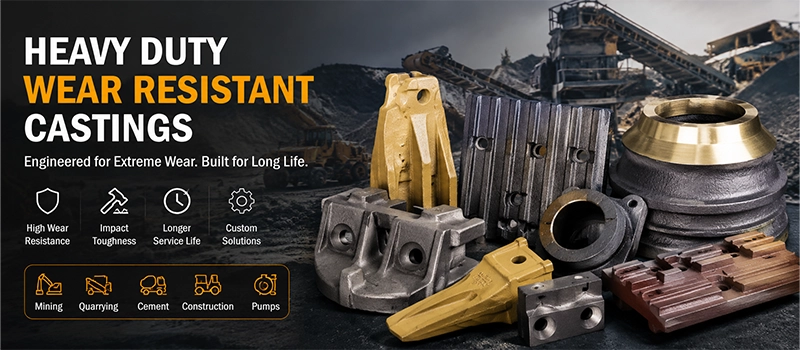
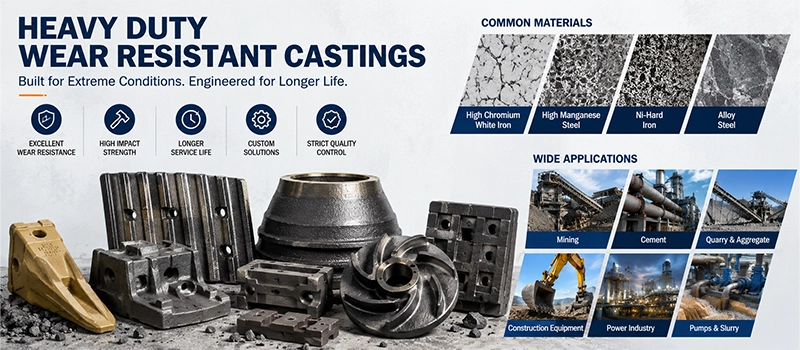
Heavy duty wear resistant castings are manufactured in a wide range of forms to meet the requirements of different industrial equipment. Although they all share the same objective of reducing wear and extending component life, each type is designed to perform a specific function under demanding operating conditions. Understanding these product categories helps buyers identify the right replacement parts for their equipment and better evaluate available manufacturing options.
Crusher Wear Parts
Crusher wear parts are among the most common heavy duty wear resistant castings used in mining, quarrying, and aggregate processing. These components are subjected to constant abrasion and impact as large rocks and hard materials are crushed into smaller sizes.
Typical crusher wear parts include:
- Jaw plates
- Cone crusher liners
- Mantles
- Blow bars
- Impact plates
Because these components are directly exposed to crushing forces, they are designed to deliver reliable performance while minimizing wear during continuous operation.
Mill Wear Parts
Grinding equipment relies on heavy duty wear resistant castings to withstand repeated contact with grinding media and abrasive materials. These castings protect critical areas inside mills where continuous impact and friction occur throughout the grinding process.
Common mill wear parts include:
- Mill liners
- Lifter bars
- End liners
- Grinding rings
- Grinding tables
These components help maintain efficient grinding performance while reducing the frequency of equipment maintenance and replacement.
Excavator and Construction Wear Parts
Heavy construction and earthmoving equipment operate in highly abrasive environments where components are constantly exposed to rock, gravel, and compacted soil. Heavy duty wear resistant castings are commonly used as replaceable wear parts that protect larger equipment structures from excessive wear.
Typical products include:
- Bucket teeth
- Adapters
- Lip shrouds
- Side cutters
- Wear blocks
These wear parts are designed to endure repeated digging and loading operations while maintaining reliable performance under heavy working loads.
Pump and Slurry Wear Parts
Pumps that transport abrasive slurries require heavy duty wear resistant castings to resist continuous erosion caused by solid particles suspended in liquid. These components play an important role in maintaining pumping efficiency under demanding operating conditions.
Common pump wear parts include:
- Pump casings
- Impellers
- Suction liners
- Wear plates
- Throat bushings
As these parts are continuously exposed to abrasive media, durability is essential for achieving a longer operating life and reducing maintenance frequency.
Custom Wear Resistant Castings
In addition to standard replacement components, many industrial applications require custom heavy duty wear resistant castings manufactured according to customer drawings or equipment specifications. These products are often developed for specialized machinery where standard parts cannot meet specific dimensional or performance requirements.
Typical custom products include:
- Chute liners
- Wear plates
- Conveyor components
- Mixer blades
- Guide plates
Custom heavy duty wear resistant castings provide manufacturers with greater flexibility when designing equipment for unique operating conditions, ensuring that each component matches the functional requirements of the application.
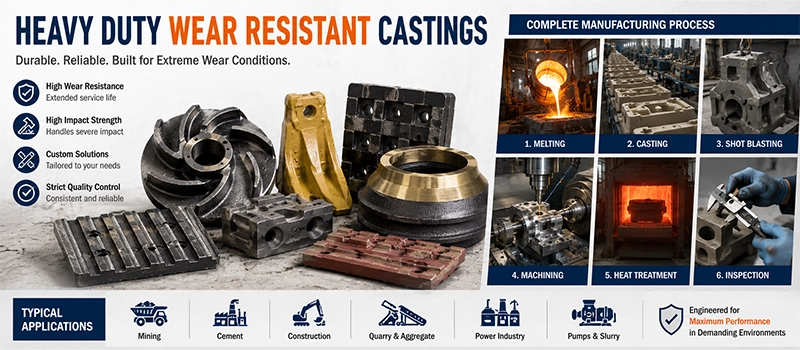
Materials Used for Heavy Duty Wear Resistant Castings
The performance of heavy duty wear resistant castings depends largely on the material from which they are manufactured. Different alloys offer different combinations of hardness, toughness, and wear resistance, making them suitable for different types of industrial equipment and operating conditions. Selecting the appropriate casting material begins with understanding the characteristics of the most commonly used wear-resistant alloys.
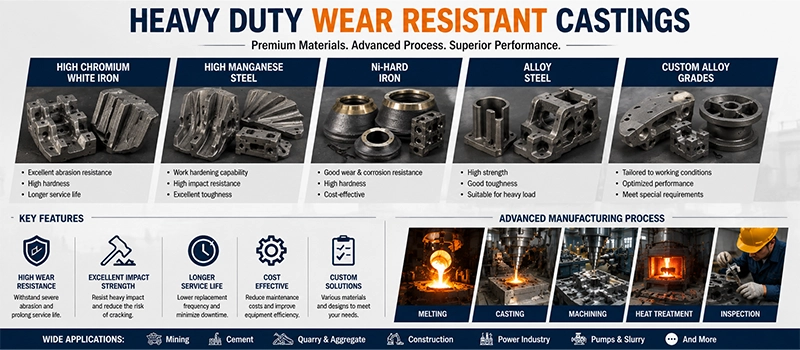
High Chromium White Iron
High chromium white iron is one of the most widely used materials for heavy duty wear resistant castings. Its high chromium content forms hard carbides throughout the microstructure, providing excellent resistance to abrasive wear.
This material is commonly selected for components that experience continuous sliding or grinding wear.
Key characteristics include:
- Excellent abrasion resistance
- High surface hardness
- Long service life in abrasive conditions
- Good dimensional stability
High chromium white iron is widely used for wear parts where abrasion is the primary source of material loss.
High Manganese Steel
High manganese steel is well known for its ability to withstand repeated impact while maintaining excellent toughness. One of its unique characteristics is work hardening, where the surface becomes harder during operation while the core remains tough and resistant to cracking.
Its main advantages include:
- Excellent impact resistance
- High toughness
- Strong work-hardening capability
- Good resistance to cracking under heavy loads
Because of these properties, high manganese steel is commonly used for heavy duty wear resistant castings subjected to repeated impact and heavy mechanical loading.
Ni-Hard Iron
Ni-Hard iron is a nickel-alloyed white cast iron developed for applications requiring both hardness and abrasion resistance. The addition of nickel improves the material’s wear performance while maintaining a stable microstructure.
Typical features include:
- High hardness
- Excellent wear resistance
- Good performance in abrasive environments
- Stable mechanical properties
Ni-Hard iron is often selected for components that operate under continuous abrasive conditions with relatively low impact loads.
Alloy Steel
Alloy steel offers a balanced combination of strength, toughness, and wear resistance. By adjusting the alloy composition and heat treatment process, manufacturers can tailor its mechanical properties to meet different service requirements.
Key benefits include:
- Good overall mechanical strength
- Excellent toughness
- Reliable wear resistance
- Suitable for demanding industrial applications
Its versatility makes alloy steel one of the most commonly specified materials for custom heavy duty wear resistant castings.
Material Comparison
Each material offers distinct advantages depending on the operating conditions and performance requirements.
| Material | Wear Resistance | Impact Resistance | Typical Characteristics |
|---|---|---|---|
| High Chromium White Iron | Excellent | Moderate | High hardness and superior abrasion resistance |
| High Manganese Steel | Good | Excellent | Work hardening and exceptional toughness |
| Ni-Hard Iron | Excellent | Low to Moderate | High hardness with stable wear performance |
| Alloy Steel | Good | Good | Balanced strength, toughness, and durability |
Because no single alloy performs best in every situation, heavy duty wear resistant castings are manufactured using a variety of materials to match different service requirements. Understanding the characteristics of each material helps buyers evaluate available options based on the specific performance needs of their equipment.
Common Applications of Heavy Duty Wear Resistant Castings
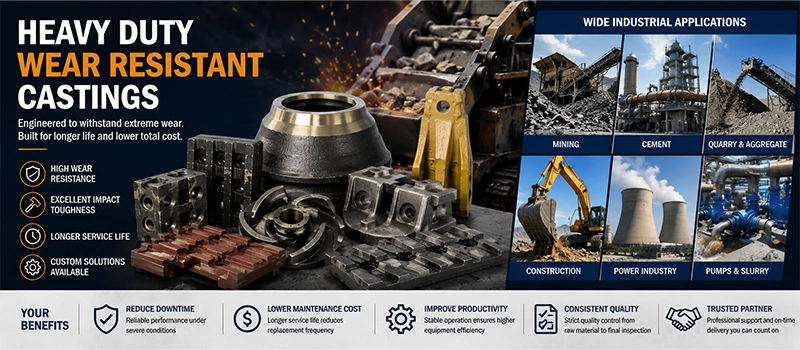
Heavy duty wear resistant castings are used across a wide range of industries where equipment is exposed to continuous abrasion, impact, and heavy mechanical loads. In these environments, standard cast components often experience rapid wear, leading to frequent maintenance and production interruptions. Wear-resistant castings are designed to improve the durability of critical equipment parts, helping industrial operations maintain consistent productivity under demanding working conditions.
Mining Industry
Mining is one of the largest users of heavy duty wear resistant castings. Mining equipment processes hard rock, ore, and other highly abrasive materials throughout extraction, crushing, conveying, and mineral processing operations.
Common applications include:
- Jaw crushers
- Cone crushers
- Grinding mills
- Chutes
- Feed hoppers
Because mining equipment often operates continuously under severe conditions, wear-resistant castings play an important role in extending equipment service life and reducing maintenance shutdowns.
Cement Industry
Cement production involves the continuous handling and grinding of limestone, clinker, and other abrasive raw materials. Equipment used throughout the production process is subjected to constant wear, making heavy duty wear resistant castings an essential part of plant operation.
Typical applications include:
- Crusher components
- Mill liners
- Grinding tables
- Wear plates
- Kiln feed equipment
These castings help maintain production efficiency while reducing the frequency of component replacement.
Quarry and Aggregate Industry
Quarries process large volumes of stone, gravel, and aggregates every day. Crushing, screening, and conveying equipment must withstand continuous contact with abrasive materials, making durability a critical requirement.
Heavy duty wear resistant castings are commonly used in:
- Primary crushers
- Secondary crushers
- Screening equipment
- Material transfer systems
Reliable wear parts help maintain stable production and minimize equipment downtime in high-capacity aggregate operations.
Construction Equipment
Construction machinery frequently operates in demanding environments where components encounter soil, sand, rock, and other abrasive materials. Heavy duty wear resistant castings are widely used as replaceable wear components that protect larger structural parts from excessive wear.
Typical equipment includes:
- Excavators
- Loaders
- Bulldozers
- Road construction machinery
These wear-resistant components contribute to longer equipment life while helping reduce maintenance requirements on construction sites.
Steel and Power Industries
Heavy duty wear resistant castings are also widely used in steel plants and power generation facilities. Equipment in these industries handles high-temperature materials, bulk solids, ash, slag, and other abrasive media that gradually wear critical components during normal operation.
Typical applications include:
- Material handling systems
- Ash handling equipment
- Slag processing equipment
- Industrial conveying systems
Using durable wear-resistant castings helps improve equipment reliability while supporting continuous industrial production.
Heavy duty wear resistant castings have become indispensable across industries where abrasive materials and demanding operating conditions accelerate component wear. Whether used in mining, cement production, quarrying, construction, or heavy industrial processing, these castings help improve equipment durability, reduce maintenance frequency, and support more reliable long-term operation.
Key Factors When Choosing Heavy Duty Wear Resistant Castings
Selecting the right heavy duty wear resistant castings involves more than simply choosing the hardest material available. Different equipment operates under different wear conditions, and a casting that performs well in one application may not be the best choice for another. Understanding the key factors that influence wear performance helps buyers select castings that deliver longer service life, improved reliability, and better overall value.
Understand the Wear Mechanism
The first step in selecting heavy duty wear resistant castings is identifying the primary type of wear the component will experience. Wear can occur in several forms, and each places different demands on the casting.
Common wear mechanisms include:
- Abrasive wear
- Impact wear
- Sliding wear
- Erosive wear
Some equipment is exposed to only one type of wear, while others operate under a combination of conditions. Defining the dominant wear mechanism helps narrow the selection of suitable wear-resistant castings.
Match the Material to the Working Conditions
The operating environment has a direct influence on casting performance. Factors such as load, operating speed, material characteristics, and service conditions should all be considered before selecting heavy duty wear resistant castings.
Important operating factors include:
- Material hardness
- Impact load
- Operating temperature
- Moisture or slurry exposure
- Continuous or intermittent operation
Selecting a casting that matches the actual working conditions helps maximize service life and improve equipment reliability.
Balance Hardness and Toughness
Hardness is often associated with wear resistance, but it should not be considered in isolation. A casting with extremely high hardness may resist abrasion very well but can become more susceptible to cracking under heavy impact. Likewise, a tougher material may absorb impact effectively while offering lower resistance to abrasive wear.
An effective heavy duty wear resistant casting achieves an appropriate balance between:
- Hardness
- Toughness
- Wear resistance
- Mechanical strength
Finding this balance is often more important than pursuing the highest hardness value alone.
Consider Service Life and Maintenance
When evaluating heavy duty wear resistant castings, buyers should look beyond the initial purchase price. Components with a longer service life generally reduce maintenance frequency, minimize equipment downtime, and improve overall operating efficiency.
Questions worth considering include:
- How often does the component require replacement?
- Will a longer-lasting casting reduce maintenance shutdowns?
- Can improved wear performance increase equipment availability?
Evaluating the total operating cost rather than the component price alone often leads to better long-term purchasing decisions.
Work with an Experienced Manufacturer
Selecting heavy duty wear resistant castings is easier when working with a manufacturer that understands different wear conditions and industrial applications. Experienced suppliers can review product drawings, operating environments, and performance requirements to recommend suitable casting solutions.
A knowledgeable manufacturing partner can also assist with:
- Material recommendations
- Design optimization
- Custom casting solutions
- Manufacturing feasibility
- Quality assurance
Professional technical support helps reduce uncertainty during product selection and ensures that the final casting is better suited to its intended application.
Choosing heavy duty wear resistant castings is a process that combines engineering requirements with practical operating conditions. By considering the wear mechanism, working environment, material performance, service life, and supplier expertise, buyers can make more informed decisions and achieve greater long-term value from their equipment.
Why Choose Dalian Zhongsheng for Heavy Duty Wear Resistant Castings
Selecting the right manufacturer is just as important as selecting the right product. High-quality heavy duty wear resistant castings require not only suitable materials but also reliable engineering, precise manufacturing, and consistent quality control. An experienced supplier can help ensure that every casting is designed and manufactured to perform reliably under demanding operating conditions.
Dalian Zhongsheng Metal Product Co., Ltd. specializes in producing custom heavy duty wear resistant castings for a wide range of industrial applications. From engineering review to final inspection, every production stage is carefully managed to deliver durable cast components that meet customer requirements.
Extensive Material Expertise
Different applications require different wear-resistant materials. Dalian Zhongsheng manufactures heavy duty wear resistant castings using a variety of alloy systems to meet diverse service conditions.
Available material options include:
- High Chromium White Iron
- High Manganese Steel
- Alloy Steel
- Ni-Hard Iron
- Other customer-specified alloy grades
Material recommendations can also be provided according to customer drawings and operating requirements, helping ensure that each casting is manufactured with the most suitable material for its intended application.
Custom Manufacturing Capabilities
Many industrial components require custom dimensions or specialized designs that are not available as standard products. Dalian Zhongsheng produces heavy duty wear resistant castings according to customer drawings, samples, or technical specifications.
Custom manufacturing services include:
- OEM production
- Customized casting designs
- Prototype development
- Low-volume production
- High-volume manufacturing
This flexibility allows customers to source castings that match their equipment and operational requirements.

Complete Manufacturing Services
Dalian Zhongsheng provides a complete manufacturing solution, allowing customers to source finished components from a single supplier.
Manufacturing capabilities include:
- Investment casting
- Sand casting
- CNC machining
- Heat treatment
- Surface finishing
- Assembly support
An integrated production process helps improve manufacturing efficiency while ensuring consistent product quality.
Strict Quality Control
Every heavy duty wear resistant casting undergoes comprehensive quality inspection before shipment.
Quality control procedures include:
- Chemical composition analysis
- Mechanical property testing
- Dimensional inspection
- Non-destructive testing (NDT)
- Final visual inspection
Each inspection stage is carried out according to customer specifications and applicable industry standards to ensure reliable product performance.
Reliable Global Supply
Dalian Zhongsheng supplies heavy duty wear resistant castings to customers across multiple industries and international markets. With extensive export experience and established manufacturing processes, the company supports projects ranging from individual replacement components to long-term production programs.
By combining engineering expertise, flexible manufacturing, comprehensive quality control, and responsive customer support, Dalian Zhongsheng helps customers obtain heavy duty wear resistant castings that deliver reliable performance, extended service life, and dependable quality for demanding industrial applications.
Conclusion
Heavy duty wear resistant castings play a critical role in protecting industrial equipment operating under severe abrasive and high-impact conditions. From crushers and grinding mills to construction and material handling equipment, selecting the appropriate wear-resistant casting helps improve equipment reliability, extend service life, and reduce maintenance costs.
Understanding the different types of heavy duty wear resistant castings, available material options, typical applications, and key selection factors enables buyers to make more informed purchasing decisions. Working with an experienced manufacturer further ensures that each casting is designed and produced to deliver dependable performance, consistent quality, and long-term value in demanding industrial environments.