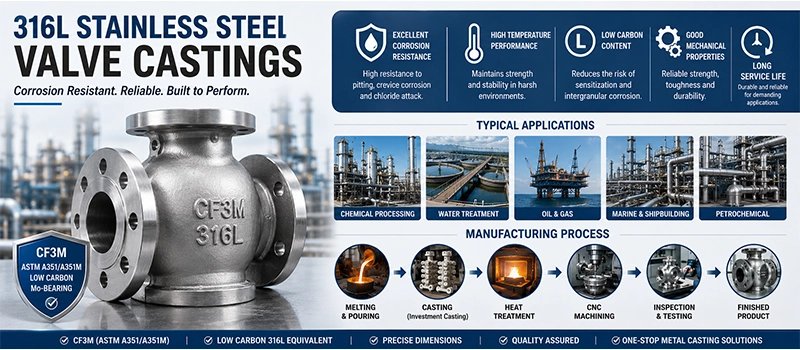
316L stainless steel for valve castings is widely considered for applications where corrosion resistance, durability, and reliable performance are essential. However, choosing 316L for a valve casting involves more than simply specifying a stainless steel grade.
Material composition, casting grade, service conditions, heat treatment, casting quality, and inspection can all affect the final performance of a valve component. In particular, understanding the relationship between 316L and cast grades such as CF3M is important for making the right material and purchasing decisions.
This guide explains the key properties, applications, manufacturing processes, quality controls, material comparisons, and selection considerations for 316L stainless steel valve castings.
What Is 316L Stainless Steel for Valve Castings?
316L stainless steel for valve castings refers to the use of low-carbon, molybdenum-bearing austenitic stainless steel for cast valve components such as valve bodies and bonnets. It is mainly selected when a valve requires good corrosion resistance, toughness, and reliable performance in contact with industrial fluids.
The material contains chromium, nickel, and molybdenum as its principal alloying elements. Chromium helps form the passive surface layer that gives stainless steel its corrosion resistance. Nickel supports the stable austenitic structure and contributes to toughness. Molybdenum improves resistance to localized corrosion, especially pitting and crevice corrosion.
The “L” in 316L means “low carbon.” Compared with standard 316 stainless steel, 316L limits carbon to a lower level. This is important for components that may experience welding or thermal exposure because lower carbon content reduces the risk of sensitization and subsequent intergranular corrosion.
For valve castings, however, buyers should understand an important material distinction. 316L is primarily a wrought stainless steel designation. When a similar low-carbon, molybdenum-containing stainless steel is required as a pressure-containing casting, ASTM A351 Grade CF3M is commonly specified. ASTM A351/A351M covers austenitic steel castings for pressure-containing parts such as valves, flanges, and fittings.
Therefore, 316L and CF3M should not simply be treated as two interchangeable names. The correct material designation depends on the product form and applicable specification. For a cast valve body, the drawing or purchase specification should identify the required casting grade and standard rather than stating only “316L.”
This distinction is particularly important when sourcing 316L stainless steel for valve castings. A correct material specification establishes the requirements for chemical composition, mechanical properties, heat treatment, and other acceptance conditions. These requirements directly affect whether the finished casting can provide the corrosion resistance and mechanical reliability expected from the valve design.
In practical terms, 316L stainless steel for valve castings can be understood as a material-selection concept centered on low-carbon, molybdenum-bearing austenitic stainless steel, while CF3M is one of the relevant cast grades used to turn that material requirement into a defined valve casting specification.
Why Choose 316L Stainless Steel for Valve Castings?
316L stainless steel for valve castings is mainly selected for its balance of corrosion resistance, mechanical reliability, and manufacturability. For valves exposed to water, chemicals, process fluids, or other corrosive media, these properties can provide longer service life than less corrosion-resistant materials.
Corrosion Resistance
Corrosion resistance is the primary reason for choosing 316L stainless steel for valve castings.
The chromium content enables a thin passive oxide film to form on the stainless steel surface. If the surface is damaged under suitable conditions, this protective layer can reform, helping the material resist general corrosion.
Molybdenum provides an additional advantage. It improves resistance to localized corrosion, particularly pitting and crevice corrosion. This is important for valves because areas around seats, gaskets, flanges, and internal cavities may retain fluids or create conditions where localized corrosion can develop.
The low carbon characteristic also helps reduce susceptibility to intergranular corrosion associated with sensitization after certain thermal exposures.
Good Weldability and Machinability
316L stainless steel for valve castings also provides practical manufacturing advantages.
Valve castings often require substantial machining after casting. Flange faces, sealing surfaces, stem holes, bolt holes, threads, and valve seats may all require precision machining to achieve the specified dimensions and surface finish.
The low-carbon composition is also beneficial when welding is required. It reduces the risk of chromium carbide precipitation compared with higher-carbon grades, making 316L-type materials suitable for components where welding or qualified weld repair may be involved.
Strength, Toughness, and Service Life
Valve bodies are pressure-containing components. They must withstand internal pressure, operating loads, temperature changes, and repeated service conditions without losing structural integrity.
316L stainless steel for valve castings combines corrosion resistance with good ductility and toughness. This combination is valuable because corrosion resistance alone is not enough for a pressure-containing valve component. The casting must also maintain adequate mechanical properties throughout its intended operating conditions.
When the correct casting grade, heat treatment, and manufacturing controls are applied, 316L-type stainless steel valve castings can provide reliable service in many chemical processing, petrochemical, water treatment, and general industrial fluid-handling applications.
Limitations of 316L Stainless Steel for Valve Castings
316L stainless steel is corrosion resistant, but it is not corrosion proof.
High chloride concentrations, elevated temperatures, stagnant solutions, aggressive chemicals, and certain combinations of tensile stress and corrosive media can increase the risk of pitting, crevice corrosion, or stress corrosion cracking.
This is particularly important in seawater and other chloride-rich environments. 316L stainless steel for valve castings should not automatically be specified simply because an application involves corrosion. More severe conditions may require duplex stainless steel or another higher-alloy material.
For this reason, the final material selection should consider the actual medium, concentration, operating temperature, pressure, flow conditions, and required service life. The main advantage of 316L stainless steel for valve castings is not universal corrosion resistance, but its effective balance of corrosion resistance, mechanical performance, and manufacturability across a broad range of industrial valve applications.
Where Are 316L Stainless Steel Valve Castings Used?
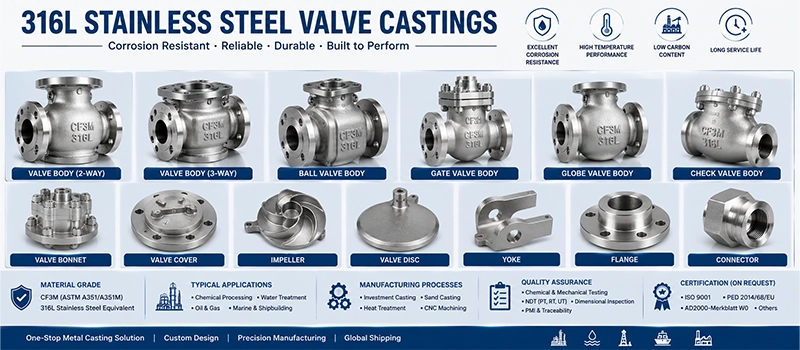
316L stainless steel for valve castings is commonly used where valve components are exposed to corrosive liquids, moisture, chemicals, or process media. Typical cast components include valve bodies and bonnets, where both corrosion resistance and pressure integrity are important.
Common Valve Components
Valve bodies are one of the main applications for 316L stainless steel for valve castings. The valve body contains the primary flow passage and is continuously exposed to the process medium. Corrosion of this component can lead to wall-thickness loss, leakage, or reduced service life.
Valve bonnets can also be produced from 316L-type stainless steel castings. Depending on the valve design, the bonnet may form part of the pressure boundary and therefore requires suitable corrosion resistance and mechanical properties.
Similar cast stainless steel materials can also be used for selected pump housings and other flow-control components when their service conditions require comparable corrosion resistance.
Typical Industrial Applications
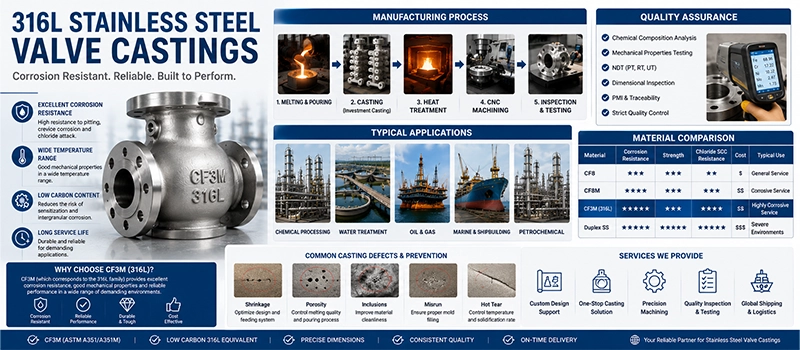
In chemical processing, 316L stainless steel for valve castings is often considered for handling corrosive process fluids. The molybdenum content provides better resistance to localized corrosion than 304-type stainless steels in many environments.
In petrochemical systems, 316L-type valve castings can be used for valves handling process liquids where carbon steel does not provide sufficient corrosion resistance. Material selection still depends on the specific chemical composition, temperature, pressure, and concentration of the medium.
Water treatment is another common application. Valves may operate continuously in wet environments and come into contact with treated water, wastewater, or process chemicals. 316L stainless steel for valve castings can provide a useful combination of corrosion resistance and durability for suitable water-treatment conditions.
Food and pharmaceutical processing can also use 316L-type stainless steel valve components because corrosion resistance and cleanable surfaces are important. In these applications, the final surface condition, machining quality, and applicable hygienic requirements are as important as the base material.
Marine-related equipment is another potential application, but material selection requires greater caution. Chlorides can cause pitting and crevice corrosion in 316L stainless steel, particularly as chloride concentration and temperature increase. Therefore, 316L stainless steel for valve castings should not automatically be considered suitable for every seawater application.
The key principle is that application determines material selection. 316L stainless steel for valve castings is most appropriate when its corrosion resistance, mechanical properties, and manufacturing characteristics match the actual fluid, temperature, pressure, and operating environment.
How Are 316L Stainless Steel Valve Castings Made?
Manufacturing 316L stainless steel for valve castings requires careful control from casting design through final machining. Valve bodies and bonnets are often pressure-containing parts, so internal soundness, dimensional accuracy, material composition, and sealing surfaces all need to meet the specified requirements.
Casting Design and Process Selection
Production starts with a review of the valve drawing and 3D model. Engineers evaluate wall thickness, dimensional tolerances, machining allowance, shrinkage, internal cavities, and pressure-bearing areas.
The casting method is then selected according to the valve size, geometry, required accuracy, surface finish, production quantity, and cost target.
Investment casting is suitable for relatively complex valve components that require good dimensional accuracy and surface quality. Sand casting is commonly considered for larger valve bodies or parts where size and production economics make investment casting less practical.
Regardless of the process, gating and riser design are important. Molten stainless steel must fill the mold properly while the feeding system compensates for solidification shrinkage. Poor design can increase the risk of shrinkage porosity, inclusions, cold shuts, and other casting defects.
Melting and Pouring
Melting is a critical stage in producing 316L stainless steel for valve castings.
The metal charge and alloy composition must be controlled to achieve the specified casting grade. Chemical analysis is used to verify important elements such as carbon, chromium, nickel, and molybdenum before the casting is accepted.
Pouring conditions also affect casting quality. If temperature, filling behavior, or solidification is poorly controlled, defects may develop inside the valve body. This is particularly important around thick sections, transitions, flanges, and other areas where solidification rates can differ.
For pressure-containing valve castings, a visually acceptable surface does not necessarily indicate a sound internal structure. Process control during melting, pouring, and solidification is therefore essential.
Solution Heat Treatment
Heat treatment is an important step for austenitic stainless steel valve castings.
After casting, the component is solution heat treated according to the applicable material specification. The purpose is to establish the required metallurgical condition and help the casting achieve its specified corrosion resistance and mechanical properties.
For CF3M castings covered by ASTM A351/A351M, the applicable heat-treatment requirements should be followed rather than simply applying a generic “316L heat treatment” procedure.
Heat treatment is especially important because the performance of 316L stainless steel for valve castings depends on more than chemical composition. Two castings with similar chemistry may perform differently if their casting and heat-treatment processes are not properly controlled.
Cleaning and Surface Treatment
After heat treatment, the castings are cleaned to remove scale, residual molding material, and surface contamination.
Depending on the production process and customer requirements, finishing operations may include shot blasting, grinding, pickling, and passivation.
Surface treatment is particularly relevant for stainless steel. Iron contamination or an unsuitable surface condition can reduce the corrosion performance expected from the material. Critical sealing and mating surfaces are normally finished during subsequent machining rather than relying on the as-cast surface.
CNC Machining
Most 316L stainless steel for valve castings requires machining before the component can be assembled into a finished valve.
Typical machining areas include flange faces, valve seats, stem holes, bolt holes, threads, sealing surfaces, and other critical interfaces. These features require tighter dimensional tolerances and better surface finishes than the casting process alone can normally provide.
Machining must also account for the geometry of the casting. Correct datum selection and fixturing are important because errors during machining can affect concentricity, sealing performance, assembly, and final dimensions even when the original casting is sound.
The complete manufacturing route can therefore be summarized as:
Drawing Review → Casting Process Selection → Melting → Pouring and Solidification → Heat Treatment → Cleaning → CNC Machining
Each stage affects the next. For 316L stainless steel for valve castings, reliable performance ultimately depends on controlling the entire manufacturing process rather than focusing only on the stainless steel grade.
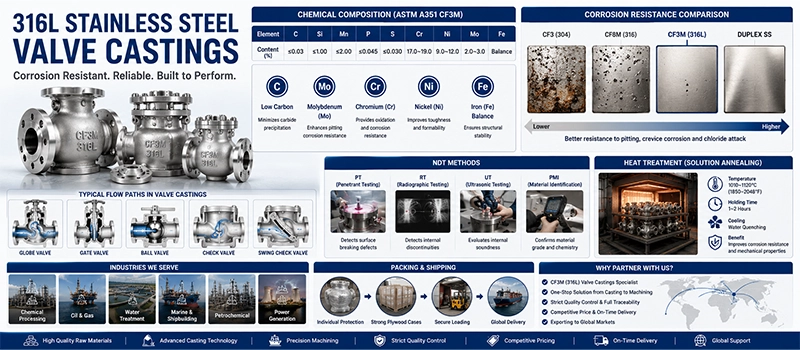
Common Defects and Quality Control for 316L Valve Castings
Quality control is critical for 316L stainless steel for valve castings because many valve bodies and bonnets are pressure-containing components. A defect that appears minor on the surface may extend into the casting and affect pressure integrity, corrosion resistance, machining, or sealing performance.
For this reason, quality control should cover both casting defects and final product requirements.
Common Casting Defects
Shrinkage porosity is one of the defects that requires close attention in stainless steel valve castings. It occurs when liquid metal cannot adequately feed a region as the casting solidifies. Thick sections and abrupt changes in wall thickness can be particularly sensitive if the feeding and solidification design is inadequate.
Gas porosity forms when gas becomes trapped in the metal during casting. Excessive gas porosity can reduce the effective cross-section of a pressure-bearing component and may become visible after machining.
Hot cracking can occur during the later stages of solidification when thermal contraction and metallurgical factors create conditions favorable to cracking. For 316L stainless steel for valve castings, controlling casting geometry, alloy chemistry, pouring conditions, and solidification is therefore important.
Inclusions are another concern. Oxides, slag, refractory material, or other non-metallic substances can become trapped in the casting. Their effect depends on their size, location, and applicable acceptance criteria.
Cold shuts and misruns are generally associated with incomplete mold filling. They can result from unsuitable pouring conditions, insufficient fluidity, or difficult casting geometry.
| Defect | Possible Cause | Potential Effect |
|---|---|---|
| Shrinkage porosity | Insufficient feeding during solidification | Reduced internal soundness |
| Gas porosity | Entrapped gas | Leakage or reduced strength |
| Hot cracking | Solidification and thermal stress | Structural discontinuities |
| Inclusions | Oxides, slag or foreign material | Localized weak areas |
| Cold shut | Incomplete metal fusion | Surface or structural discontinuity |
| Misrun | Incomplete mold filling | Incomplete casting geometry |
Preventing these defects starts before pouring. Casting design, gating and riser systems, melting control, mold preparation, pouring parameters, and solidification control all influence the final quality of 316L stainless steel for valve castings.
Material and Mechanical Testing
Chemical composition should be verified to confirm that the casting meets the specified material grade.
Important elements include carbon, chromium, nickel, and molybdenum. For a CF3M valve casting, the acceptance limits should follow the specified casting standard rather than simply comparing the results with a wrought 316L datasheet.
Mechanical testing may also be required to verify tensile strength, yield strength, elongation, and other specified properties.
Positive Material Identification (PMI) can provide additional material verification when required. This is particularly useful when several stainless steel grades are being processed because similar stainless steel castings may be difficult to distinguish visually.
Nondestructive Testing
Nondestructive testing helps identify discontinuities without destroying the valve casting.
Liquid penetrant testing (PT) is commonly used for detecting surface-breaking discontinuities in austenitic stainless steel castings. It can reveal cracks and other defects that may not be easily visible during ordinary visual inspection.
Radiographic testing (RT) can be used to evaluate internal casting quality. It is particularly valuable when critical pressure-bearing areas need to be checked for internal shrinkage, porosity, inclusions, or other volumetric discontinuities.
Ultrasonic testing (UT) may also be specified for certain castings, depending on component geometry, material, applicable standard, and customer requirements.
The inspection method should therefore be selected according to the valve design and acceptance requirements. Simply requesting “NDT” without defining the method, inspection area, standard, and acceptance level can lead to different interpretations between the buyer and casting supplier.
Dimensional Inspection and Traceability
Quality control for 316L stainless steel for valve castings continues after casting and heat treatment.
Critical dimensions should be inspected according to the drawing. After CNC machining, particular attention may be given to flange dimensions, sealing surfaces, bore dimensions, stem locations, bolt-hole patterns, and other features that affect valve assembly and sealing.
Traceability is equally important. Heat numbers and production records allow the finished casting to be connected with its material analysis, heat treatment, inspection, and other required quality documentation.
A practical quality-control route is:
Material Verification → Casting Inspection → Heat Treatment → NDT → CNC Machining → Dimensional Inspection → Final Documentation
For 316L stainless steel for valve castings, effective quality control is not a single final inspection. It is a continuous process that begins with material control and continues through casting, heat treatment, machining, inspection, and final traceability.
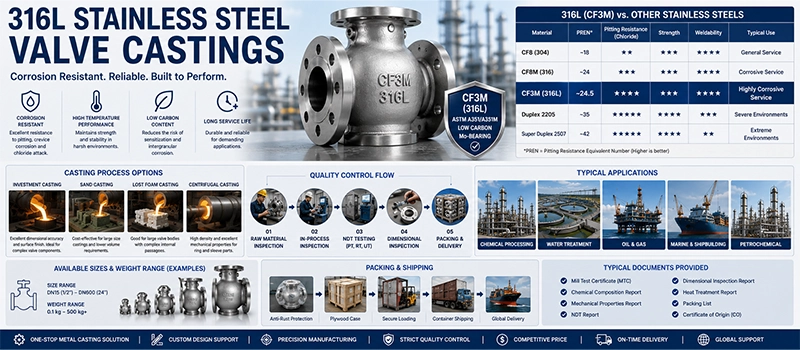
316L/CF3M vs Other Valve Casting Materials
When selecting 316L stainless steel for valve castings, CF3M should be compared with other commonly used cast stainless steel grades rather than relying only on wrought-grade comparisons. CF8, CF8M, CF3M, and duplex stainless steel offer different combinations of corrosion resistance, strength, manufacturability, and cost.
| Comparison | Key Material Difference | Corrosion Resistance | Strength | Cost | When to Consider |
|---|---|---|---|---|---|
| CF3M vs CF8M | Both contain Mo, but CF3M has lower carbon | Both provide good resistance to general and localized corrosion; CF3M’s lower carbon is beneficial where sensitization is a concern | Similar general level | Similar | CF3M is often considered when low-carbon characteristics associated with 316L are required |
| CF3M vs CF8 | CF3M contains Mo and has lower carbon; CF8 is associated with the 304 stainless family | CF3M generally provides better resistance to pitting and crevice corrosion in many corrosive environments | Similar general level | CF8 is generally lower | CF8 suits less aggressive environments; CF3M is preferred when additional localized corrosion resistance is needed |
| CF3M vs Duplex Stainless Steel | CF3M is austenitic; duplex has a mixed austenitic-ferritic structure | Duplex generally provides better resistance in demanding chloride environments | Duplex is generally higher | Duplex is generally higher | Duplex may be preferable for severe chloride exposure or higher-strength requirements |
| CF3M / 316L-Type Casting | Low-carbon, Cr-Ni-Mo austenitic stainless steel | Good general corrosion resistance with improved resistance to localized corrosion | Good toughness and ductility | Medium | Chemical processing, water treatment, petrochemical and other suitable corrosive services |
For 316L stainless steel for valve castings, there is no single material that is best for every application. CF8 may reduce cost in mild environments, CF3M offers a useful balance of low-carbon characteristics and corrosion resistance, while duplex stainless steel can be considered for more severe chloride conditions or higher strength requirements.
The final choice should be based on the process medium, chloride concentration, operating temperature, pressure, corrosion requirements, and applicable material specification.
How to Select and Buy 316L Stainless Steel Valve Castings
Selecting 316L stainless steel for valve castings requires more than specifying a material name. Buyers should confirm the actual operating conditions, casting grade, inspection requirements, machining specifications, and total manufacturing cost before placing an order.

Confirm the Service Conditions
Before selecting 316L stainless steel for valve castings, the actual service environment should be reviewed. Important factors include:
- Process medium and chemical composition
- Operating temperature
- Working pressure
- Chloride concentration
- Flow conditions
- Expected corrosion resistance
- Required service life
This is especially important in chloride-containing environments. 316L-type stainless steel provides good corrosion resistance in many applications, but severe chloride concentrations or elevated temperatures may require duplex stainless steel or another higher-alloy material.
Specify the Correct Material Standard
A purchase order that states only “316L stainless steel” may not provide enough information for a valve casting.
For pressure-containing cast components, the buyer should specify the applicable casting standard and grade. ASTM A351/A351M Grade CF3M is commonly considered when the low-carbon and molybdenum-containing characteristics associated with 316L are required in an austenitic stainless steel casting.
A clearer specification should therefore include:
Material Standard + Casting Grade + Drawing + Heat Treatment Requirements + Inspection Requirements
This reduces the risk of misunderstandings between the valve manufacturer, casting supplier, and buyer.
Define Inspection and Machining Requirements
Inspection requirements for 316L stainless steel for valve castings should be established before production rather than after the castings are completed.
Depending on the application, the order may specify chemical analysis, mechanical testing, PMI, PT, RT, dimensional inspection, or other required tests. For NDT, the inspection method, inspection area, applicable standard, and acceptance criteria should be clearly defined.
Machining requirements are equally important. Valve seats, flange faces, stem holes, sealing surfaces, threads, and bolt holes can require precise tolerances and surface finishes.
A supplier quoting a raw casting and a supplier quoting a fully machined component are therefore providing very different products. Buyers should make this distinction clear when comparing quotations.
What Affects the Cost of 316L Stainless Steel for Valve Castings?
The price of 316L stainless steel for valve castings depends on the complete manufacturing requirement rather than raw material cost alone.
| Cost Factor | How It Affects the Price |
|---|---|
| Material | Chromium, nickel, and molybdenum content influence alloy cost |
| Casting weight | Larger castings require more molten metal |
| Casting process | Investment casting and sand casting have different tooling and production costs |
| Casting complexity | Complex internal passages and difficult geometries increase manufacturing difficulty |
| Heat treatment | Solution heat treatment adds processing and energy costs |
| NDT | PT, RT, PMI, and additional testing increase inspection costs |
| CNC machining | Tight tolerances and complex sealing surfaces increase machining time |
| Order quantity | Tooling and setup costs can be distributed across larger production quantities |
For this reason, the lowest unit price does not always represent the lowest total procurement cost.
When purchasing 316L stainless steel for valve castings, buyers should compare material compliance, casting quality, machining scope, inspection requirements, and manufacturing capability together with price. A lower-cost casting can become more expensive if it results in excessive machining allowance, rejected parts, leakage, rework, or production delays.
The most effective purchasing decision is therefore based on the total value of the finished valve component, not simply the price per kilogram of the casting.
Conclusion
316L stainless steel for valve castings provides a strong balance of corrosion resistance, durability, and manufacturability. Reliable performance depends on selecting the correct casting grade, controlling casting and heat treatment, applying suitable inspection, and matching the material to the actual valve service conditions.