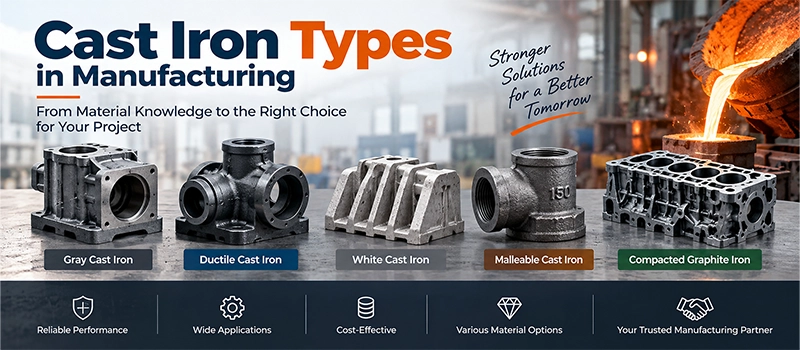
Cast iron types in manufacturing refer to the different grades of cast iron used to meet specific performance and production requirements. Each type offers unique characteristics in terms of strength, machinability, wear resistance, and cost, making it suitable for different industrial applications. Understanding these differences helps you select the right material for better product performance and more cost-effective manufacturing.
What Is Cast Iron?
When you work with metal components, choosing the right material is one of the most important decisions you will make. Cast iron has been widely used in manufacturing for hundreds of years because it offers an excellent balance of performance, manufacturability, and cost.
Simply put, cast iron is an iron-carbon alloy with a carbon content typically between 2% and 4%. This higher carbon content allows molten metal to flow easily into molds, making it possible to produce complex shapes that would be more difficult or expensive to manufacture using many other metals.
If your project requires components with intricate geometries, stable dimensions, or cost-effective production, cast iron is often a practical choice. It can be cast into near-net-shape parts, reducing the amount of machining required after casting and helping improve overall manufacturing efficiency.
Another reason manufacturers continue to choose cast iron is its combination of mechanical and manufacturing advantages. Depending on the application, it can provide:
- Excellent casting performance
- Good machinability
- High compressive strength
- Good wear resistance
- Excellent vibration damping
- Cost-effective production
These characteristics make cast iron suitable for producing reliable components while keeping manufacturing costs under control.
It’s also important to understand that “cast iron” is not a single material. Instead, it refers to a family of iron-based alloys with different internal structures and performance characteristics. Although they all belong to the cast iron family, their properties can vary significantly depending on their composition and the way they are manufactured.
Before selecting a material for your next project, it’s worth understanding that not every cast iron performs the same. Choosing the right type starts with understanding what cast iron is and why it remains one of the most widely used materials in modern manufacturing.
Common Cast Iron Types in Manufacturing
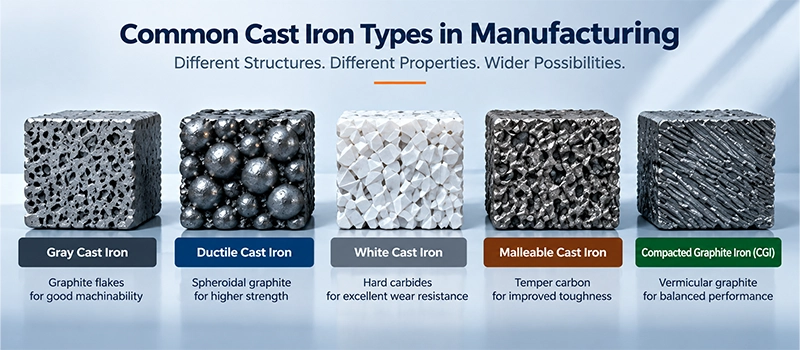
Once you understand what cast iron is, the next step is recognizing that there isn’t just one type. In manufacturing, different cast iron grades are developed to achieve different mechanical properties, production characteristics, and performance requirements. Choosing the right material starts with understanding what makes each type unique.
Gray Cast Iron
Gray cast iron is one of the most widely used cast iron types in manufacturing. It contains graphite in the form of flakes, giving the material excellent vibration damping and outstanding machinability.
If your priority is producing complex components efficiently while keeping manufacturing costs under control, gray cast iron is often a practical option.
Key characteristics include:
- Excellent machinability
- Good vibration damping
- High compressive strength
- Good thermal conductivity
- Cost-effective production
One limitation is that gray cast iron has relatively low tensile strength and impact resistance compared with some other cast iron grades.
Ductile Cast Iron
Ductile cast iron, also known as nodular cast iron or spheroidal graphite iron, contains graphite in spherical form rather than flakes. This change in graphite structure significantly improves strength, ductility, and toughness.
If your component needs to withstand higher mechanical loads while maintaining good castability, ductile cast iron is often considered a reliable choice.
Its main advantages include:
- High tensile strength
- Excellent toughness
- Good fatigue resistance
- Better impact resistance
- Good machinability
These properties make ductile cast iron one of the most versatile engineering materials available today.
White Cast Iron
White cast iron is designed for applications where wear resistance is more important than machinability. Unlike gray or ductile cast iron, most of its carbon exists as hard iron carbides, resulting in a very hard surface.
Its primary characteristics include:
- Extremely high hardness
- Excellent abrasion resistance
- Long service life under severe wear
- High compressive strength
Because of its hardness, white cast iron is difficult to machine and is generally used in its as-cast or heat-treated condition.
Malleable Cast Iron
Malleable cast iron is produced by heat treating white cast iron to improve its ductility and toughness. This process creates a material that combines good strength with improved resistance to cracking.
Key benefits include:
- Better ductility than gray cast iron
- Good toughness
- Reliable machinability
- Good shock resistance
For components that require moderate strength and improved flexibility, malleable cast iron offers a balanced combination of mechanical properties.
Compacted Graphite Iron (CGI)
Compacted Graphite Iron (CGI) combines characteristics found in both gray and ductile cast iron. Its graphite structure is compacted rather than flake-shaped or fully spherical, giving it a unique balance of strength, stiffness, and thermal performance.
Compared with conventional cast iron grades, CGI offers:
- Higher strength than gray cast iron
- Better thermal fatigue resistance
- Improved stiffness
- Good thermal conductivity
- Excellent dimensional stability
As manufacturing technologies continue to evolve, CGI has become an increasingly important material for applications that require higher performance without sacrificing castability.
Each of these cast iron types in manufacturing has its own strengths and limitations. Understanding their individual characteristics is the first step toward selecting a material that matches your product’s performance requirements, production goals, and budget.
Cast Iron Types Comparison
Now that you’ve seen the most common cast iron types in manufacturing, the next question is straightforward: how do they compare?
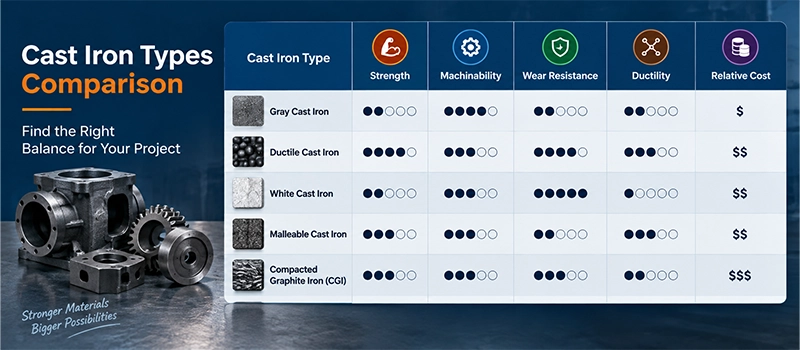
The truth is that no single cast iron is better than all the others. Every material is developed to achieve a different balance of strength, machinability, wear resistance, toughness, and production cost. The right choice depends on what matters most for your specific project.
The table below provides a quick comparison of the most important characteristics.
| Cast Iron Type | Strength | Machinability | Wear Resistance | Ductility | Relative Cost |
|---|---|---|---|---|---|
| Gray Cast Iron | Medium | Excellent | Good | Low | Low |
| Ductile Cast Iron | High | Good | Good | Excellent | Medium |
| White Cast Iron | Medium | Poor | Excellent | Very Low | Medium |
| Malleable Cast Iron | Medium | Good | Moderate | Good | Medium |
| Compacted Graphite Iron (CGI) | High | Moderate | Good | Moderate | High |
While the table offers a useful overview, your final material selection should always be based on your product’s functional requirements rather than a single property.
For example, if your priority is easy machining and cost-effective production, one material may be a better fit. If your component must withstand repeated impact or higher mechanical loads, another option may deliver better long-term performance. Likewise, if severe abrasion is the primary concern, a material with superior wear resistance may provide the longest service life.
Instead of asking, “Which cast iron is the best?”, it’s often more useful to ask:
- Does the material provide enough strength?
- Will it perform reliably under the expected working conditions?
- Can it be machined efficiently?
- Does it meet the project’s cost target?
- Will it achieve the required service life?
Looking at these questions together gives you a much clearer picture than comparing a single performance value. In manufacturing, selecting the right cast iron is rarely about choosing the strongest or the hardest material—it’s about finding the best balance between performance, manufacturability, and cost for your specific application.
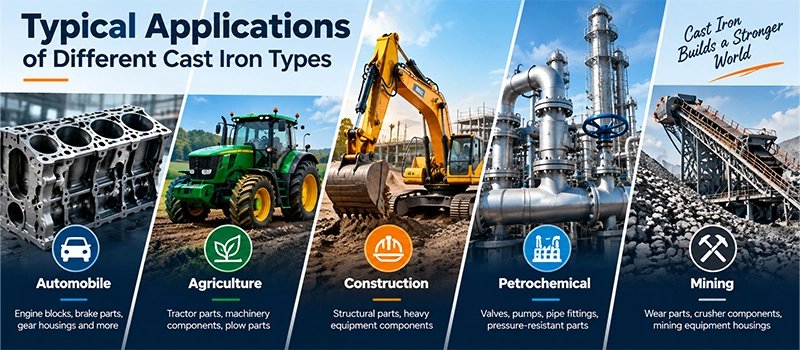
Typical Applications of Different Cast Iron Types
Once you understand the characteristics of different cast iron grades, it’s easier to see why they are used in different products. In manufacturing, material selection is closely linked to how a component will perform in service. Factors such as strength, wear resistance, vibration control, and production cost all influence which cast iron type is chosen.
Gray Cast Iron
If your component requires excellent vibration damping and easy machining, gray cast iron is often the preferred choice.
You’ll commonly find it in products such as:
- Engine blocks
- Machine tool bases
- Pump housings
- Valve bodies
- Gearbox housings
These components benefit from gray cast iron’s ability to absorb vibration while maintaining dimensional stability during operation.
Ductile Cast Iron
When higher strength and better toughness are required, ductile cast iron is widely used.
Typical applications include:
- Pipe fittings
- Hydraulic components
- Agricultural machinery
- Automotive suspension parts
- Construction equipment components
These products often operate under higher loads, making improved mechanical properties an important advantage.
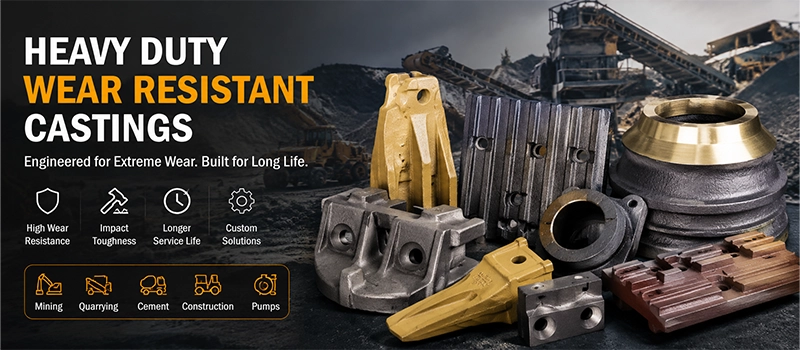
White Cast Iron
White cast iron is commonly selected for components that are exposed to continuous abrasion.
Typical examples include:
- Crusher liners
- Grinding mill liners
- Wear plates
- Slurry pump components
- Mining wear parts
In these applications, extending wear life is often more important than improving machinability.
Malleable Cast Iron
Malleable cast iron is frequently used where moderate strength and good ductility are both required.
Common applications include:
- Pipe connectors
- Hand tools
- Agricultural fittings
- Brackets
- Mechanical hardware
Its balanced mechanical properties make it suitable for components subjected to repeated loading and light impact.
Compacted Graphite Iron (CGI)
As manufacturing technology continues to evolve, Compacted Graphite Iron is becoming increasingly popular for high-performance applications.
You’ll often see CGI used in:
- Heavy-duty diesel engine blocks
- Cylinder heads
- Exhaust manifolds
- High-performance automotive components
Its combination of strength, thermal conductivity, and stiffness makes it an excellent choice for components operating under demanding conditions.
No matter which cast iron type you use, the application should always determine the material—not the other way around. A material that performs exceptionally well in one product may not be the right solution for another. Matching the material to the component’s operating requirements is one of the most effective ways to achieve reliable performance, longer service life, and cost-effective manufacturing.
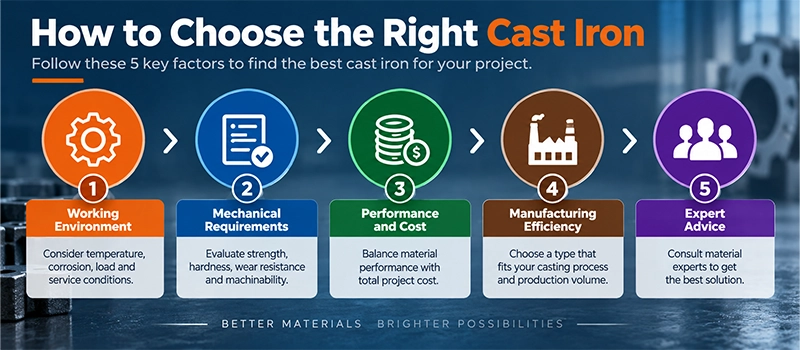
How to Choose the Right Cast Iron Type
Choosing the right cast iron isn’t about finding the strongest or the least expensive material. It’s about selecting a material that matches your product’s performance requirements, manufacturing process, and budget. Before making a decision, it’s worth taking a closer look at how your component will actually be used.
Consider the Working Environment
Start by thinking about the conditions your component will face during service.
Ask yourself questions such as:
- Will it be exposed to heavy loads?
- Will it experience continuous wear or abrasion?
- Will it operate at high temperatures?
- Will vibration reduction improve equipment performance?
The answers will help narrow your material options and eliminate grades that are unsuitable for the application.
Define Your Mechanical Requirements
Every project has different performance expectations.
Before selecting a material, identify the properties that matter most for your component.
For example:
- High strength
- Good toughness
- Excellent wear resistance
- Easy machinability
- Dimensional stability
Trying to maximize every property usually increases manufacturing costs without improving overall performance. Focus on the characteristics that are truly important for your application.
Balance Performance and Cost
Choosing a higher-grade material doesn’t always create a better product.
For many applications, a more economical cast iron grade can deliver the required performance while reducing manufacturing costs. On the other hand, selecting a material that is too inexpensive may shorten service life or increase maintenance costs.
Rather than asking, “Which material is the cheapest?”, consider asking:
“Which material offers the best value for this application?”
That small change in perspective often leads to a more practical and cost-effective decision.
Think About Manufacturing Efficiency
Material selection also affects how efficiently your component can be manufactured.
Some cast iron grades are easier to cast and machine, helping reduce production time and machining costs. Others require more specialized processing but provide improved performance in demanding applications.
Looking at both manufacturing efficiency and product performance allows you to evaluate the total value of each material rather than focusing on material cost alone.
Discuss Your Requirements Early
If you’re unsure which cast iron grade is the best fit, don’t wait until production begins.
Sharing your drawings, performance requirements, and expected working conditions with your manufacturing partner early in the project often leads to better material recommendations. Experienced engineers can identify potential issues before production starts and suggest alternatives that improve manufacturability without compromising product performance.
Selecting the right cast iron type is ultimately a balance between engineering requirements and manufacturing efficiency. By understanding how your component will be used and clearly defining your priorities, you can choose a material that delivers reliable performance, supports efficient production, and provides the best long-term value for your project.
Frequently Asked Questions
Is cast iron stronger than steel?
Not necessarily. Steel generally offers higher tensile strength and greater ductility than cast iron. However, cast iron often provides better compressive strength, vibration damping, and casting efficiency. Whether cast iron or steel is the better choice depends on the component’s operating requirements rather than the material itself.
Which cast iron is the easiest to machine?
Gray cast iron is generally considered the easiest cast iron to machine. Its graphite flake structure helps break chips during cutting and reduces tool wear, making it a preferred material for components that require extensive machining.
Can cast iron be welded?
Yes, but welding cast iron can be challenging. Its high carbon content makes it more susceptible to cracking during heating and cooling. Depending on the cast iron grade and the application, preheating, controlled cooling, and specialized welding procedures may be required to achieve satisfactory results.
Which cast iron offers the best wear resistance?
White cast iron is widely recognized for its excellent wear resistance due to its hard carbide-rich microstructure. It is commonly selected for components exposed to severe abrasion where long service life is more important than machinability or impact resistance.
How do I know which cast iron type is right for my project?
The best choice depends on several factors, including your product design, mechanical requirements, production volume, operating environment, and budget. If you’re unsure which material is most suitable, sharing your drawings and application requirements with an experienced casting manufacturer is often the most efficient way to receive practical material recommendations.
Conclusion
Choosing among different cast iron types in manufacturing is about more than comparing material properties. The right selection should match your product’s performance requirements, manufacturing process, and budget. If you’re planning a new casting project or need help selecting the most suitable cast iron grade, contact our engineering team for professional material recommendations and technical support before production begins.