Heavy Duty Railway Bogie Steel Castings play a critical role in modern railway transportation systems, where safety, strength, and long-term reliability are essential. As freight and industrial rail vehicles operate under heavy loads, repeated vibration, and complex mechanical stresses, the quality of bogie components directly affects operational performance and service life.
Railway bogies require steel castings with excellent structural strength, fatigue resistance, and dimensional accuracy. Advanced casting technologies allow manufacturers to produce complex railway components that meet demanding engineering requirements while maintaining consistent quality. This article explores the key features, materials, manufacturing processes, and quality control methods behind reliable railway bogie steel castings.
What Are Heavy Duty Railway Bogie Steel Castings?
Heavy duty railway bogie steel castings are steel components manufactured through casting processes and specifically designed for heavy-duty railway bogie systems. They are the structural parts that form the main support framework of a railway bogie and are produced by pouring molten steel into molds to create the required shapes.
A railway bogie is an assembly located beneath a railway vehicle that supports the vehicle body and connects the wheel system with the main structure. Heavy duty railway bogie steel castings refer to the cast steel parts used in bogie structures that are designed for high-load railway operations.
Unlike ordinary steel parts, heavy duty railway bogie steel castings are produced as integrated metal components with complex shapes and specific structural requirements. The casting process allows manufacturers to create parts that match the required design geometry while maintaining the strength characteristics needed for railway equipment.
The term “heavy duty” indicates that these railway bogie steel castings are designed for applications involving higher loads and more demanding operating conditions. They are typically used where railway components must provide stable structural support and maintain consistent performance during continuous operation.
Heavy duty railway bogie steel castings are an important category of railway steel components. They combine the advantages of steel materials and casting manufacturing methods, providing a suitable solution for producing large, complex, and durable railway structural parts.
In modern railway component manufacturing, heavy duty railway bogie steel castings represent a specialized casting product developed to meet the structural requirements of heavy railway transportation systems.
Why Steel Castings Are Used for Heavy Duty Railway Bogies
Heavy duty railway bogie steel castings are widely selected for railway bogie structures because they provide the necessary structural characteristics required for heavy-load railway systems. Compared with other manufacturing methods, steel casting allows manufacturers to produce strong and reliable components that can meet the demanding requirements of railway equipment.
Railway bogie components are subjected to continuous mechanical forces during operation. The structure must maintain stability while supporting vehicle weight and handling repeated external loads. Heavy duty railway bogie steel castings provide a solid structural solution because cast steel components can achieve excellent strength and durability while maintaining complex geometrical designs.
High Structural Strength
One of the main reasons for using heavy duty railway bogie steel castings is their high structural strength. Railway bogie components need to support significant loads while maintaining their shape and performance over long periods of operation.
Steel castings provide strong load-bearing capability because the material has suitable mechanical properties for heavy industrial applications. The integrated structure produced through casting helps create stable components that can withstand demanding railway service conditions.
Suitable for Complex Component Designs
Railway bogie structures often include complex shapes that require precise manufacturing. Heavy duty railway bogie steel castings allow manufacturers to produce components with complicated geometries that may be difficult to achieve through other production methods.
The casting process provides greater design flexibility, enabling the production of large structural parts with integrated features. This reduces the need for multiple assembled pieces and helps create more consistent component structures.
Reliable Performance Under Repeated Loads
Railway equipment experiences continuous movement, vibration, and repeated loading during operation. Heavy duty railway bogie steel castings are designed to provide stable performance under these conditions.
The use of steel casting technology allows manufacturers to produce components with consistent structural characteristics. This makes heavy duty railway bogie steel castings suitable for railway systems where long-term reliability and stable operation are important requirements.
Better Integration of Railway Components
Another advantage of heavy duty railway bogie steel castings is their ability to integrate different structural features into a single component. Instead of combining multiple separate parts, casting can create a more unified structure.
This integrated design helps simplify component construction and provides a practical solution for manufacturing large railway bogie parts.
Overall, heavy duty railway bogie steel castings are used for heavy-duty railway applications because they combine strength, structural flexibility, and reliable performance. These characteristics make steel casting an important manufacturing solution for producing railway bogie components that meet demanding engineering requirements.
Common Types of Heavy Duty Railway Bogie Steel Castings
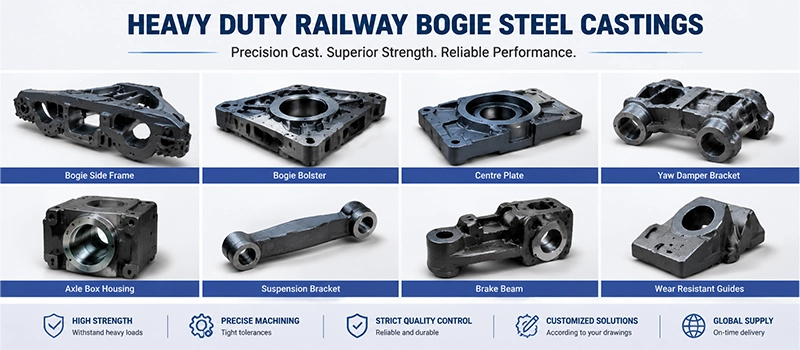
Heavy duty railway bogie steel castings include various structural components that are designed to support railway vehicles and maintain stable operation under heavy loads. Different cast steel components perform different functions within the bogie system, and each part requires suitable structural design and manufacturing accuracy.
Depending on the railway vehicle type and operating requirements, heavy duty railway bogie steel castings can include frames, side structures, support components, and other customized cast parts. These components work together to provide a strong foundation for the railway system.
Bogie Frames
Bogie frames are one of the most important types of heavy duty railway bogie steel castings. They serve as the main structural support component that connects the wheel system, suspension system, and vehicle body.
Because the bogie frame carries significant loads during railway operation, it requires excellent structural stability and reliable strength. Steel casting allows manufacturers to produce large and complex frame structures with integrated designs that meet specific railway requirements.
Side Frames
Side frames are another important category of heavy duty railway bogie steel castings. They are positioned on both sides of the bogie structure and play a role in supporting and connecting different railway components.
These components must maintain accurate dimensions and stable structures to ensure proper interaction between the wheel assembly and the overall bogie system. Steel casting provides the flexibility needed to manufacture side frames with complex shapes and sufficient strength.
Suspension Support Components
Suspension-related components are also commonly produced as heavy duty railway bogie steel castings. These parts help connect suspension systems with the main bogie structure and contribute to stable vehicle movement.
Because suspension components experience repeated forces during operation, their structural design and casting quality are important for maintaining consistent railway performance.
Customized Railway Steel Casting Components
In addition to standard bogie components, many railway projects require customized heavy duty railway bogie steel castings based on specific vehicle designs and operating conditions.
Customized castings may include various brackets, connection parts, and structural supports. By using steel casting technology, manufacturers can produce components with unique geometries and specific functional requirements.
Different types of heavy duty railway bogie steel castings serve different structural purposes within railway systems. Through proper design and manufacturing, these steel components provide the necessary support and stability required for heavy-duty railway operations.
Materials Used for Heavy Duty Railway Bogie Steel Castings
Material selection is a key factor in the performance of heavy duty railway bogie steel castings. Since railway bogie components need to support heavy loads and maintain stable operation under continuous mechanical stress, the selected steel material must provide suitable strength, toughness, and durability.
Different railway applications may require different steel grades depending on operating conditions, component design, and performance requirements. The most commonly used materials for heavy duty railway bogie steel castings include carbon steel, low alloy steel, and other specially developed steel alloys.
Carbon Steel Castings
Carbon steel is one of the commonly used materials for heavy duty railway bogie steel castings because it provides a good balance between strength, toughness, and cost efficiency.
Carbon steel castings are suitable for structural railway components that require reliable load-bearing performance. The material provides sufficient mechanical strength to support heavy railway applications while maintaining good manufacturability during the casting process.
The main characteristics of carbon steel include:
- Good structural strength
- Reliable toughness
- Stable casting performance
- Cost-effective material selection
These characteristics make carbon steel a practical option for many heavy duty railway bogie steel castings.
Low Alloy Steel Castings
Low alloy steel is another important material choice for heavy duty railway bogie steel castings. By adding alloying elements such as chromium, nickel, or molybdenum, low alloy steel can achieve improved mechanical properties compared with standard carbon steel.
Low alloy steel castings are often selected when railway components require enhanced strength and better resistance to repeated mechanical loads.
The advantages of low alloy steel include:
- Higher strength performance
- Improved toughness
- Better fatigue resistance
- Enhanced service reliability
For heavy-duty railway applications, low alloy steel provides additional performance benefits where higher mechanical requirements are needed.
Special Alloy Steel Castings
In certain railway applications, special alloy steels may be used for heavy duty railway bogie steel castings to meet specific performance requirements.
These materials are developed to provide improved characteristics such as:
- Higher wear resistance
- Better impact performance
- Improved durability under demanding conditions
Special alloy steel castings can be selected for railway components that require additional performance beyond standard steel grades.
Manufacturing Process of Heavy Duty Railway Bogie Steel Castings
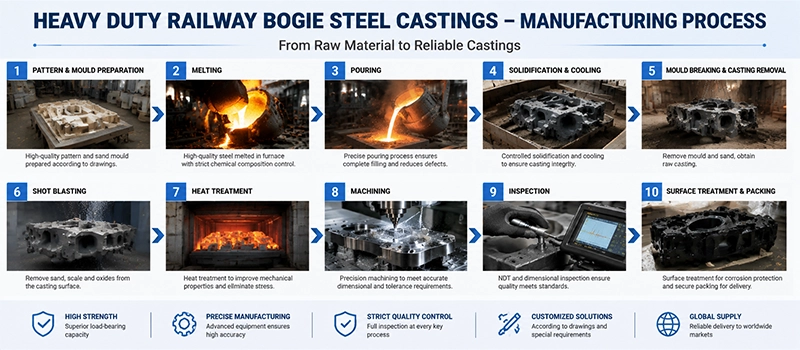
The manufacturing process of heavy duty railway bogie steel castings requires precise control throughout every production stage to achieve the required structural strength, dimensional accuracy, and reliability. Since railway bogie components are safety-related parts, each step from engineering design to final finishing plays an important role in determining the quality of the finished casting.
Compared with ordinary steel components, heavy duty railway bogie steel castings often have larger sizes, more complex structures, and stricter performance requirements. Therefore, manufacturers need to carefully control casting parameters and production processes to ensure consistent quality.
Engineering Design and Casting Analysis
The production of heavy duty railway bogie steel castings begins with engineering design review and casting analysis. Before manufacturing starts, engineers evaluate component drawings, 3D models, structural requirements, and production feasibility.
During this stage, manufacturers analyze factors such as:
- Component structure
- Wall thickness distribution
- Casting accessibility
- Machining allowance
- Potential defect risks
Proper design analysis helps optimize the casting structure and improves the possibility of achieving stable production results.
Pattern and Mold Production
After design confirmation, manufacturers prepare the required patterns and molds for producing heavy duty railway bogie steel castings.
The pattern represents the shape of the final component and is used to create the mold cavity. Accurate pattern production is essential because any dimensional deviation may affect the final casting.
For large railway components, mold design must consider factors such as metal flow, solidification behavior, and structural stability. A properly designed mold helps manufacturers produce steel castings with consistent dimensions and reliable internal structures.
Steel Melting and Pouring
Steel melting and pouring are critical stages in manufacturing heavy duty railway bogie steel castings. During this process, selected steel materials are melted and poured into prepared molds to form the required components.
Manufacturers carefully control:
- Steel composition
- Melting temperature
- Pouring temperature
- Metal cleanliness
Proper control of these factors helps reduce casting defects and ensures that the finished steel castings achieve the expected mechanical properties.
Heat Treatment
After casting, heat treatment is commonly applied to improve the performance of heavy duty railway bogie steel castings.
Heat treatment can help optimize:
- Strength
- Toughness
- Internal stress distribution
- Structural stability
Because railway bogie components experience repeated mechanical loading during operation, appropriate heat treatment is important for improving long-term reliability.
Machining and Surface Finishing
After heat treatment, heavy duty railway bogie steel castings may undergo machining and surface finishing processes to achieve the required dimensions and functional requirements.
Machining operations can include:
- Precision cutting
- Drilling
- Surface processing
- Dimensional adjustment
These processes ensure that the final components match engineering drawings and can be properly assembled into railway bogie systems.
Through controlled manufacturing processes, heavy duty railway bogie steel castings can achieve the required combination of strength, accuracy, and durability. A complete production process ensures that these critical railway components meet demanding industrial requirements before being delivered for service.
Quality Control for Heavy Duty Railway Bogie Steel Castings
Quality control is a critical part of producing heavy duty railway bogie steel castings because these components are directly related to railway safety, structural stability, and long-term operating performance. Since railway bogie parts must withstand continuous loading, vibration, and mechanical stress, manufacturers need to ensure that every casting meets strict technical requirements before use.
A comprehensive quality control system for heavy duty railway bogie steel castings includes material verification, dimensional inspection, mechanical testing, and defect detection. These inspection procedures help manufacturers confirm that the castings have the required strength, accuracy, and structural integrity.
Chemical Composition Testing
Material consistency is an essential requirement for heavy duty railway bogie steel castings. The chemical composition of steel directly affects the mechanical properties and overall performance of the finished components.
During production, manufacturers analyze the steel composition to verify that the selected material meets the required specifications. This process helps ensure that alloy elements are controlled within acceptable ranges and that the casting achieves the expected performance characteristics.
Chemical composition testing helps identify potential material variations and provides confidence that heavy duty railway bogie steel castings are produced with stable steel quality.
Mechanical Property Testing
Mechanical testing is used to evaluate whether heavy duty railway bogie steel castings can withstand the loads and stresses experienced during railway operation.
Common mechanical tests include:
- Tensile strength testing
- Yield strength testing
- Impact testing
- Hardness testing
These tests provide important information about the strength, toughness, and durability of steel castings. By verifying mechanical properties, manufacturers can ensure that the components meet the required performance standards.
Non-Destructive Testing (NDT)
Non-destructive testing is an important inspection method for identifying internal and surface defects in heavy duty railway bogie steel castings without damaging the components.
Common NDT methods include:
- Ultrasonic Testing (UT)
- Magnetic Particle Testing (MT)
- Radiographic Testing (RT)
These inspection methods help detect potential issues such as cracks, inclusions, and internal discontinuities that may affect component reliability.
For heavy duty railway bogie steel castings, NDT provides additional assurance that the internal structure of the casting meets quality requirements.
Dimensional Inspection
Dimensional accuracy is another important quality requirement for heavy duty railway bogie steel castings. Accurate dimensions ensure that components can be correctly assembled and function properly within the railway bogie system.
Manufacturers use inspection equipment to verify:
- Overall dimensions
- Critical tolerances
- Machined surfaces
- Assembly positions
Through dimensional inspection, manufacturers can identify deviations early and ensure that the final castings match engineering drawings.
Quality Documentation and Traceability
Reliable quality management also requires complete production records and inspection documentation. Quality documents provide evidence that heavy duty railway bogie steel castings have been manufactured and tested according to required specifications.
Documentation may include:
- Material test reports
- Inspection records
- Testing results
- Production records
Traceability helps manufacturers maintain consistent quality control and allows customers to verify the reliability of railway steel castings throughout the supply chain.
Through strict quality control procedures, heavy duty railway bogie steel castings can achieve the strength, accuracy, and reliability required for demanding railway applications. A systematic inspection process ensures that these critical components provide stable performance throughout their service life.
Common Defects in Heavy Duty Railway Bogie Steel Castings and Prevention
Heavy duty railway bogie steel castings require strict manufacturing control because even small casting defects may affect the structural performance and service reliability of railway components. During the casting process, factors such as molten steel quality, mold design, pouring conditions, and solidification control can influence the final quality of the castings.
Understanding common defects in heavy duty railway bogie steel castings helps manufacturers improve production processes and reduce potential risks. Through proper process optimization and inspection methods, many casting issues can be prevented before the components enter service.
Porosity Defects
Porosity is one of the common defects found in steel castings. It refers to small cavities or voids formed inside the casting due to trapped gases or insufficient metal feeding during solidification.
For heavy duty railway bogie steel castings, internal porosity may reduce the effective strength of the component and affect its long-term reliability under repeated loading conditions.
Common causes of porosity include:
- Excessive gas in molten steel
- Poor mold permeability
- Improper pouring conditions
- Incomplete feeding during solidification
To reduce porosity risks, manufacturers need to control molten steel quality, optimize mold design, and improve pouring processes.
Shrinkage Defects
Shrinkage defects occur when molten steel contracts during cooling and solidification without sufficient liquid metal supply to fill the shrinking area.
Because heavy duty railway bogie steel castings are often large structural components, controlling solidification behavior is especially important.
Shrinkage defects may affect:
- Internal structural integrity
- Mechanical properties
- Component reliability
Manufacturers can reduce shrinkage problems through improved casting design, proper feeding systems, and optimized solidification control.
Cracks
Cracks are another potential issue in heavy duty railway bogie steel castings. They may occur during cooling, heat treatment, or when internal stresses exceed the material’s ability to withstand deformation.
Common causes of cracks include:
- Uneven cooling
- Excessive thermal stress
- Improper heat treatment
- Structural stress concentration
Preventing cracks requires careful control of casting parameters, cooling conditions, and heat treatment processes.
Inclusions
Inclusions refer to unwanted non-metallic materials trapped inside the steel casting during manufacturing. These defects may affect the uniformity and mechanical performance of heavy duty railway bogie steel castings.
Possible sources of inclusions include:
- Impurities in molten steel
- Improper melting control
- Mold-related contamination
Manufacturers reduce inclusion risks through proper steel cleaning, melting control, and inspection procedures.
Misruns and Incomplete Filling
Misruns occur when molten steel fails to completely fill the mold cavity before solidification. This can result in incomplete shapes or missing sections in the final casting.
For heavy duty railway bogie steel castings with complex structures, proper metal flow control is essential to prevent incomplete filling.
Solutions may include:
- Optimizing pouring temperature
- Improving mold design
- Adjusting pouring methods
Importance of Defect Prevention
Preventing defects in heavy duty railway bogie steel castings requires a combination of engineering analysis, production control, and inspection technology. By improving casting design, controlling manufacturing parameters, and applying effective testing methods, manufacturers can produce more reliable railway components.
A systematic approach to defect prevention helps ensure that heavy duty railway bogie steel castings achieve the required strength, durability, and performance for demanding railway applications.
Applications of Heavy Duty Railway Bogie Steel Castings
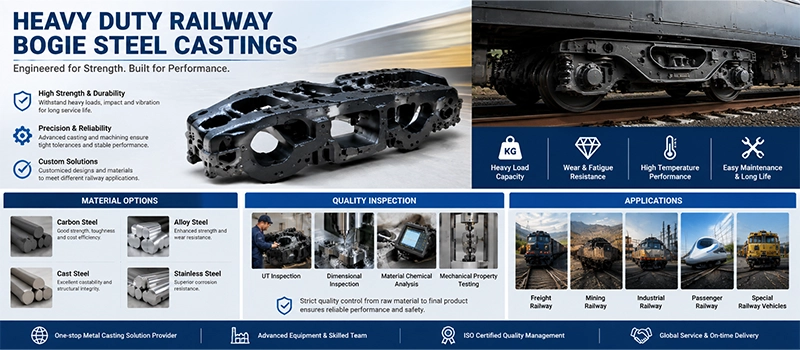
Heavy duty railway bogie steel castings are widely used in different railway transportation systems where components must provide reliable structural support and maintain stable performance under demanding operating conditions. As important structural parts of railway vehicles, these steel castings are designed to meet the requirements of different railway applications, including heavy freight transportation, industrial rail systems, and specialized railway equipment.
The use of heavy duty railway bogie steel castings allows railway manufacturers to develop durable bogie structures that can support various vehicle designs. Depending on the application, different bogie components may require specific designs, dimensions, and performance characteristics.
Freight Railway Transportation
Freight railway systems are one of the most important application areas for heavy duty railway bogie steel castings. Freight trains often carry large amounts of cargo and operate under high axle loads, requiring bogie components with strong structural capability.
Heavy duty railway bogie steel castings used in freight railway applications help support the weight of railway vehicles and maintain stable movement during transportation. Their strong structural characteristics make them suitable for heavy-load railway environments where reliability and durability are essential.
Mining Railway Systems
Mining operations often use specialized railway systems to transport raw materials and heavy equipment. These railway vehicles usually operate in challenging environments with continuous loading, vibration, and demanding working conditions.
Heavy duty railway bogie steel castings provide the necessary structural support for mining railway equipment. Their robust design helps railway vehicles handle heavy transportation tasks while maintaining dependable performance during long-term operation.
Industrial Railway Equipment
Many industrial facilities use internal railway transportation systems for moving materials, components, and heavy products. These systems require customized railway components that can adapt to specific operating environments.
Heavy duty railway bogie steel castings are suitable for industrial railway equipment because they can be manufactured according to different structural requirements. Customized cast steel components help ensure that railway vehicles can operate efficiently within factories, ports, and other industrial areas.
Passenger Railway Applications
Although passenger railway systems often focus on comfort and speed, the bogie structure remains an important part of vehicle stability and safety. Reliable components are required to support the vehicle body and maintain smooth operation.
Heavy duty railway bogie steel castings can also be applied in passenger railway systems where strong structural components are required. Properly designed steel castings contribute to the overall stability and reliability of railway vehicles.
Customized Railway Component Development
Different railway projects may require specially designed components based on vehicle structure, operating conditions, and technical requirements. Heavy duty railway bogie steel castings provide flexibility for customized manufacturing because casting processes can produce complex shapes and integrated structures.
Customized railway castings can be developed for:
- Special railway vehicles
- Industrial transportation systems
- Heavy-load railway equipment
- Unique bogie designs
Through customized manufacturing, heavy duty railway bogie steel castings can meet specific engineering requirements and support the development of various railway transportation solutions.
Overall, heavy duty railway bogie steel castings play an important role across multiple railway applications. Their ability to provide strong structural support, design flexibility, and reliable performance makes them a valuable solution for modern railway component manufacturing.
Why Choose Dalian Zhongsheng for Heavy Duty Railway Bogie Steel Castings
Selecting a reliable manufacturer is important for producing heavy duty railway bogie steel castings because these components require stable quality, accurate manufacturing, and consistent performance. Railway steel castings are not ordinary industrial parts. They must meet strict structural requirements and maintain reliability during long-term operation.
Dalian Zhongsheng Metal Product Co., Ltd. provides customized steel casting solutions for customers requiring complex and durable metal components. With professional casting experience, machining capabilities, and quality control procedures, the company supports the development and production of heavy duty railway bogie steel castings according to customer requirements.
Experience in Custom Steel Casting Manufacturing
Heavy duty railway bogie steel castings involve complex structures and strict performance requirements. Successful production requires experience in casting design, material selection, process control, and defect prevention.
Dalian Zhongsheng Metal Product Co., Ltd. has experience in manufacturing customized steel components based on customer drawings and technical specifications. The engineering team can evaluate component designs, analyze manufacturing feasibility, and provide suitable production solutions.
This experience helps ensure that heavy duty railway bogie steel castings can be produced with stable quality and consistent performance.
One-Stop Manufacturing Capability
A complete manufacturing process is important for producing reliable railway steel castings. Dalian Zhongsheng Metal Product Co., Ltd. provides integrated manufacturing services to support customers from casting production to finished components.
The company’s capabilities include:
- Steel casting production
- CNC machining
- Heat treatment
- Surface finishing
- Quality inspection
This integrated approach helps improve production efficiency and provides better control over product quality throughout the manufacturing process.
Advanced Quality Control System
Quality control is a key requirement for heavy duty railway bogie steel castings. Dalian Zhongsheng Metal Product Co., Ltd. applies inspection procedures throughout production to verify material quality, dimensional accuracy, and structural performance.
Quality control processes may include:
- Material composition analysis
- Mechanical property testing
- Dimensional inspection
- Non-destructive testing
Through systematic quality management, the company helps ensure that manufactured steel castings meet customer expectations for reliability and durability.
Customized Solutions for Railway Components
Different railway projects may require different component designs, dimensions, and performance requirements. Standard products may not always meet the needs of specialized railway equipment.
Dalian Zhongsheng Metal Product Co., Ltd. provides customized manufacturing solutions based on:
- Customer drawings
- 3D models
- Material requirements
- Technical specifications
- Inspection standards
This flexible approach allows customers to develop heavy duty railway bogie steel castings that match their specific application requirements.
Supporting Prototype Development and Mass Production
The development of heavy duty railway components often requires both prototype verification and long-term production support. A capable manufacturer should be able to support different project stages.
Dalian Zhongsheng Metal Product Co., Ltd. provides support from initial component development to batch production. This allows customers to work with one experienced manufacturing partner throughout the product lifecycle.
By combining casting expertise, manufacturing capabilities, and quality management, Dalian Zhongsheng Metal Product Co., Ltd. provides reliable solutions for customers seeking heavy duty railway bogie steel castings with consistent quality and dependable performance.
Conclusion
Heavy duty railway bogie steel castings are essential structural components that support the safe and stable operation of modern railway systems. Their excellent strength, structural flexibility, and durability make them suitable for demanding railway applications that require reliable performance under heavy loads and continuous operation.
From material selection and casting processes to quality inspection and customized manufacturing, every stage influences the final performance of railway steel castings. Professional manufacturing capabilities and strict quality control are important factors in producing dependable heavy duty railway bogie steel castings.
Dalian Zhongsheng Metal Product Co., Ltd. provides customized steel casting solutions with integrated manufacturing capabilities, helping customers develop high-quality railway components that meet complex industrial requirements.