Rapid prototyping for steel castings provides an efficient way for engineers to develop, test, and improve steel components before full-scale production. By creating functional prototypes earlier in the development process, manufacturers can verify designs, identify potential issues, and reduce production risks. This approach is especially valuable for complex steel castings that require high strength, precision, and reliable performance in industrial applications.
What Is Rapid Prototyping for Steel Castings?
Rapid prototyping for steel castings is a manufacturing approach that allows engineers and manufacturers to quickly develop, test, and evaluate steel casting designs before moving into full-scale production. Instead of directly starting with mass production, rapid prototyping creates an early-stage physical component that can be used to verify design accuracy, material selection, structural performance, and manufacturing feasibility.
Steel castings are widely used in industries that require high strength, durability, and reliable performance, including industrial equipment, automotive systems, mining machinery, valves, pumps, and construction applications. However, developing a new steel casting traditionally involves multiple stages, including tooling preparation, mold development, casting trials, and design adjustments. These steps may require significant time and investment, especially when dealing with complex components.
Rapid prototyping for steel castings helps shorten this development cycle by providing a faster way to transform digital designs into physical metal components. Through technologies such as 3D printed patterns, rapid tooling, CNC machining, and advanced casting methods, manufacturers can produce prototype castings without immediately committing to expensive large-scale production processes.
The main purpose of rapid prototyping is not only to create a sample part but also to validate the complete design concept. Engineers can evaluate whether the component structure is suitable, whether the dimensions meet requirements, and whether the selected steel material can achieve the expected performance.
For steel casting applications, prototype development is particularly valuable because steel components often operate under demanding conditions. Factors such as mechanical loads, impact resistance, temperature changes, and corrosion exposure must be considered before production. A prototype allows manufacturers and customers to identify potential issues at an early stage and make necessary improvements before final manufacturing.
Rapid prototyping for steel castings provides greater flexibility during product development. Design modifications can be tested more efficiently, helping companies reduce development risks while improving the final quality of the finished casting. This makes rapid prototyping an important solution for modern industries that require customized steel components with shorter development cycles and reliable performance.
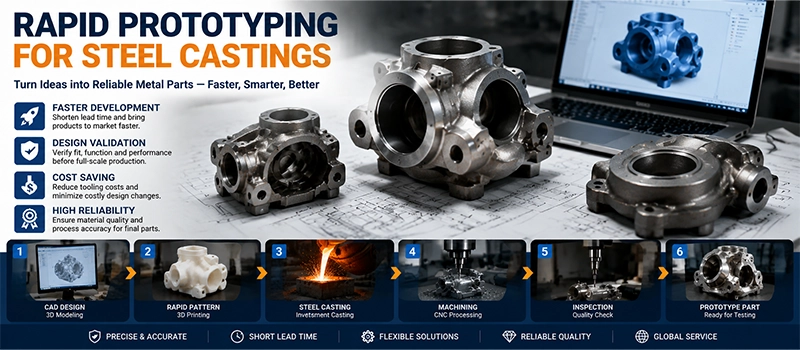
Why Rapid Prototyping Is Important for Steel Castings
Rapid prototyping for steel castings has become an important approach for manufacturers developing new components that require high strength, complex structures, and reliable performance. Compared with traditional product development methods, rapid prototyping allows engineers to evaluate designs earlier, optimize manufacturing processes, and reduce potential risks before entering full production.
For steel castings, the development stage is especially important because casting defects, structural problems, or design limitations may become costly to correct after mass production begins. By creating and testing prototypes at an early stage, manufacturers can improve product reliability while shortening the overall development cycle.
Reduce Product Development Time
One of the biggest advantages of rapid prototyping for steel castings is the ability to significantly reduce development time. Traditional steel casting projects may require extensive preparation, including tooling production, mold adjustments, and multiple trial castings before achieving the desired result.
Rapid prototyping provides a faster way to evaluate designs by producing initial samples earlier in the process. Engineers can quickly review the physical component, compare it with the original CAD model, and make necessary adjustments before committing to final production.
This faster feedback cycle helps companies accelerate new product development and bring improved components to the market more efficiently.
Identify Design Problems Early
Complex steel castings often involve challenging geometries, uneven wall thicknesses, internal structures, and strict dimensional requirements. Problems that are not identified during the design stage may lead to casting difficulties, additional machining costs, or reduced product performance.
Rapid prototyping for steel castings allows engineers to physically evaluate the design before large-scale manufacturing. Prototype testing can reveal potential issues such as:
- Difficult casting areas
- Incorrect component dimensions
- Insufficient structural strength
- Machining challenges
- Assembly problems
By identifying these issues early, manufacturers can optimize the design and improve the manufacturability of the final steel casting.
Reduce Manufacturing Risks and Costs
Developing new steel castings involves investment in tooling, production preparation, and process optimization. If design problems are discovered after production begins, companies may face additional costs caused by tooling modifications, production delays, and material waste.
Rapid prototyping helps reduce these risks by allowing manufacturers to verify important design factors before full production. Prototype components provide valuable information about casting behavior, material performance, and required manufacturing adjustments.
For customized steel components, this approach creates a more controlled development process. Customers can confirm the design direction, evaluate performance requirements, and make improvements before placing larger production orders.
Improve Communication Between Engineers and Manufacturers
Another important benefit of rapid prototyping for steel castings is improved communication between product designers and manufacturing teams. A physical prototype provides a clearer understanding of the final component compared with drawings or digital models alone.
Engineers, designers, and casting specialists can review the prototype together, discuss possible improvements, and make decisions based on an actual component. This collaboration helps reduce misunderstandings and creates a smoother transition from product concept to final manufacturing.
Through faster validation, better design communication, and reduced development uncertainty, rapid prototyping provides an effective solution for companies developing high-performance steel casting components.
Common Rapid Prototyping Methods for Steel Castings
Rapid prototyping for steel castings includes several manufacturing approaches that help engineers create functional prototype components before full-scale production. Different methods are selected according to factors such as component complexity, required accuracy, production quantity, development stage, and final application requirements.
For steel casting projects, the most suitable rapid prototyping method depends on whether the goal is design verification, performance testing, material evaluation, or preparation for mass production. By choosing the right prototyping technology, manufacturers can shorten development cycles while maintaining the reliability expected from steel components.
3D Printed Patterns for Investment Casting
3D printed patterns are one of the most efficient approaches used in rapid prototyping for steel castings, especially for components with complex geometries and customized designs.
Traditional investment casting usually requires dedicated tooling to produce wax patterns. However, rapid prototyping for steel castings can use 3D printing technology to create resin patterns directly from digital CAD models. This eliminates or reduces the need for expensive tooling during the early development stage.
The main advantages of 3D printed patterns include:
- Faster prototype production
- Lower initial tooling investment
- Ability to create complex structures
- Easy design modification
For companies developing new steel components, this method allows engineers to quickly evaluate the actual casting shape and make improvements before entering production.
CNC Machined Steel Prototypes
CNC machining is another commonly used method in rapid prototyping for steel castings. Instead of producing a casting directly, engineers can machine a prototype component from a solid steel block to verify dimensions, assembly requirements, and functional performance.
CNC machined prototypes provide excellent dimensional accuracy and are suitable for applications where engineers need to test the physical behavior of a component before developing casting processes.
Advantages of CNC machined steel prototypes include:
- High dimensional precision
- Fast production for simple geometries
- Suitable for functional testing
- Direct use of production-grade materials
However, CNC machining may become less economical for highly complex geometries because large amounts of material may need to be removed during manufacturing.
Sand Casting Prototypes
Sand casting can also be used for rapid prototyping for steel castings, especially when larger components or early-stage design validation are required.
Compared with traditional permanent tooling methods, sand casting prototypes generally require shorter preparation time and lower tooling costs. This makes the process suitable for larger steel components where rapid evaluation is more important than achieving final production-level surface finish.
Sand casting prototypes can help engineers evaluate:
- Component size and structure
- Basic mechanical performance
- Manufacturing feasibility
- Assembly compatibility
Although the surface finish and dimensional accuracy may differ from investment casting, sand casting remains a practical solution for certain prototype applications.
Rapid Investment Casting
Rapid investment casting is one of the most closely related methods to rapid prototyping for steel castings because it combines the advantages of investment casting with faster prototype development.
In this process, manufacturers often use 3D printed patterns or other rapid pattern technologies to create the investment mold without producing traditional tooling first.
This approach is particularly suitable for:
- Complex steel components
- Low-volume prototype production
- Customized industrial parts
- Design verification before mass production
Rapid investment casting allows engineers to test real cast metal components rather than plastic or machined substitutes. This provides more accurate information about casting performance, material behavior, and final product quality.
Materials Used in Rapid Prototyping for Steel Castings
Material selection is a critical factor in rapid prototyping for steel castings because prototype components are often used to evaluate real performance before final production. Unlike plastic prototypes or non-metallic models, steel casting prototypes must demonstrate the actual mechanical behavior, strength, durability, and operating characteristics required for the final application.
Different steel alloys provide different performance advantages. The choice of material depends on factors such as working environment, mechanical loads, corrosion exposure, temperature conditions, and required service life. By selecting the appropriate steel grade during the prototype stage, engineers can obtain more accurate validation results and reduce potential risks before mass production.
Stainless Steel Prototype Castings
Stainless steel is one of the most commonly used materials in rapid prototyping for steel castings because of its excellent corrosion resistance, mechanical performance, and wide range of industrial applications.
Common stainless steel grades used for prototype castings include:
- 304 stainless steel
- 304L stainless steel
- 316 stainless steel
- 316L stainless steel
304 and 304L stainless steel provide good corrosion resistance and reliable mechanical properties, making them suitable for general industrial components and equipment parts.
316 and 316L stainless steel offer improved corrosion resistance due to the addition of molybdenum. These materials are often selected for applications involving chemicals, saltwater environments, and other corrosive conditions.
Using stainless steel in rapid prototyping for steel castings allows engineers to test components under conditions closer to actual production environments. This helps verify whether the selected material can meet performance expectations before large-scale manufacturing begins.
Carbon Steel Prototype Castings
Carbon steel is another important material option for rapid prototyping for steel castings, especially when high strength, toughness, and cost efficiency are required.
Carbon steel prototype castings are commonly used for components that experience mechanical loads, impact forces, or heavy-duty operating conditions. These materials provide excellent structural performance and are widely applied in industrial machinery, construction equipment, and transportation-related components.
The main advantages of carbon steel include:
- High mechanical strength
- Good toughness
- Reliable performance under stress
- Cost-effective material selection
During the prototype development stage, carbon steel allows engineers to evaluate the actual strength and durability of a component using the same material characteristics expected in final production.
Alloy Steel Prototype Castings
Alloy steel provides enhanced performance through the addition of alloying elements such as chromium, nickel, and molybdenum. These elements improve specific properties, including wear resistance, toughness, and high-temperature performance.
For demanding applications, rapid prototyping for steel castings using alloy steel helps manufacturers evaluate components that require higher mechanical performance.
Common applications include:
- Heavy industrial equipment
- Mining machinery components
- High-load mechanical parts
- Specialized engineering components
Alloy steel prototypes provide valuable information about how the final component will perform under challenging operating conditions.
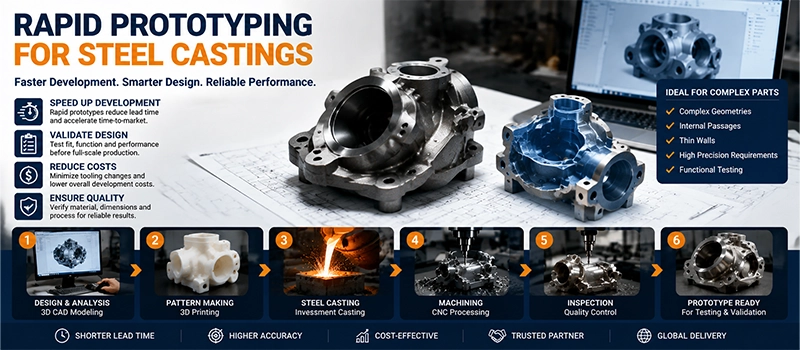
Rapid Prototyping Process for Steel Castings
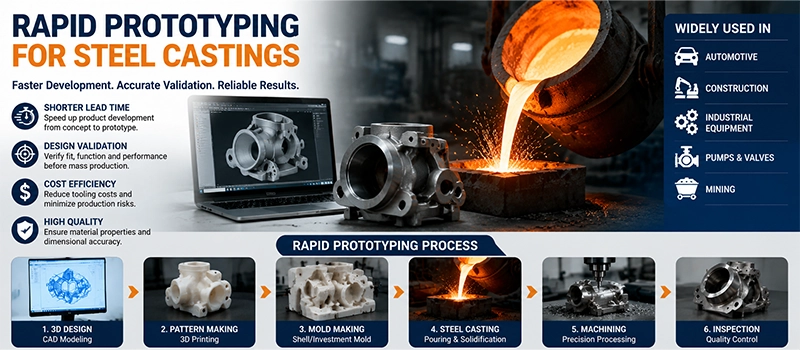
The process of rapid prototyping for steel castings involves multiple carefully controlled stages, from initial design evaluation to final prototype inspection. Unlike traditional product development methods that may require long preparation cycles, rapid prototyping focuses on creating a faster connection between digital design concepts and physical steel components.
A successful prototype development process requires cooperation between engineering teams and casting specialists. By evaluating design feasibility, selecting suitable manufacturing methods, and performing necessary inspections, manufacturers can ensure that prototype steel castings provide valuable information before moving into production.
Step 1: Design Review and Engineering Analysis
The first stage of rapid prototyping for steel castings begins with a detailed review of the component design. Engineers analyze customer drawings, 3D CAD models, material requirements, and application conditions to determine whether the design is suitable for casting.
During this stage, manufacturers evaluate important factors such as:
- Component geometry
- Wall thickness distribution
- Draft requirements
- Machining allowances
- Potential casting challenges
Engineering analysis helps identify possible issues before prototype production begins. For example, complex structures may require adjustments to improve metal flow, reduce shrinkage risks, or improve overall casting quality.
Early design evaluation is valuable because modifications at the prototype stage are usually faster and more cost-effective than changes after production tooling has been completed.
Step 2: Prototype Pattern Production
After design approval, the next stage is creating the pattern or prototype model required for steel casting production.
Depending on project requirements, manufacturers may use different methods, including:
- 3D printed patterns
- CNC machined patterns
- Rapid tooling solutions
For investment casting applications, 3D printed patterns are often used because they can be produced quickly from digital models without requiring traditional tooling.
This flexibility makes rapid prototyping for steel castings especially suitable for customized components, new product development, and low-volume production projects.
Step 3: Steel Casting Production
Once the prototype pattern is prepared, the casting process begins. The pattern is used to create the mold, and molten steel is poured into the mold cavity to form the required component.
During this stage, manufacturers carefully control:
- Steel alloy composition
- Melting temperature
- Pouring conditions
- Solidification process
Proper process control is essential because steel casting performance depends heavily on material quality and manufacturing stability.
For rapid prototyping for steel castings, the goal is not only to create a physical sample but also to produce a prototype that accurately represents the expected production component.
Step 4: Finishing and Machining
After casting, prototype components usually require finishing operations to achieve the required specifications.
Common finishing processes include:
- Surface cleaning
- Grinding
- Heat treatment
- CNC machining
- Surface treatment
Machining is especially important when prototype components require precise assembly dimensions or functional testing.
Through finishing and machining, manufacturers can transform initial castings into fully functional prototype parts suitable for evaluation.
Step 5: Inspection and Performance Evaluation
The final stage of rapid prototyping for steel castings is inspection and evaluation. Prototype components are tested to confirm whether they meet design requirements and expected performance standards.
Inspection methods may include:
- Dimensional measurement
- Material testing
- Surface inspection
- Non-destructive testing
- Functional testing
These inspection results provide valuable feedback for improving the final production design.
If any issues are identified, engineers can adjust the design, manufacturing process, or material selection before moving into larger-scale production.
Applications of Rapid Prototyping for Steel Castings
Rapid prototyping for steel castings is widely used across industries where companies need to develop, test, and improve metal components before full-scale manufacturing. Steel castings are often selected for applications that require high strength, impact resistance, durability, and reliable performance under demanding conditions.
By using rapid prototyping for steel castings, manufacturers and engineers can evaluate real metal components at an early development stage instead of relying only on digital models or simulations. This approach helps verify product designs, improve manufacturing processes, and accelerate the transition from concept development to final production.
Automotive Components
The automotive industry frequently requires customized steel components that must provide excellent mechanical performance and long service life. Before mass production, manufacturers often need to verify component structures, assembly accuracy, and material performance.
Rapid prototyping for steel castings allows automotive engineers to test prototype components before investing in large-scale production. This is especially valuable for newly developed vehicle systems or customized parts that require design optimization.
Common automotive steel casting prototypes include:
- Structural components
- Transmission parts
- Brackets and supports
- Heavy-duty mechanical components
By producing and evaluating prototypes earlier, automotive manufacturers can identify potential design issues and improve component reliability before production begins.
Industrial Equipment Components
Industrial machinery often relies on steel components that must operate continuously under heavy loads and challenging environments. Equipment manufacturers frequently require customized parts that are not available as standard products.
Rapid prototyping for steel castings provides an efficient solution for developing these specialized components. Engineers can test prototype parts, verify installation requirements, and optimize designs before moving into larger production quantities.
Typical industrial applications include:
- Machine frames
- Mechanical housings
- Connecting components
- Wear-resistant parts
- Custom equipment components
For industrial equipment manufacturers, rapid prototyping reduces development risks and helps create components that better match specific operating requirements.
Valve and Pump Components
Valve and pump systems require components with excellent dimensional accuracy, pressure resistance, and structural reliability. Any design issues may affect sealing performance, fluid control efficiency, and operational safety.
Rapid prototyping for steel castings is valuable for developing customized valve and pump components because it allows engineers to evaluate actual steel parts before final production.
Common prototype components include:
- Valve bodies
- Pump housings
- Impellers
- Flow control components
- Connection parts
Through prototype testing, manufacturers can verify component geometry, improve flow performance, and confirm whether the selected steel material meets application requirements.
Mining and Construction Equipment
Mining and construction industries operate in some of the most demanding environments. Equipment components must withstand impact, vibration, abrasion, and heavy mechanical loads.
Rapid prototyping for steel castings helps manufacturers develop stronger and more reliable components for heavy-duty equipment. Before committing to production, engineers can test prototype parts and make improvements based on actual performance feedback.
Applications include:
- Excavator components
- Mining machinery parts
- Heavy equipment brackets
- Wear-resistant steel components
This development approach helps reduce equipment downtime and improves the service life of critical components.
Energy and Industrial Processing Equipment
Energy and industrial processing applications often require steel castings that can withstand high temperatures, pressure, and corrosive environments. Developing these components requires careful validation of material selection and structural design.
Rapid prototyping for steel castings allows engineers to evaluate new component designs and confirm their suitability before entering production.
Typical applications include:
- Power generation equipment
- Chemical processing components
- Petrochemical machinery
- Industrial control systems
By supporting faster testing and design improvements, rapid prototyping helps manufacturers create steel components that meet demanding performance requirements.
Supporting Customized Product Development
One of the greatest advantages of rapid prototyping for steel castings is its ability to support customized manufacturing. Many industrial customers require unique components based on specific equipment designs, operating conditions, or performance requirements.
Instead of developing expensive tooling immediately, companies can use prototype production to verify their designs first. This makes the development process more flexible and reduces the risks associated with new steel casting projects.
Through applications across automotive, industrial equipment, energy, mining, and other sectors, rapid prototyping for steel castings has become an effective method for accelerating innovation and improving the reliability of customized steel components.
Quality Control for Rapid Prototyping Steel Castings
Quality control is a critical stage in rapid prototyping for steel castings because prototype components are not only used to verify appearance and dimensions but also to evaluate whether the final production design can meet performance requirements.
Unlike simple prototype models made from plastic or other materials, steel casting prototypes need to represent the actual characteristics of the final metal component. Therefore, inspection and testing procedures are essential to confirm material properties, structural integrity, dimensional accuracy, and manufacturing feasibility before moving into mass production.
Dimensional Inspection
Dimensional accuracy is one of the most important quality requirements in rapid prototyping for steel castings. Prototype components must match engineering drawings and CAD models to ensure that design concepts can be successfully transferred into final production.
During dimensional inspection, manufacturers verify:
- Overall component dimensions
- Critical tolerances
- Machining allowances
- Assembly features
- Geometric accuracy
Advanced measuring equipment, such as Coordinate Measuring Machines (CMM), can be used to inspect complex steel casting prototypes with high precision.
Accurate dimensional verification helps engineers identify design deviations at an early stage and make necessary adjustments before production tooling or large-scale manufacturing begins.
Material Testing and Verification
Material performance is a key factor in steel casting applications. A prototype made from the wrong material may provide inaccurate testing results and lead to incorrect production decisions.
Therefore, material verification is an important part of rapid prototyping for steel castings. Manufacturers may perform tests to confirm:
- Chemical composition
- Mechanical properties
- Hardness levels
- Heat treatment results
For example, stainless steel, carbon steel, and alloy steel prototypes may require different testing procedures to ensure they achieve the expected strength, corrosion resistance, and durability.
By verifying material properties during the prototype stage, manufacturers can reduce the risk of material-related problems in final production.
Non-Destructive Testing (NDT)
Non-destructive testing is commonly applied in rapid prototyping for steel castings to evaluate internal and surface quality without damaging the prototype component.
Depending on project requirements, inspection methods may include:
- Dye Penetrant Testing (PT)
- Magnetic Particle Testing (MT)
- Radiographic Testing (RT)
- Ultrasonic Testing (UT)
These methods help identify potential defects such as:
- Surface cracks
- Internal porosity
- Shrinkage cavities
- Inclusions
NDT provides valuable information about casting quality and helps engineers determine whether the prototype manufacturing process is suitable for future production.
Surface Quality Inspection
Surface condition is another important aspect of rapid prototyping for steel castings. The surface quality of a prototype can affect machining requirements, assembly performance, and final product appearance.
Surface inspection focuses on identifying:
- Surface cracks
- Rough areas
- Casting marks
- Incomplete filling
- Other visible defects
A high-quality prototype should not only demonstrate the correct design but also provide information about the expected surface condition of future production components.
Prototype Evaluation Before Mass Production
The ultimate purpose of quality control in rapid prototyping for steel castings is to provide reliable information before full production begins.
Through dimensional inspection, material verification, and defect detection, engineers can evaluate whether:
- The design is manufacturable
- The selected material is suitable
- The casting process is stable
- The component meets application requirements
This evaluation process helps companies make informed decisions and reduces the risks associated with developing new steel casting products.
By combining rapid manufacturing methods with strict inspection procedures, rapid prototyping for steel castings becomes more than a sample production process. It becomes an effective engineering tool for improving product reliability, optimizing designs, and achieving successful transition from prototype development to final production.
Why Choose Dalian Zhongsheng for Rapid Prototyping for Steel Castings
Choosing the right manufacturing partner is essential for companies developing new steel casting components. Rapid prototyping for steel castings is not only about producing a sample part quickly. It also requires engineering experience, casting knowledge, material understanding, and the ability to smoothly transfer prototype designs into stable production.
Dalian Zhongsheng Metal Product Co., Ltd. provides customized steel casting solutions by combining prototype development capabilities with professional casting experience. From initial design evaluation to final production support, the company helps customers reduce development risks and create reliable steel components for industrial applications.
Experience in Steel Casting Manufacturing
Steel casting development involves many technical challenges, including material selection, casting structure optimization, defect prevention, and dimensional control. A prototype supplier must understand not only how to produce a sample but also how to ensure that the prototype represents future production conditions.
With experience in metal casting manufacturing, Dalian Zhongsheng Metal Product Co., Ltd. supports customers in developing various customized steel components. The engineering team can review drawings, analyze casting feasibility, and provide suggestions to improve manufacturability before production begins.
This experience is especially valuable in rapid prototyping for steel castings because early-stage decisions often influence final product quality, cost efficiency, and production stability.
From Prototype Development to Production
One major advantage of working with an experienced casting manufacturer is the ability to support the complete product development process.
Rapid prototyping for steel castings is often the first step toward mass production. After prototype verification, customers usually need a supplier that can continue with production casting, machining, finishing, and quality inspection.
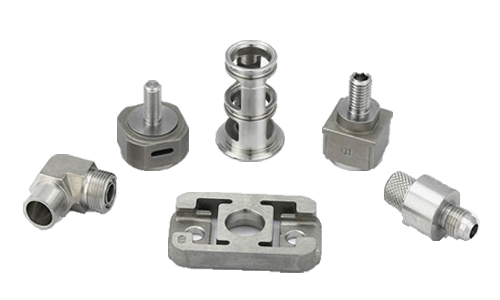
Dalian Zhongsheng Metal Product Co., Ltd. provides integrated manufacturing capabilities, including:
- Steel casting production
- Investment casting
- CNC machining
- Surface finishing
- Quality inspection
This complete manufacturing capability helps customers transition from prototype validation to production without changing suppliers, reducing communication difficulties and improving project efficiency.
Engineering Support for Customized Components
Every steel casting project has unique requirements. Component geometry, operating environment, material selection, and performance expectations can vary significantly between applications.
Professional engineering support is important during rapid prototyping for steel castings because design improvements made during the prototype stage can prevent future production problems.
Dalian Zhongsheng Metal Product Co., Ltd. works with customers to evaluate:
- CAD drawings and 3D models
- Material requirements
- Casting feasibility
- Manufacturing processes
- Inspection requirements
Through technical communication and engineering analysis, customers can develop more reliable steel casting designs before entering full production.
Flexible Solutions for Different Project Requirements
Different customers may require different prototype approaches. Some projects need a single prototype for design verification, while others require small-batch production before large-scale manufacturing.
Dalian Zhongsheng Metal Product Co., Ltd. provides flexible manufacturing solutions based on project requirements. Whether customers need customized prototypes, trial production, or continuous supply of steel casting components, the company can adjust production methods according to specific needs.
This flexibility makes rapid prototyping for steel castings more practical for companies developing new products or improving existing designs.
Commitment to Quality and Long-Term Cooperation
Quality consistency is essential throughout the entire development process. A prototype should not only confirm the shape of a component but also provide confidence that the final production process can achieve stable results.
By combining casting expertise, quality control procedures, and customer-focused engineering support, Dalian Zhongsheng Metal Product Co., Ltd. helps customers develop reliable steel casting solutions.
Through professional rapid prototyping for steel castings services, manufacturers can reduce development uncertainty, optimize product designs, and move toward successful production with greater confidence.
Conclusion
Rapid prototyping for steel castings provides an efficient approach for developing reliable steel components while reducing development time and production risks. By allowing engineers to evaluate designs, test materials, and optimize manufacturing processes before full-scale production, rapid prototyping helps create better-performing steel castings with greater confidence.
For complex industrial components, successful prototype development requires more than fast sample production. Professional engineering support, suitable material selection, precise casting technology, and strict quality control are all essential factors in achieving reliable results.
Dalian Zhongsheng Metal Product Co., Ltd. combines steel casting experience, customized manufacturing capabilities, and quality inspection procedures to support customers from prototype development to final production. Through rapid prototyping for steel castings, the company helps customers transform designs into dependable metal components for demanding industrial applications.