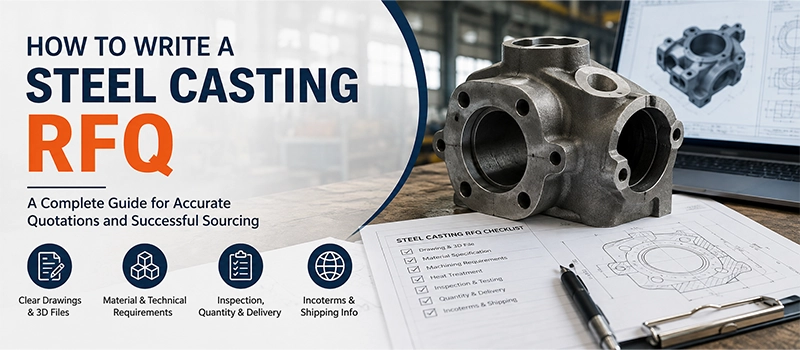
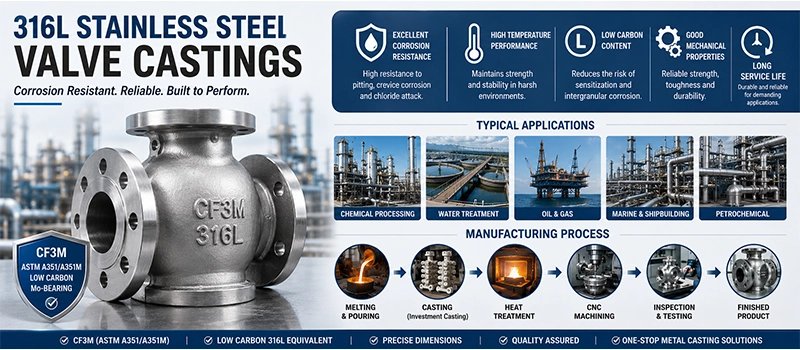
A well-written steel casting RFQ is the first step toward receiving an accurate quotation and ensuring a smooth manufacturing process. Missing or unclear information can lead to pricing errors, production delays, and unnecessary communication. This guide explains exactly what to include in a steel casting RFQ, helping buyers prepare clear quotation requests and improve sourcing efficiency for custom steel castings.
Prepare Complete Product Drawings
The first and most important step in writing a professional steel casting RFQ is providing complete product drawings. Regardless of the size or complexity of the project, manufacturers rely on technical drawings to evaluate production feasibility, estimate manufacturing costs, and prepare an accurate quotation. Without clear drawings, even an experienced supplier can only provide a rough estimate instead of a reliable quote.
A complete steel casting RFQ should always include engineering drawings that clearly define the product’s geometry, dimensions, and functional requirements. The more detailed the drawings are, the fewer questions the manufacturer needs to ask during the quotation process, which helps reduce communication time and speeds up project evaluation.
Include Both 2D Drawings and 3D Models
Whenever possible, a steel casting RFQ should contain both 2D engineering drawings and 3D CAD models.
The 2D drawing provides manufacturing specifications such as dimensions, tolerances, machining symbols, and technical notes, while the 3D model helps engineers better understand complex geometries and internal structures.
- PDF for engineering drawings
- STEP (.stp)
- IGES (.igs)
- Parasolid (.x_t)
Providing both types of files allows manufacturers to review the design more efficiently and identify potential production challenges before preparing a quotation.
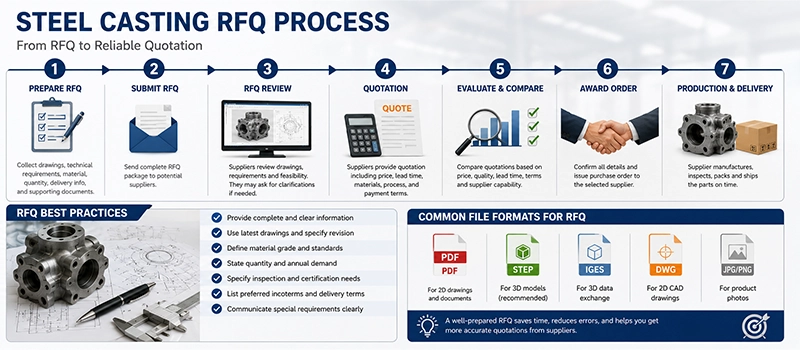
Clearly Define Critical Dimensions
Not every dimension has the same level of importance. A professional steel casting RFQ should clearly identify critical dimensions that affect assembly, machining, or product performance.
For example, buyers should specify:
- Functional dimensions
- Hole locations
- Center distances
- Mounting interfaces
- Bearing or sealing surfaces
Highlighting these critical features enables manufacturers to focus on the dimensions that require tighter process control during production.
Specify Tolerances
Dimensions alone are not sufficient. Every steel casting RFQ should also define the required tolerances whenever they are critical to the product’s function.
If no tolerance information is provided, manufacturers may apply general casting standards, which could differ from the buyer’s expectations.
Typical tolerance information may include:
- General dimensional tolerances
- Critical machining tolerances
- Geometric tolerances (GD&T)
- Surface flatness or perpendicularity requirements
Providing tolerance requirements at the quotation stage allows suppliers to evaluate machining costs more accurately.
Mark Machined Areas
Many custom steel castings require machining after casting. Therefore, a steel casting RFQ should clearly indicate which surfaces will be machined.
Engineering drawings should identify:
- Machined faces
- Threaded holes
- Precision bores
- Milling surfaces
- Datum references
This information helps manufacturers determine machining time, select appropriate production processes, and calculate costs more precisely.
Include Drawing Revision Information
Design revisions are common during product development. To avoid manufacturing or quotation errors, every steel casting RFQ should include the latest drawing revision number and revision date.
Maintaining revision control ensures that both the buyer and manufacturer are working from the same version of the design, reducing the risk of quoting or producing outdated components.
By providing complete and accurate engineering drawings, buyers create a solid foundation for a successful steel casting RFQ. Clear technical documentation enables manufacturers to evaluate the project efficiently, prepare more accurate quotations, and reduce unnecessary engineering discussions before production begins.
Specify the Correct Material Grade
Material selection is one of the most important sections of a steel casting RFQ. Simply describing the material as “steel” is not enough for a manufacturer to prepare an accurate quotation. Different steel grades have different chemical compositions, mechanical properties, heat treatment requirements, machining characteristics, and production costs. Without a clearly specified material grade, suppliers may make different assumptions, resulting in quotations that are difficult to compare.
A professional steel casting RFQ should always identify the exact material standard and grade required for the project. This allows manufacturers to evaluate material availability, select the appropriate casting process, and estimate production costs more accurately.
Use Recognized Material Standards
Instead of using general descriptions, specify internationally recognized material standards whenever possible. This helps eliminate misunderstandings between buyers and manufacturers, especially when working with overseas suppliers.
Common material standards include:
- ASTM
- AISI
- DIN
- EN
- ISO
- JIS
- GB
Using standard material specifications also makes it easier for suppliers to verify equivalent grades when necessary.
Specify the Exact Material Grade
A steel casting RFQ should include the complete material designation rather than a generic material name.
For example, instead of writing:
- Steel
- Carbon steel
- Stainless steel
Provide the exact grade, such as:
- ASTM A216 WCB
- ASTM A217 WC6
- ASTM A148 105-85
- ASTM A351 CF8
- ASTM A351 CF8M
- ASTM A743 CA6NM
- 42CrMo
- 35CrMo
- 20MnCr5
This level of detail allows manufacturers to determine the appropriate melting process, heat treatment requirements, and inspection standards before preparing a quotation.
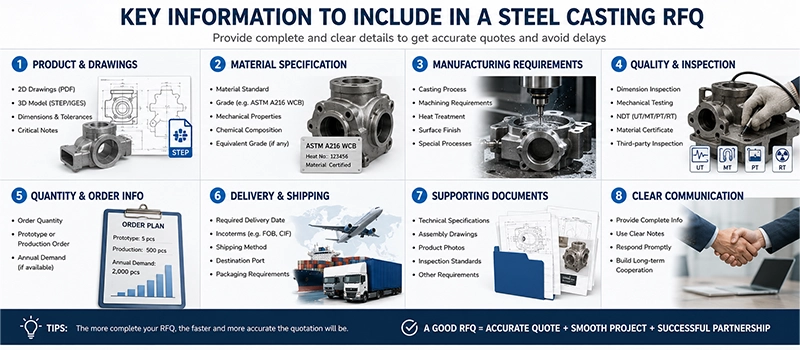
Include Material Performance Requirements
If the project requires specific mechanical properties or operating performance, these requirements should also be included in the steel casting RFQ.
Typical information may include:
- Tensile strength
- Yield strength
- Hardness
- Impact toughness
- Operating temperature
- Corrosion resistance
- Wear resistance
Providing these requirements helps suppliers confirm whether the selected material is suitable for the intended application or recommend a more appropriate alternative if necessary.
Mention Equivalent Material Grades When Available
Some projects involve international cooperation where different countries use different material standards. If an equivalent material grade is acceptable, including this information in the steel casting RFQ can help suppliers source suitable materials more efficiently.
For example:
| ASTM | DIN / EN | GB |
|---|---|---|
| ASTM A216 WCB | GS-C25 / 1.0619 | ZG270-500 |
| ASTM A351 CF8 | 1.4308 | ZG06Cr19Ni10 |
| ASTM A351 CF8M | 1.4408 | ZG06Cr17Ni12Mo2 |
| ASTM A743 CA6NM | 1.4313 | ZG0Cr13Ni4Mo |
Equivalent grades should always be confirmed according to the required application and applicable standards.
Consult Your Supplier If You’re Unsure
Not every buyer is a materials expert, and in many cases the exact steel grade may not yet be finalized during the RFQ stage. If material selection is still under evaluation, it is helpful to explain the product’s application, operating environment, and performance expectations in the steel casting RFQ.
An experienced steel casting manufacturer can recommend suitable material grades based on factors such as load conditions, corrosion exposure, wear resistance, and temperature requirements. Early technical communication often leads to more accurate quotations and helps avoid material changes later in the project.
By specifying the correct material grade and clearly communicating performance requirements, a steel casting RFQ provides manufacturers with the technical information needed to prepare accurate quotations and recommend the most suitable manufacturing solution.
Define Dimensions and Tolerances Clearly
Providing accurate dimensions is essential when preparing a steel casting RFQ. Even if detailed product drawings are included, manufacturers still need clear dimensional and tolerance requirements to evaluate the casting process, machining workload, inspection methods, and overall production cost. Incomplete or ambiguous dimensional information can result in inaccurate quotations or additional engineering discussions before production begins.
A professional steel casting RFQ should clearly distinguish between casting dimensions and finished dimensions after machining. This allows manufacturers to determine machining allowances, estimate processing time, and select suitable manufacturing methods.
Identify Critical Dimensions
Not every dimension on a drawing has the same level of importance. A steel casting RFQ should clearly identify the dimensions that directly affect product function, assembly, or performance.
Critical dimensions may include:
- Overall length, width, and height
- Hole diameters and locations
- Center-to-center distances
- Mounting surfaces
- Bearing seats
- Sealing surfaces
By identifying these key dimensions, manufacturers can focus on the features that require tighter process control during both casting and machining.
Specify Tolerance Requirements
Tolerance information is just as important as the dimensions themselves. Without defined tolerances, suppliers may apply their standard manufacturing practices, which could differ from the buyer’s expectations.
A steel casting RFQ should specify tolerance requirements whenever they are critical to the finished product.
Typical tolerance information includes:
- General dimensional tolerances
- Machining tolerances
- Hole tolerances
- Flatness
- Parallelism
- Perpendicularity
- Concentricity
- Position tolerance
If international standards such as ISO, ASME, or customer-specific tolerance specifications are required, they should also be referenced in the RFQ.
Distinguish Casting and Machined Dimensions
Many steel castings undergo CNC machining after casting. Therefore, a steel casting RFQ should clearly indicate which dimensions apply to the raw casting and which apply to the finished machined component.
For example:
- As-cast dimensions
- Machined dimensions
- Machining allowance
- Finished tolerance after machining
This distinction helps manufacturers estimate machining costs more accurately and avoid misunderstandings during production.
Define Surface Finish Requirements
Surface finish can influence both manufacturing methods and machining costs. If specific surface roughness is required, it should be included in the steel casting RFQ.
Examples include:
- As-cast surface finish
- Machined surface roughness (Ra value)
- Grinding requirements
- Polishing requirements
Providing this information allows suppliers to determine whether additional finishing operations are necessary.
Reference Applicable Standards
If the project requires compliance with specific dimensional or tolerance standards, those standards should be identified in the steel casting RFQ.
Examples include:
- ISO 8062 for casting tolerances
- ASME Y14.5 for GD&T
- Customer-specific engineering standards
Including applicable standards helps ensure that both the buyer and manufacturer evaluate the project using the same technical requirements.
Clearly defining dimensions and tolerances allows manufacturers to understand exactly what must be produced and inspected. A detailed steel casting RFQ reduces engineering questions, improves quotation accuracy, and minimizes the risk of dimensional issues during manufacturing.
Include Machining Requirements
Many steel castings are not finished products immediately after casting. They often require additional machining to achieve the final dimensions, surface quality, and assembly requirements. For this reason, machining information should always be included in a steel casting RFQ. Without clear machining requirements, manufacturers cannot accurately estimate production time, machining costs, or the overall project price.
A detailed steel casting RFQ should specify exactly which features require machining and which surfaces can remain in the as-cast condition. This allows suppliers to evaluate the manufacturing process more efficiently and avoid assumptions that could affect the quotation.
Identify All Machined Features
Engineering drawings should clearly indicate every feature that requires machining after casting.
Common machined features include:
- Precision holes
- Threaded holes
- Bearing seats
- Mounting faces
- Mating surfaces
- Grooves
- Slots
- Counterbores
Clearly identifying these features enables manufacturers to estimate machining time and determine the appropriate CNC operations required.
Specify Machining Tolerances
Different machined features may require different levels of precision. A steel casting RFQ should include the required machining tolerances for all critical areas.
Typical requirements include:
- Hole diameter tolerances
- Shaft tolerances
- Flatness
- Parallelism
- Concentricity
- Surface runout
Providing tolerance requirements early allows suppliers to determine whether standard machining is sufficient or whether additional precision processes will be required.
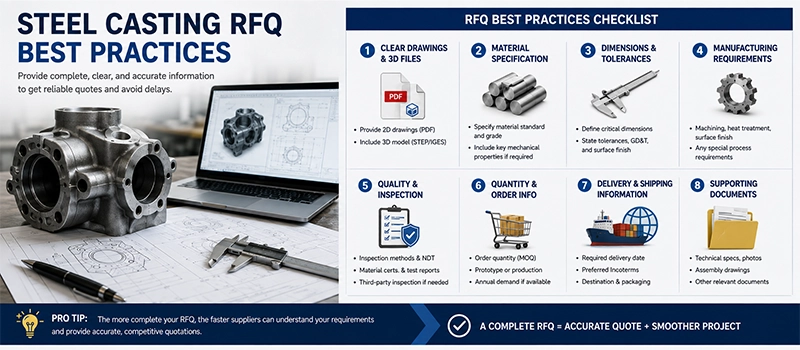
Define Thread Specifications
If threaded holes or threaded shafts are required, the thread specifications should be clearly stated in the steel casting RFQ.
Typical information includes:
- Metric threads (M)
- Unified threads (UNC/UNF)
- BSP threads
- NPT threads
- Thread depth
- Number of threaded holes
Incomplete thread information often results in additional clarification before a quotation can be issued.
Indicate Surface Finish After Machining
Some machined surfaces require a specific surface finish to ensure proper assembly or product performance.
If applicable, the steel casting RFQ should specify:
- Surface roughness (Ra)
- Ground surfaces
- Polished surfaces
- Sealing surfaces
- Bearing contact surfaces
This information helps manufacturers select suitable machining methods and estimate finishing costs more accurately.
Clarify Whether Machining Is Included
One of the most common quotation issues occurs when buyers assume machining is included while suppliers quote for the casting only.
To avoid misunderstandings, a steel casting RFQ should clearly state whether the quotation should include:
- Raw casting only
- Casting with rough machining
- Fully machined finished component
If multiple quotation options are acceptable, buyers can also request separate prices for each manufacturing stage. This makes it easier to compare costs and choose the most suitable sourcing solution.
By providing complete machining requirements, a steel casting RFQ allows manufacturers to calculate machining time, tooling requirements, inspection procedures, and production costs more accurately. Clear machining information also reduces quotation revisions and helps ensure that both the buyer and supplier have the same expectations before production begins.
State Heat Treatment and Surface Finish Requirements
Heat treatment and surface finish requirements can significantly affect both the manufacturing process and the final quotation. If these requirements are not clearly stated in a steel casting RFQ, suppliers may make different assumptions, leading to inconsistent pricing and unexpected changes after the order is placed.
To avoid misunderstandings, a steel casting RFQ should specify any post-casting treatments required to achieve the desired mechanical properties, corrosion resistance, appearance, or service performance.
Specify Heat Treatment Requirements
Many steel castings require heat treatment to improve strength, hardness, toughness, or wear resistance. Different heat treatment processes involve different production costs and lead times, making this information essential for an accurate quotation.
Common heat treatment processes include:
- Annealing
- Normalizing
- Quenching
- Tempering
- Solution Treatment
- Stress Relieving
If a specific standard or heat treatment specification applies, it should also be referenced in the steel casting RFQ. For example, buyers may require a particular hardness range or mechanical properties after heat treatment.
Define Mechanical Property Requirements
In some cases, specifying the heat treatment process alone is not sufficient. A steel casting RFQ should also include the required mechanical properties if they are critical to the application.
Typical requirements include:
- Tensile strength
- Yield strength
- Hardness
- Impact toughness
- Elongation
Providing these performance requirements helps manufacturers verify whether the selected material and heat treatment process can achieve the expected results.
Specify Surface Finish Requirements
Surface finish is another important item that should be clearly described in a steel casting RFQ. Different finishing methods affect production cost, appearance, corrosion resistance, and subsequent assembly.
Common surface finish options include:
- As-cast
- Shot blasting
- Sand blasting
- Grinding
- Polishing
- Pickling
- Painting
- Powder coating
- Galvanizing
If no special surface treatment is required, stating “as-cast” or “shot blasted” can prevent unnecessary assumptions during quotation.
Identify Functional Surfaces
Not all surfaces require the same finish. Some areas may only need basic cleaning, while others require precision finishing to ensure proper sealing, assembly, or wear resistance.
A steel casting RFQ should clearly identify any functional surfaces that require additional processing, such as:
- Sealing faces
- Bearing contact surfaces
- Sliding surfaces
- Mounting interfaces
- Decorative surfaces
Clearly identifying these areas allows manufacturers to estimate finishing operations more accurately.
Reference Applicable Standards
If the project requires compliance with specific coating, painting, or surface preparation standards, these should be included in the steel casting RFQ.
Examples may include:
- Surface roughness specifications
- Painting standards
- Corrosion protection requirements
- Customer-specific finishing specifications
Providing these references ensures that suppliers understand the expected quality level before preparing their quotations.
By clearly defining heat treatment and surface finish requirements, a steel casting RFQ enables manufacturers to estimate processing costs, production time, and inspection requirements with greater accuracy. Complete technical information also reduces quotation revisions and helps ensure that the finished steel castings meet the expected performance and quality standards.
Specify Inspection and Quality Requirements
Inspection requirements are often overlooked when preparing a steel casting RFQ, yet they can have a significant impact on manufacturing cost, lead time, and product quality. Different customers have different quality expectations, and suppliers cannot accurately prepare a quotation unless these requirements are clearly defined at the RFQ stage.
A professional steel casting RFQ should specify the required inspection methods, acceptance standards, certification documents, and any third-party inspection requirements. Providing this information upfront allows manufacturers to plan the appropriate quality control procedures and avoid unexpected costs after production begins.
Define Required Inspection Methods
Not every steel casting requires the same level of inspection. The required inspection methods should be based on the product’s application and quality requirements.
Common inspection methods include:
- Visual Inspection (VT)
- Dimensional Inspection
- Ultrasonic Testing (UT)
- Magnetic Particle Testing (MT)
- Dye Penetrant Testing (PT)
- Radiographic Testing (RT)
If a specific inspection method is mandatory, it should be clearly stated in the steel casting RFQ instead of assuming the supplier will perform it automatically.
Specify Applicable Standards
Inspection requirements should reference recognized international standards whenever possible.
For example, a steel casting RFQ may specify compliance with standards such as:
- ASTM
- ISO
- EN
- ASME
- Customer-specific inspection specifications
Using established standards helps both buyers and manufacturers evaluate product quality according to the same criteria.
Request Material and Inspection Certificates
Many industrial projects require documentation to verify material quality and inspection results. If certificates are needed, they should be listed in the steel casting RFQ.
Common documentation includes:
- Material Test Certificate (MTC)
- Chemical Composition Report
- Mechanical Property Report
- Heat Treatment Report
- NDT Report
- Dimensional Inspection Report
Clearly identifying these document requirements prevents suppliers from excluding them from the quotation.
Include Third-Party Inspection Requirements
Some projects require independent inspection before shipment. If third-party inspection is necessary, the steel casting RFQ should identify this requirement early in the quotation process.
Typical third-party inspection organizations include:
- SGS
- TÜV
- Bureau Veritas (BV)
- Lloyd’s Register (LR)
- DNV
Specifying third-party inspection at the RFQ stage allows manufacturers to include the necessary coordination, scheduling, and inspection costs in their quotation.
Define Acceptance Criteria
In addition to specifying inspection methods, buyers should explain how the finished steel castings will be accepted.
For example, the steel casting RFQ may include requirements such as:
- Acceptance quality standards
- Maximum allowable defects
- Sampling requirements
- Final inspection before shipment
Clear acceptance criteria reduce the possibility of disputes after production is completed.
A complete steel casting RFQ should communicate quality expectations as clearly as it communicates product specifications. By defining inspection methods, required documentation, applicable standards, and acceptance criteria, buyers enable manufacturers to prepare accurate quotations and establish a quality control plan that meets project requirements from the very beginning.
Provide Order Quantity and Delivery Information
Order quantity and delivery information are essential parts of a steel casting RFQ. These details directly influence production planning, tooling decisions, manufacturing methods, lead time, and unit cost. Even if the product drawings and technical specifications are complete, manufacturers cannot prepare an accurate quotation without understanding the expected order volume and delivery schedule.
A professional steel casting RFQ should clearly explain both the immediate purchasing requirements and the long-term demand whenever possible. This allows suppliers to recommend the most cost-effective production solution and provide more competitive pricing.
Specify the Order Quantity
One of the first questions every manufacturer asks is, “How many parts do you need?”
The required quantity affects nearly every aspect of production, including mold selection, tooling investment, machining strategy, and manufacturing efficiency.
A steel casting RFQ should clearly indicate whether the project involves:
- Prototype production
- Sample order
- Small-batch production
- Mass production
- Annual purchasing volume
For example:
- Prototype: 5 pieces
- Initial order: 100 pieces
- Annual demand: 2,000 pieces
Providing this information helps manufacturers optimize the production process and calculate unit costs more accurately.
Indicate Forecast Demand
If the project is expected to continue over a longer period, including an estimated annual demand can be highly beneficial.
For example, a steel casting RFQ may include information such as:
- Monthly demand
- Quarterly purchasing plan
- Annual forecast
- Estimated project lifetime
This enables suppliers to evaluate production capacity, material procurement, and tooling investments more effectively, which may lead to lower manufacturing costs.
Specify the Required Delivery Time
Delivery expectations should be clearly stated in every steel casting RFQ. Without a target delivery schedule, manufacturers may assume standard production lead times that do not match the buyer’s project requirements.
Typical information includes:
- Required delivery date
- Expected production lead time
- Urgent delivery requirements
- Project deadline
If delivery timing is flexible, mentioning this can also help suppliers optimize their production schedules and potentially offer more competitive quotations.
Include Shipping Information
Shipping details also influence quotation accuracy, particularly for international projects.
A steel casting RFQ should specify information such as:
- Destination country
- Destination port
- Delivery address (if available)
- Preferred shipping method
Providing shipping information allows suppliers to estimate logistics costs or recommend suitable transportation solutions if requested.
Specify Preferred Incoterms
For international purchasing, the preferred trade terms should be included in the steel casting RFQ to avoid confusion when comparing quotations.
Common Incoterms include:
- EXW (Ex Works)
- FOB (Free On Board)
- CIF (Cost, Insurance and Freight)
- DAP (Delivered at Place)
- DDP (Delivered Duty Paid)
When all suppliers quote using the same Incoterms, buyers can compare prices more fairly and make better purchasing decisions.
By providing clear order quantity and delivery information, a steel casting RFQ enables manufacturers to develop realistic production plans, estimate lead times accurately, and prepare quotations that better reflect the actual requirements of the project.
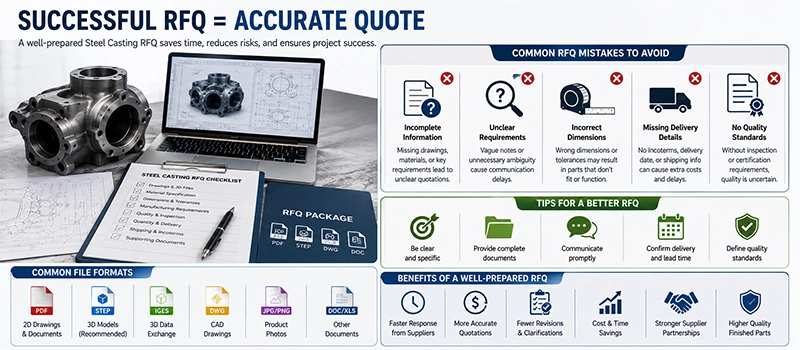
Attach Supporting Documents
A well-prepared steel casting RFQ is more than a product drawing and a material specification. Supporting documents provide additional technical information that helps manufacturers fully understand the project, evaluate production feasibility, and prepare a more accurate quotation. In many cases, these documents answer questions before they need to be asked, reducing quotation time and improving communication efficiency.
When preparing a steel casting RFQ, buyers should include all available technical documents that may assist the engineering team during the quotation review.
Provide 3D CAD Files
While 2D drawings define dimensions and tolerances, 3D CAD models help manufacturers better understand complex geometries and casting structures.
Recommended file formats include:
- STEP (.stp)
- IGES (.igs)
- Parasolid (.x_t)
A 3D model allows engineers to review wall thickness, draft angles, internal cavities, and other design features more efficiently. Including a CAD model in a steel casting RFQ can also reduce the risk of misinterpreting complex drawings.
Include Assembly Drawings
If the steel casting is part of a larger assembly, an assembly drawing can provide valuable context.
An assembly drawing helps manufacturers understand:
- How the casting fits with other components
- Functional mating surfaces
- Critical assembly dimensions
- Space limitations
- Installation orientation
This information enables engineers to identify potential manufacturing or machining issues that may not be obvious from the individual part drawing alone.
Share Product Photos or Existing Samples
If the project involves replacing or improving an existing component, including photos of the current product can help manufacturers understand its overall shape, surface condition, and functional features.
If physical samples are available, mentioning this in the steel casting RFQ is also beneficial. Sample parts can be used to verify dimensions, evaluate manufacturing methods, and confirm design details before production.
Include Technical Specifications
Additional technical documents can further improve quotation accuracy.
Useful supporting documents include:
- Technical specifications
- Product standards
- Customer specifications
- Inspection requirements
- Performance requirements
- Test procedures
Providing these documents helps suppliers understand the complete technical expectations of the project rather than relying solely on engineering drawings.
Explain the Product Application
Although not always required, a brief description of how the casting will be used can help manufacturers recommend suitable materials or manufacturing processes.
For example, the steel casting RFQ may indicate whether the component is intended for:
- Mining equipment
- Construction machinery
- Agricultural machinery
- Pumps and valves
- Railway equipment
- Marine applications
Understanding the working environment allows manufacturers to evaluate whether the specified material and production process are appropriate for the application.
Organize All Documents Before Sending
Before submitting a steel casting RFQ, it is good practice to organize all files into a clearly named folder or compressed package.
A complete RFQ package may include:
- PDF engineering drawings
- 3D CAD files
- Material specifications
- Technical requirements
- Assembly drawings
- Product photos
- Inspection specifications
Providing complete supporting documentation helps manufacturers review the project more efficiently, minimizes unnecessary clarification, and significantly improves the accuracy and speed of the quotation process. A well-organized steel casting RFQ demonstrates professionalism and creates a stronger foundation for successful cooperation.
Common Steel Casting RFQ Mistakes
Even experienced buyers can make mistakes when preparing a steel casting RFQ. Missing or incomplete information often leads to inaccurate quotations, longer response times, repeated engineering discussions, and unexpected cost changes during production. Fortunately, most of these issues can be avoided by reviewing the RFQ carefully before sending it to potential suppliers.
Below are some of the most common mistakes manufacturers encounter when reviewing a steel casting RFQ.
Sending Drawings Without Technical Requirements
One of the most frequent mistakes is providing only a drawing while leaving out important technical specifications.
For example, the drawing may show the part geometry but not include:
- Material grade
- Heat treatment
- Surface finish
- Inspection requirements
- Machining scope
Without this information, manufacturers can only make assumptions, and different suppliers may quote completely different solutions for the same project.
Using Unclear Material Descriptions
Another common mistake is describing the material too generally.
For example:
❌ Steel
❌ Carbon Steel
❌ Stainless Steel
These descriptions are not sufficient for a professional steel casting RFQ because each category contains many different material grades with different costs and performance characteristics.
Instead, always specify the exact material grade, such as ASTM A216 WCB, ASTM A351 CF8, or ASTM A743 CA6NM.
Omitting Quantity Information
Many buyers request quotations without specifying the required quantity.
However, production costs for:
- 5 pieces
- 100 pieces
- 5,000 pieces
can differ significantly.
Without quantity information, manufacturers cannot determine the most suitable production method or calculate an accurate unit price.
Every steel casting RFQ should clearly state the required order quantity and, if available, the estimated annual demand.
Forgetting Machining Requirements
Some buyers assume suppliers understand which areas require machining, but this information should never be left to interpretation.
A steel casting RFQ should clearly indicate:
- Machined surfaces
- Threaded holes
- Precision bores
- Tolerance requirements
- Finished dimensions
Incomplete machining information often results in revised quotations after engineering review.
Not Defining Inspection Requirements
Quality expectations vary from project to project. If inspection requirements are not included in the steel casting RFQ, suppliers may only provide their standard inspection process.
If the project requires:
- UT
- MT
- RT
- PMI
- Material certificates
- Third-party inspection
these requirements should be clearly specified before the quotation is prepared.
Providing Unrealistic Delivery Expectations
Requesting extremely short lead times without discussing production feasibility is another common issue.
If delivery deadlines are critical, the steel casting RFQ should clearly state:
- Required delivery date
- Project schedule
- Priority level
- Whether partial shipments are acceptable
Providing realistic delivery expectations allows suppliers to evaluate production capacity and propose achievable schedules.
Sending an Incomplete RFQ Package
A steel casting RFQ should contain all documents necessary for technical evaluation.
Before sending the RFQ, confirm that the package includes:
- Engineering drawings
- 3D CAD files
- Material specifications
- Quantity information
- Machining requirements
- Heat treatment requirements
- Inspection standards
- Supporting technical documents
Taking a few extra minutes to review the RFQ before submission can save days of clarification later. A complete steel casting RFQ not only helps manufacturers prepare faster and more accurate quotations but also demonstrates professionalism and improves communication throughout the entire sourcing process.
Steel Casting RFQ Checklist
Before sending a steel casting RFQ to potential suppliers, it is worth taking a few minutes to review all the information. A complete and well-organized RFQ not only helps manufacturers prepare faster and more accurate quotations but also reduces unnecessary questions and shortens the overall sourcing process.
The following steel casting RFQ checklist can be used as a final review before submitting your inquiry.
Product Information
Confirm that your steel casting RFQ includes:
- Product name or part number
- Latest drawing revision
- 2D engineering drawing (PDF)
- 3D CAD model (STEP, IGES, or Parasolid)
Material Information
Verify that the material requirements are clearly defined.
Include:
- Material standard
- Material grade
- Required mechanical properties (if applicable)
- Equivalent material grade (if acceptable)
Dimensional Requirements
Check that all important dimensional information has been provided.
Confirm:
- Critical dimensions
- General tolerances
- GD&T requirements (if applicable)
- Machining allowances
- Surface roughness requirements
Manufacturing Requirements
Ensure the manufacturing scope is clearly explained.
Include:
- Machining requirements
- Heat treatment
- Surface finish
- Special processing requirements
Inspection Requirements
Specify the required quality control procedures.
Include:
- Dimensional inspection
- Material certification
- Mechanical testing
- NDT requirements (UT, MT, PT, or RT)
- Third-party inspection (if required)
Commercial Information
Provide enough information for suppliers to prepare a complete quotation.
Include:
- Order quantity
- Prototype or production order
- Annual demand (if available)
- Required delivery date
- Preferred Incoterms
- Shipping destination
Supporting Documents
Before sending your steel casting RFQ, confirm that all supporting documents are attached.
Typical attachments include:
- PDF drawings
- 3D CAD files
- Technical specifications
- Assembly drawings
- Product photos
- Inspection specifications
Final Review
Before clicking “Send,” ask yourself these simple questions:
- Can a supplier fully understand the project without asking additional questions?
- Is every technical requirement clearly documented?
- Are the latest drawing revisions attached?
- Have all required files been included?
- Will different suppliers be able to quote based on the same information?
If the answer to all of these questions is Yes, your steel casting RFQ is likely complete and ready for quotation.
A complete steel casting RFQ benefits both buyers and manufacturers. Buyers receive faster and more accurate quotations, while suppliers can evaluate the project efficiently and recommend the most suitable manufacturing solution. Spending a little extra time reviewing the RFQ before submission can help avoid costly misunderstandings and create a smoother purchasing process from the very beginning.
Why Choose Dalian Zhongsheng for Your Steel Casting RFQ
Submitting a complete steel casting RFQ is only the first step toward a successful project. Choosing a manufacturer that can accurately review your RFQ, identify potential engineering issues, and provide practical manufacturing solutions is equally important. An experienced supplier does more than calculate costs—they help optimize the design, improve manufacturability, and reduce production risks before manufacturing begins.
At Dalian Zhongsheng Metal Product Co., Ltd., every steel casting RFQ is reviewed by an experienced engineering team before a quotation is prepared. This ensures that technical requirements are fully understood and that customers receive accurate pricing based on the actual manufacturing process.

Engineering Review Before Quotation
Every steel casting RFQ undergoes a technical evaluation before pricing.
The engineering team reviews:
- Product drawings
- Material specifications
- Machining requirements
- Heat treatment requirements
- Inspection standards
If any information is incomplete or unclear, recommendations are provided before the quotation is finalized, helping customers avoid unnecessary delays and revisions.
Support for Drawing Optimization
A quotation is not simply based on the drawing provided. If engineers identify opportunities to improve manufacturability or reduce production costs, they will communicate these suggestions during the RFQ review process.
Typical recommendations may include:
- Simplifying complex casting features
- Improving wall thickness distribution
- Optimizing machining allowances
- Recommending alternative material grades
- Reducing unnecessary manufacturing costs
Early engineering feedback often leads to a more efficient production process without affecting product performance.
One-Stop Manufacturing Services
After the steel casting RFQ is approved, Dalian Zhongsheng provides complete manufacturing support, including:
- Steel casting
- CNC machining
- Heat treatment
- Surface finishing
- Quality inspection
Working with a single supplier throughout the project simplifies communication and helps maintain consistent quality from prototype production to mass manufacturing.
Strict Quality Management
Quality requirements specified in a steel casting RFQ are carefully implemented throughout production.
Inspection capabilities include:
- Chemical composition analysis
- Mechanical property testing
- Dimensional inspection
- Non-destructive testing (NDT)
- Material certification
This comprehensive quality control system helps ensure that finished steel castings meet customer specifications and applicable industry standards.
Fast Response to Custom RFQs
Every custom project is different. Whether the requirement is a prototype, a low-volume order, or long-term production, Dalian Zhongsheng responds to steel casting RFQs with detailed technical evaluations and competitive quotations.
By combining engineering expertise, manufacturing experience, and responsive customer service, the company helps customers move from RFQ to production more efficiently while minimizing technical risks and communication delays.
Conclusion
A well-prepared steel casting RFQ is the foundation of a successful custom casting project. By providing complete product drawings, accurate material specifications, clear dimensional requirements, machining details, heat treatment instructions, quality standards, order quantities, delivery information, and supporting documents, buyers enable manufacturers to prepare faster, more accurate, and more competitive quotations.
Taking the time to prepare a complete steel casting RFQ not only reduces communication delays and quotation revisions but also helps identify potential engineering issues before production begins. Whether you are sourcing prototype castings or high-volume production parts, a detailed RFQ improves purchasing efficiency and creates a stronger partnership between buyers and manufacturers.
If you are looking for a reliable steel casting manufacturer, Dalian Zhongsheng Metal Product Co., Ltd. offers professional engineering support, comprehensive manufacturing capabilities, and responsive RFQ review services to help turn your designs into high-quality steel castings with confidence.