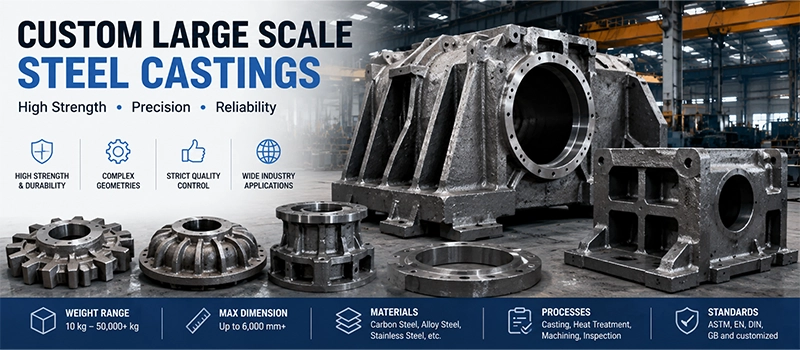
Custom large scale steel castings play a critical role in industries that demand exceptional strength, durability, and precision. From mining equipment and construction machinery to power plants and offshore facilities, these heavy-duty components are often custom engineered to meet unique performance and operational requirements. Choosing the right manufacturing partner is just as important as selecting the right material or design. This guide explains everything buyers need to know about custom large scale steel castings, including their advantages, manufacturing process, quality control, applications, and the key factors to consider when selecting a reliable supplier.
What Are Custom Large Scale Steel Castings?
Custom large scale steel castings are steel components manufactured to a customer’s unique specifications rather than produced as standard, off-the-shelf products. They are designed and cast according to engineering drawings, CAD models, or technical requirements to meet the exact dimensions, geometry, and performance needs of a specific project.
The term “large scale” generally refers to steel castings with substantial dimensions or heavy weight. While there is no universal definition, these castings are typically much larger than conventional industrial castings and are produced for equipment that operates under demanding conditions. Their size and complexity often require specialized foundry equipment, advanced engineering expertise, and customized production planning.
Unlike standard castings that follow fixed designs, custom large scale steel castings are manufactured as one-off or low-volume products. Every casting is unique because each customer may have different requirements for dimensions, structural design, machining allowances, connection features, or operating conditions. This level of customization allows manufacturers to produce components that cannot be replaced by standard catalog products.
Another defining characteristic of custom large scale steel castings is their ability to integrate complex shapes into a single component. Instead of assembling multiple fabricated parts through welding or bolting, engineers can design one casting that incorporates various functional features. This integrated approach simplifies assembly, improves structural integrity, and provides greater design flexibility for large industrial equipment.
Custom large scale steel castings are typically supplied as engineered solutions rather than finished products with fixed specifications. Manufacturers work closely with customers to transform design concepts into cast components that meet precise technical requirements. As a result, these castings play an important role in projects where standard products cannot satisfy the required size, shape, or structural performance.
In simple terms, custom large scale steel castings are tailor-made steel components developed to solve unique engineering challenges. Their defining features are customization, large dimensions, complex geometry, and the ability to be manufactured according to individual project requirements, making them an essential solution for modern heavy industry.
Advantages of Custom Large Scale Steel Castings
Custom large scale steel castings offer significant advantages over standard castings and fabricated steel structures, especially for heavy industrial equipment that requires high strength, complex designs, and long service life. By manufacturing each casting according to specific project requirements, engineers can optimize both performance and production efficiency.
Design Flexibility
One of the greatest advantages of custom large scale steel castings is design flexibility. Every component is produced according to customer drawings and technical specifications, allowing manufacturers to create unique shapes, dimensions, and structural features that cannot be achieved with standard products. Whether the design requires thick sections, complex internal cavities, or integrated mounting points, custom casting provides engineers with greater freedom to develop components that meet exact functional requirements.
High Structural Strength
Large industrial equipment is often exposed to heavy loads, vibration, and continuous operation. Custom steel castings can be designed with optimized cross-sections and reinforced areas to improve structural strength where it is needed most. This allows the finished component to withstand demanding working conditions while maintaining long-term reliability.
Reduced Assembly Requirements
Custom castings can combine multiple structural features into a single component. Instead of manufacturing and assembling numerous fabricated parts, engineers can consolidate the design into one casting. Fewer individual parts simplify assembly, reduce welding and fastening operations, and help minimize potential weak points within the overall structure.
Better Performance for Specific Applications
Every industrial project has its own operating requirements. Custom large scale steel castings are designed around these requirements rather than forcing equipment to adapt to a standard component. Dimensions, structural configuration, connection interfaces, and functional features can all be optimized for the intended application, resulting in better equipment performance and improved operational efficiency.
Cost-Effective for Complex Components
Although custom manufacturing requires engineering and tooling, it can be a cost-effective solution for large and complex components. Producing a single integrated casting often reduces fabrication time, lowers assembly costs, and minimizes the need for additional machining or welding. For heavy industrial equipment, this can lead to lower overall manufacturing costs while delivering a stronger and more reliable component.
Long Service Life
Durability is a key consideration for heavy machinery. Because custom large scale steel castings are engineered for specific operating conditions, they are designed to provide reliable performance throughout their intended service life. A properly designed casting can help reduce unexpected failures, decrease maintenance requirements, and improve the overall reliability of industrial equipment.
For industries that rely on large and complex machinery, custom large scale steel castings provide an effective combination of engineering flexibility, structural performance, manufacturing efficiency, and long-term value. These advantages make them the preferred choice for projects where standard components cannot fully meet technical or operational requirements.
Common Materials for Custom Large Scale Steel Castings
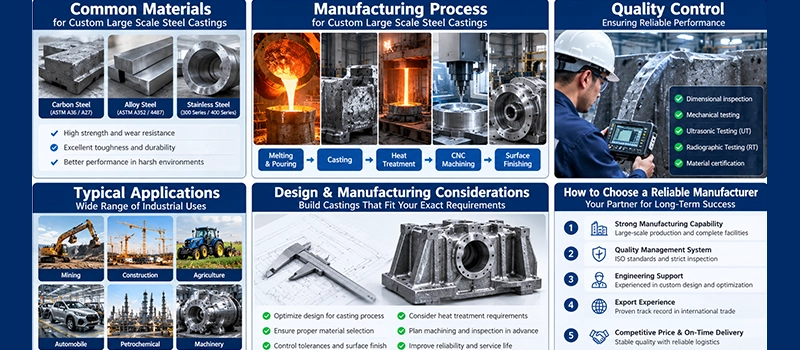
Material selection plays an important role in the performance and service life of custom large scale steel castings. The right material depends on the component’s operating environment, mechanical load, temperature, wear conditions, and corrosion exposure. Rather than using a single material for every application, manufacturers typically recommend the most suitable steel grade based on the customer’s technical requirements.
The following table summarizes the most commonly used materials for custom large scale steel castings.
| Material | Key Characteristics | Typical Applications |
|---|---|---|
| Carbon Steel | High strength, good weldability, cost-effective | Construction machinery, mining equipment, heavy structural components |
| Low Alloy Steel | Improved toughness, higher strength, excellent fatigue resistance | Heavy equipment, power generation, industrial machinery |
| Stainless Steel | Excellent corrosion resistance and good mechanical properties | Marine equipment, chemical processing, food processing machinery |
| Heat-Resistant Steel | Maintains strength at elevated temperatures | Furnaces, cement plants, power plants, metallurgical equipment |
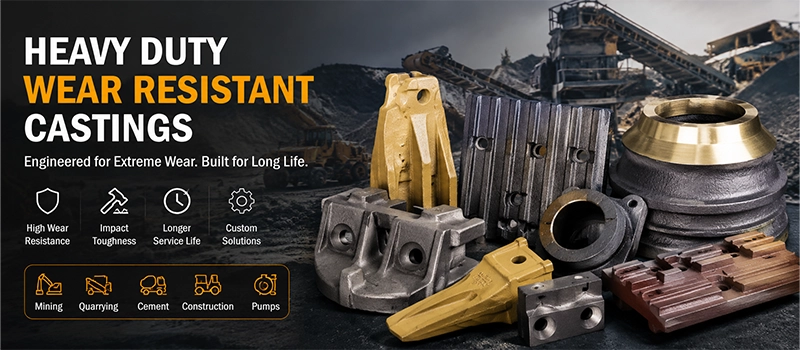
| Wear-Resistant Steel | Outstanding abrasion and impact resistance | Crushers, grinding mills, excavators, mining machinery |
Carbon steel is one of the most widely used materials because it offers an excellent balance of strength, machinability, and cost. It is suitable for many heavy-duty structural components that operate under normal industrial conditions.
Low alloy steel contains additional alloying elements that improve strength, toughness, and fatigue resistance. It is commonly selected for equipment subjected to high dynamic loads or severe working environments where greater mechanical performance is required.
Stainless steel is preferred for applications where corrosion resistance is a primary concern. Its ability to resist rust and chemical attack makes it suitable for equipment operating in marine, chemical, or humid environments.
Heat-resistant steel is designed to maintain its mechanical properties under continuous high-temperature service. It is frequently used for components exposed to furnaces, boilers, kilns, and other thermal processing equipment.
Wear-resistant steel is engineered for applications involving continuous abrasion, impact, or material handling. It helps extend the service life of components that operate in highly abrasive environments, reducing maintenance frequency and replacement costs.
Selecting the appropriate material is not simply a matter of choosing the strongest steel. Factors such as operating conditions, expected service life, manufacturing requirements, and overall project cost should all be considered. Working with an experienced casting manufacturer can help ensure the selected material provides the best balance between performance, durability, and cost-effectiveness for each custom large scale steel casting project.
Manufacturing Process for Custom Large Scale Steel Castings
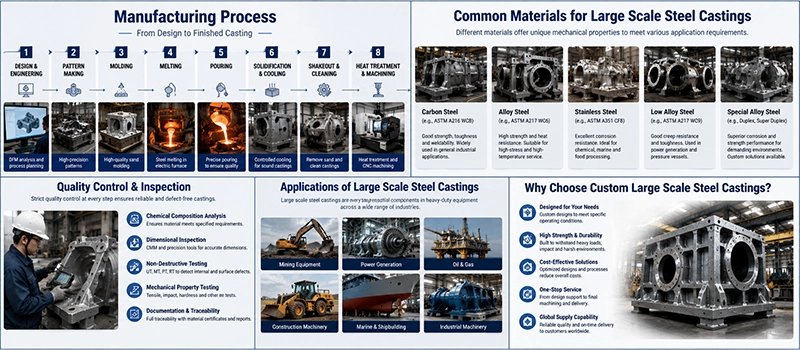
Manufacturing custom large scale steel castings involves a series of carefully planned production stages to ensure the final component meets the required dimensions, mechanical properties, and quality standards. Although the exact process may vary depending on the casting size and design, the following steps are commonly followed in large-scale steel casting production.
Engineering Review
The manufacturing process begins with a thorough review of the customer’s drawings and technical specifications. Engineers evaluate the casting geometry, dimensional tolerances, machining requirements, and service conditions to confirm that the design is suitable for production. At this stage, potential manufacturing challenges can be identified and optimized before production starts.
Pattern and Mold Production
After the engineering review is completed, a pattern is produced based on the approved design. The pattern is then used to create the mold cavity that determines the final shape of the casting. For large steel castings, molds are carefully prepared to ensure dimensional accuracy and stable pouring conditions throughout the casting process.
Steel Melting
The selected steel material is melted in a high-temperature furnace under controlled conditions. During melting, the chemical composition is carefully monitored to ensure it complies with the required material specifications. Maintaining consistent composition is essential for achieving the desired mechanical properties in the finished casting.
Pouring and Solidification
Once the molten steel reaches the required temperature, it is poured into the prepared mold. The casting is then allowed to solidify under controlled conditions. Proper pouring techniques and solidification control help produce a sound casting with consistent internal quality, particularly for large and complex components.
Heat Treatment
After the casting has cooled and been removed from the mold, heat treatment is performed when required by the material specification. This process helps achieve the required mechanical properties while improving the overall performance and stability of the casting.
CNC Machining
Large steel castings often require precision machining after casting. CNC machining is used to produce critical dimensions, mounting surfaces, holes, and other functional features that cannot be achieved directly through the casting process. This ensures the component is ready for assembly or installation.
Surface Finishing
Surface finishing removes residual sand, scale, and other surface imperfections created during casting. Depending on customer requirements, additional treatments such as shot blasting, grinding, or protective coatings may also be applied to improve the appearance and surface condition of the finished component.
Final Inspection
Before shipment, every custom large scale steel casting undergoes final inspection to verify that it meets the specified requirements. Dimensional checks, visual inspection, and other quality verification procedures are carried out according to the customer’s specifications and applicable industry standards. Only castings that successfully pass the required inspections are approved for delivery.
Applications of Custom Large Scale Steel Castings
Custom large scale steel castings are widely used in industries that require heavy-duty equipment capable of operating under demanding conditions. Their ability to be manufactured in large sizes and customized for specific engineering requirements makes them suitable for a broad range of industrial applications.
Mining Equipment
The mining industry relies heavily on large steel castings for equipment that operates under high loads and abrasive conditions. Components such as crusher frames, mill housings, shovel parts, dragline components, and heavy support structures require excellent strength and durability to withstand continuous operation in harsh environments.
Construction Machinery
Construction equipment often incorporates custom large scale steel castings to provide the structural strength needed for lifting, digging, and material handling. These castings are commonly used in excavators, loaders, cranes, and other heavy machinery where reliable performance and long service life are essential.
Power Generation
Power plants require large cast components for equipment that operates under high pressure and demanding working conditions. Turbine casings, valve bodies, pump housings, and generator components are typical examples of custom steel castings used in thermal, hydroelectric, and other power generation facilities.
Oil and Gas Equipment
The oil and gas industry uses custom steel castings for equipment that must perform reliably in challenging operating environments. Large valve bodies, pump casings, compressor housings, drilling equipment components, and pressure-containing parts are commonly manufactured as custom castings to meet project-specific requirements.
Marine and Offshore Equipment
Ships, offshore platforms, and port facilities require heavy-duty components capable of supporting large mechanical loads and continuous operation. Custom large scale steel castings are widely used in propulsion systems, deck machinery, mooring equipment, lifting systems, and other structural components designed for marine and offshore applications.
Cement and Metallurgical Industries
Equipment used in cement plants and metallurgical facilities operates under high temperatures, heavy loads, and abrasive conditions. Large steel castings are commonly used for kiln components, grinding equipment, furnace parts, and heavy structural assemblies that require excellent durability and dimensional stability.
General Heavy Industrial Machinery
Many other industrial sectors also depend on custom large scale steel castings for specialized equipment. Rolling mills, hydraulic presses, industrial gearboxes, machine tool bases, and other large mechanical systems often require custom-designed cast components that cannot be manufactured using standard products.
As industrial equipment continues to increase in size and complexity, the demand for custom large scale steel castings continues to grow across multiple industries. Their versatility, structural integrity, and ability to meet unique engineering requirements make them an indispensable solution for manufacturers seeking reliable components for heavy industrial applications.
Quality Control and Inspection
Quality control is a critical part of manufacturing custom large scale steel castings. Because these components are often used in heavy industrial equipment, they must meet strict requirements for material quality, dimensional accuracy, and structural integrity. A comprehensive inspection process helps ensure that every casting complies with customer specifications before delivery.
Raw Material Verification
Quality assurance begins with the verification of raw materials. Steel used for casting should meet the specified chemical composition and material grade required by the project. Proper material verification provides a reliable foundation for the manufacturing process and helps ensure consistent product quality.
Chemical Composition Analysis
Chemical composition analysis is performed to confirm that the molten steel meets the required material specifications. The content of key alloying elements is carefully measured to ensure the casting will achieve the desired mechanical properties and performance characteristics.
Mechanical Property Testing
Mechanical testing is conducted to verify that the casting meets the specified strength and toughness requirements. Common tests include tensile strength, yield strength, elongation, hardness, and impact testing. The testing methods and acceptance criteria are determined according to the applicable standards or customer requirements.
Dimensional Inspection
After machining, the casting is inspected to confirm that all critical dimensions comply with the approved engineering drawings. Precision measuring instruments are used to verify overall dimensions, mounting surfaces, hole locations, and machining tolerances, ensuring the component can be assembled correctly with other equipment.
Non-Destructive Testing (NDT)
Non-destructive testing is widely used to evaluate the internal and surface quality of custom large scale steel castings without damaging the component. Depending on the project requirements, one or more of the following inspection methods may be performed:
- Visual Testing (VT) for surface appearance and visible defects.
- Magnetic Particle Testing (MT) for detecting surface and near-surface cracks in ferromagnetic materials.
- Penetrant Testing (PT) for identifying fine surface discontinuities.
- Ultrasonic Testing (UT) for locating internal defects such as shrinkage cavities or cracks.
- Radiographic Testing (RT) for examining the internal structure of critical castings using X-rays or gamma rays.
The appropriate NDT method is selected based on the casting material, geometry, service conditions, and customer specifications.
Third-Party Inspection
Some projects require inspection by an independent third-party organization. Third-party inspectors verify that the manufacturing process, testing procedures, and final products comply with contractual requirements and applicable industry standards. This additional level of verification provides greater confidence in product quality, particularly for large or critical components.
Material Certification and Inspection Reports
Upon completion of all required inspections, manufacturers typically provide supporting documentation to accompany the finished castings. Depending on the project requirements, this may include material certificates, chemical composition reports, mechanical test reports, dimensional inspection records, non-destructive testing reports, and other quality documentation. These records provide traceability and demonstrate that the casting has been manufactured and inspected in accordance with the specified requirements.
A well-established quality control system helps ensure that custom large scale steel castings consistently achieve the required performance, reliability, and service life. For buyers, comprehensive inspection procedures and complete quality documentation are important indicators of a manufacturer’s technical capability and commitment to product quality.
Key Design Considerations for Large Steel Castings
Design is one of the most important factors affecting the quality, manufacturability, and performance of custom large scale steel castings. A well-designed casting not only improves structural reliability but also helps reduce manufacturing complexity, production costs, and the risk of casting defects. During the design stage, engineers must balance product performance with practical manufacturing requirements.
Wall Thickness
Wall thickness has a direct impact on the casting process. Excessively thin sections may not fill completely during pouring, while overly thick sections can increase the risk of shrinkage defects and extend cooling time. Whenever possible, wall thickness should remain relatively uniform throughout the casting to promote stable solidification and improve overall quality.
Draft Angles
Draft angles are incorporated into the casting design to allow the pattern to be removed from the mold without damaging the mold cavity. Proper draft design simplifies mold production, improves dimensional consistency, and reduces the possibility of surface defects caused during pattern removal.
Machining Allowance
Most large steel castings require machining after casting to achieve the final dimensions and surface finish. Sufficient machining allowance should be included in the casting design to remove surface irregularities and ensure that critical dimensions can be accurately machined without unnecessarily increasing material consumption or machining time.
Shrinkage Allowance
Steel contracts as it cools and solidifies. To compensate for this natural shrinkage, engineers incorporate shrinkage allowances into the pattern design. Accurate shrinkage calculations are essential for ensuring that the finished casting meets the required dimensions after cooling and machining.
Weight Optimization
Large steel castings are often used in heavy-duty equipment where structural strength is essential, but excessive weight can increase manufacturing costs, transportation expenses, and installation difficulty. Engineers therefore optimize the casting design by placing material where it contributes most to structural performance while eliminating unnecessary mass wherever possible.
Casting Simulation
Many manufacturers use casting simulation software during the design stage to evaluate mold filling and solidification behavior before production begins. Simulation helps identify potential issues such as shrinkage, porosity, or hot spots, allowing engineers to optimize the gating and feeding system in advance. This reduces production risks, improves casting quality, and minimizes costly modifications after manufacturing has started.
Careful consideration of these design factors helps ensure that custom large scale steel castings can be manufactured efficiently while meeting the required quality and performance standards. Early collaboration between customers and experienced casting engineers is often the most effective way to optimize both product design and production outcomes.
How to Choose a Reliable Custom Large Scale Steel Castings Manufacturer
Choosing the right manufacturer is one of the most important decisions when sourcing custom large scale steel castings. A reliable supplier should offer more than competitive pricing—they should have the engineering expertise, production capacity, and quality management systems needed to deliver castings that meet your exact requirements.

Manufacturing Capability
Large steel castings require specialized equipment and extensive production experience. Before selecting a supplier, buyers should evaluate the manufacturer’s casting capacity, melting equipment, machining capabilities, and heat treatment facilities. A manufacturer with comprehensive in-house production capabilities can better control quality, production efficiency, and delivery schedules.
Engineering Support
Every custom casting project begins with an engineering review. An experienced manufacturer should be able to evaluate customer drawings, identify potential manufacturing challenges, and recommend practical improvements to optimize both manufacturability and performance. Strong engineering support helps reduce production risks and shortens project lead times.
Quality Assurance
A reliable manufacturer should follow a well-established quality management system and perform comprehensive inspections throughout the production process. Buyers should verify whether the supplier provides material certification, dimensional inspection, mechanical testing, and non-destructive testing according to customer specifications or applicable industry standards.
One-Stop Manufacturing Services
Choosing a supplier that offers casting, heat treatment, CNC machining, surface finishing, and inspection under one roof can simplify project management and improve production consistency. Integrated manufacturing also helps reduce lead times and minimizes communication between multiple suppliers.
Industry Experience and Export Capability
Manufacturers with extensive experience in international markets are generally more familiar with global quality standards, technical documentation, packaging requirements, and shipping procedures. This experience can help ensure smoother communication and more reliable project execution.
When evaluating potential suppliers, buyers should look beyond price and consider the manufacturer’s technical capabilities, quality control, production capacity, and long-term reliability. A trusted manufacturing partner can significantly reduce procurement risks and contribute to the success of your project.
At Dalian ZhongSheng Metal Products Co., Ltd., we specialize in manufacturing custom large scale steel castings based on customer drawings and technical specifications. With comprehensive casting, machining, heat treatment, and inspection capabilities, we provide one-stop manufacturing solutions for customers worldwide. If you are looking for a reliable partner for your next project, feel free to contact us with your drawings or requirements. Our engineering team is ready to provide a fast quotation and professional technical support.