Austenitic stainless steel is the most widely used family of stainless steels in modern engineering and manufacturing. According to the World Stainless Association, austenitic grades account for the majority of stainless steel production worldwide due to their excellent corrosion resistance, high ductility, and outstanding weldability. These steels are typically alloyed with chromium and nickel, forming a stable austenitic crystal structure that gives the material its unique combination of strength and toughness.
Materials engineering literature, including research from the ASM International, describes austenitic stainless steel as the backbone of industries such as chemical processing, food equipment manufacturing, marine engineering, and construction. Grades like 304 and 316 have become global standards because they provide a reliable balance between performance, durability, and cost.
Understanding the composition, properties, grades, and applications of austenitic stainless steel is essential for engineers, designers, and industrial buyers seeking long-term material performance.
What Is Austenitic Stainless Steel
Austenitic stainless steel refers to a category of stainless steels whose primary microstructure is austenite, a face-centered cubic (FCC) crystal structure. This structure remains stable at room temperature due to the presence of specific alloying elements, particularly chromium and nickel. Because of this stable austenitic structure, the material belongs to a distinct metallurgical family within stainless steels.
From a materials science perspective, the term austenite originally described a phase observed in carbon steels at elevated temperatures. When alloying elements are introduced in sufficient quantities, this phase can remain stable even after cooling to room temperature. Stainless steels that maintain this structure under normal conditions are therefore classified as austenitic stainless steels. Materials research publications from ASM International describe these steels as alloys specifically designed to retain the austenitic phase through controlled chemical composition.

In the broader classification of stainless steels, austenitic stainless steel represents one of several structural families. Stainless steels are commonly grouped according to their metallurgical structure into austenitic, ferritic, martensitic, and duplex types. Each category differs in crystal structure and alloy composition, which ultimately determines the behavior of the material under different conditions.
The defining feature of austenitic stainless steel is therefore its crystal structure rather than a single chemical formula. While individual compositions may vary among different alloys, the stable austenitic microstructure remains the key criterion used by metallurgists and engineers to identify this stainless steel family.
Because of its distinct metallurgical structure, austenitic stainless steel has become one of the most important material categories within the stainless steel industry. Industry reports from the World Stainless Association note that stainless steels with an austenitic structure represent the largest portion of global stainless steel production.
Understanding what austenitic stainless steel is begins with recognizing its structural basis: a chromium-containing alloy system designed to maintain a stable austenitic crystal structure under normal service conditions. This structural characteristic forms the foundation for the material’s behavior and classification within the stainless steel family.
Chemical Composition and Microstructure of Austenitic Stainless Steel
The defining characteristics of austenitic stainless steel originate from its chemical composition and resulting microstructure. Unlike carbon steels or other stainless steel families, austenitic stainless steel relies on a carefully balanced combination of alloying elements to stabilize the austenitic phase at room temperature. The most important of these elements are chromium and nickel, which together determine the corrosion resistance, structural stability, and metallurgical classification of the alloy.
Chromium is the fundamental element present in all stainless steels. In austenitic stainless steel, chromium content typically ranges from 16% to 26%, although the exact amount varies depending on the specific alloy grade. Chromium is responsible for the formation of a thin and stable passive oxide film on the steel surface. This invisible layer of chromium oxide protects the metal from environmental attack by preventing oxygen and moisture from penetrating the underlying metal. According to materials research published by Nickel Institute, the chromium-rich passive layer is the key mechanism that allows stainless steels to maintain corrosion resistance in a wide range of environments.
Nickel plays a second critical role in the composition of austenitic stainless steel. While chromium provides corrosion resistance, nickel stabilizes the austenitic crystal structure. In iron alloys, austenite is normally stable only at high temperatures. However, when sufficient nickel is added, the austenitic phase becomes stable even at room temperature. This stabilization allows the material to retain its characteristic face-centered cubic structure after solidification and cooling.
In addition to chromium and nickel, several other alloying elements may be present in austenitic stainless steel. Carbon, although typically kept at relatively low levels, influences the strength and hardness of the alloy. Molybdenum is often added to improve resistance to localized corrosion in aggressive environments. Nitrogen may also be included in certain alloys to enhance strength and further stabilize the austenitic structure. Small amounts of manganese and silicon are commonly used during steelmaking to improve deoxidation and processing characteristics.
The microstructure of austenitic stainless steel is characterized by the face-centered cubic (FCC) lattice structure of austenite. This structure contains atoms arranged in a highly symmetrical configuration that provides numerous slip systems for plastic deformation. As a result, the material can undergo significant deformation without fracturing. Metallurgical references from ASM International explain that the FCC structure contributes to the exceptional ductility and toughness commonly associated with austenitic alloys.
During solidification and processing, small amounts of delta ferrite may occasionally appear within the microstructure of austenitic stainless steel. Delta ferrite is a body-centered cubic phase that can form during the cooling of molten stainless steel. In controlled amounts, the presence of delta ferrite can actually improve the material’s resistance to solidification cracking during welding. However, excessive ferrite content may influence certain mechanical or corrosion properties, so metallurgists carefully control alloy composition and cooling conditions to maintain the desired microstructure.
The relationship between alloy composition and microstructure is often illustrated using stainless steel phase diagrams, which show how different combinations of chromium, nickel, and other elements influence the stability of austenite and ferrite phases. These diagrams help metallurgists design stainless steel compositions that maintain a fully austenitic structure under normal service conditions.
In summary, the chemical composition of austenitic stainless steel is engineered to maintain a stable austenitic microstructure. The interaction between chromium, nickel, and additional alloying elements determines how the steel solidifies, how its microstructure develops, and how the material behaves in engineering environments. Understanding this relationship between composition and structure is essential for interpreting the performance characteristics of austenitic stainless steels in industrial applications.
Key Properties of Austenitic Stainless Steel
The widespread use of austenitic stainless steel is closely related to its distinctive set of material properties. These properties originate primarily from its stable austenitic crystal structure and its alloy composition dominated by chromium and nickel. Together, these factors give austenitic stainless steel a combination of mechanical, physical, and magnetic characteristics that differentiate it from other stainless steel families.
Mechanical Properties of Austenitic Stainless Steel
One of the most notable characteristics of austenitic stainless steel is its excellent mechanical performance, particularly its combination of strength and ductility. The face-centered cubic (FCC) crystal structure allows the material to undergo significant plastic deformation before fracture. As a result, austenitic stainless steels generally exhibit high elongation and impact toughness, even at low temperatures.
Typical mechanical properties include moderate yield strength combined with good tensile strength. While the yield strength of austenitic stainless steel is generally lower than that of martensitic or duplex stainless steels, the material compensates with superior ductility and toughness. This balance allows components made from austenitic stainless steel to absorb mechanical stress without sudden failure.
Another important aspect of the mechanical behavior of austenitic stainless steel is its ability to work-harden during deformation. When the material undergoes cold working processes such as rolling, drawing, or forming, its strength can increase significantly due to strain hardening. This characteristic is particularly useful in manufacturing processes where higher strength can be achieved without changing the chemical composition of the material.
Physical Properties of Austenitic Stainless Steel
In addition to its mechanical behavior, austenitic stainless steel exhibits a range of physical properties that influence its performance in engineering environments. The density of most austenitic stainless steels is typically around 7.9 to 8.0 g/cm³, which is similar to other stainless steel families.
Thermal conductivity in austenitic stainless steels is generally lower than that of carbon steels. This lower thermal conductivity means heat travels more slowly through the material. While this characteristic can influence certain fabrication processes, it can also be beneficial in applications where heat transfer needs to be controlled.
Austenitic stainless steels also exhibit relatively high thermal expansion coefficients compared with ferritic stainless steels. Engineers must take this factor into account when designing components that operate under changing temperature conditions, as thermal expansion can affect dimensional stability.
Magnetic Properties of Austenitic Stainless Steel
Another distinctive characteristic of austenitic stainless steel is its generally non-magnetic behavior in the annealed condition. The face-centered cubic structure of austenite does not support strong ferromagnetism, which means that most austenitic stainless steels show little or no magnetic response under normal conditions.
However, magnetic behavior can change slightly after cold working or severe deformation. During mechanical processing, small amounts of martensite may form within the microstructure. This transformation can introduce weak magnetic properties in certain areas of the material. Even so, austenitic stainless steels are widely recognized as the primary non-magnetic stainless steel family in engineering applications.
Hardness and Strength Characteristics
The hardness of austenitic stainless steel is typically moderate when compared with hardened martensitic stainless steels. Because the austenitic structure cannot be hardened through conventional heat treatment, the hardness level of the material mainly depends on its composition and the degree of cold working.
Cold deformation processes such as rolling or drawing can significantly increase hardness and strength through strain hardening. This capability allows manufacturers to tailor the mechanical properties of austenitic stainless steel by adjusting processing conditions rather than altering alloy chemistry.
Structural Stability and Toughness
A key advantage of austenitic stainless steel is its excellent toughness across a wide temperature range. Unlike some other steels that become brittle at low temperatures, austenitic stainless steels maintain good impact resistance even in cryogenic environments. Materials engineering references from ASM International highlight that the FCC crystal structure of austenite contributes significantly to this temperature stability.
This combination of ductility, toughness, and structural stability allows austenitic stainless steel to perform reliably under mechanical stress and varying environmental conditions.
In summary, the key properties of austenitic stainless steel arise from its austenitic microstructure and alloy composition. The material combines good mechanical strength, high ductility, stable physical behavior, and generally non-magnetic characteristics. These fundamental properties form the basis for understanding how austenitic stainless steel behaves in engineering applications and why it occupies an important position among stainless steel materials.
Common Austenitic Stainless Steel Grades
Different types of austenitic stainless steel are classified according to their chemical composition and performance characteristics. In practice, most austenitic stainless steels belong to the 300-series, which are chromium-nickel alloys designed to maintain a stable austenitic structure. Within this series, several grades have become internationally recognized standards because of their balanced combination of corrosion resistance, formability, and mechanical stability.
The following table summarizes several widely used austenitic stainless steel grades and their typical characteristics.
| Austenitic Stainless Steel Grade | Typical Composition Features | Key Characteristics | Common Industrial Use |
|---|---|---|---|
| 301 | High chromium and nickel with relatively higher carbon content | Good strength after cold working, excellent formability | Springs, railway components, structural parts |
| 302 | Chromium-nickel alloy similar to 304 with slightly higher carbon | Good corrosion resistance and strength | General industrial components and fasteners |
| 304 (18-8 Stainless Steel) | Approx. 18% chromium and 8% nickel | Excellent corrosion resistance and formability | Food equipment, chemical containers, architectural structures |
| 304L | Low-carbon version of 304 | Reduced risk of intergranular corrosion after welding | Welded structures and piping systems |
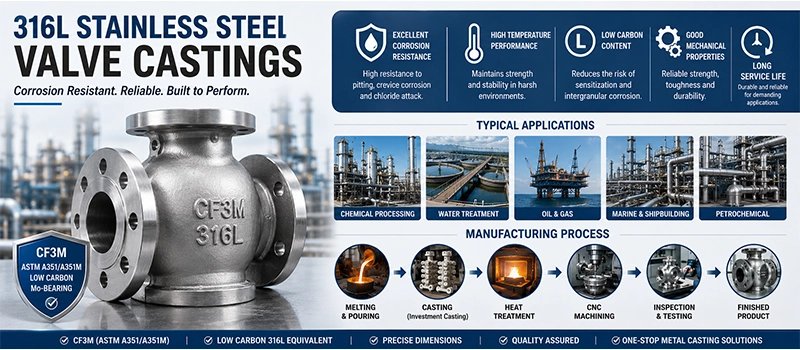
| 316 | Chromium-nickel alloy with added molybdenum | Improved resistance to chloride environments | Marine equipment, chemical processing components |
| 316L | Low-carbon version of 316 | Better weldability and resistance to sensitization | Pharmaceutical equipment, pressure vessels |
| 317 / 317L | Higher molybdenum content than 316 | Enhanced resistance to aggressive chemical environments | Chemical industry and industrial processing equipment |
| Super Austenitic Grades (e.g., 904L) | Higher nickel, chromium, and molybdenum content | Excellent resistance to highly corrosive environments | Offshore engineering, petrochemical plants |
These grades demonstrate how austenitic stainless steel compositions can be adjusted to achieve different performance characteristics. By modifying the levels of chromium, nickel, molybdenum, and carbon, metallurgists can tailor the material to meet the needs of specific industrial environments.
Another important feature of the austenitic stainless steel family is the presence of low-carbon variants, typically indicated by the letter “L” in the grade designation. These low-carbon alloys are designed to reduce the risk of intergranular corrosion in welded structures. By limiting carbon content, the formation of chromium carbides at grain boundaries is minimized, helping maintain the integrity of the protective chromium oxide layer.
In addition to standard grades, the development of super austenitic stainless steels has expanded the capabilities of this material family. These alloys contain higher concentrations of nickel, chromium, molybdenum, and sometimes nitrogen. The enhanced alloying improves resistance to aggressive environments such as seawater, acidic solutions, and chloride-rich industrial processes.
The wide range of grades available demonstrates the flexibility of austenitic stainless steel as an engineering material. Through careful control of chemical composition, different alloys can be designed to perform reliably in environments ranging from food processing equipment to highly corrosive chemical processing systems.
Corrosion Resistance of Austenitic Stainless Steel
Corrosion resistance is one of the most important characteristics of austenitic stainless steel. The ability of this material to resist chemical attack in a wide variety of environments is primarily attributed to the presence of chromium in its composition. When exposed to oxygen, chromium forms a thin, stable oxide layer on the surface of the metal. This passive film acts as a protective barrier that prevents further oxidation or chemical reaction between the steel and its surrounding environment.
According to technical studies and materials data published by the Nickel Institute, the passive chromium oxide layer is self-healing. If the surface of the material is scratched or mechanically damaged, chromium in the alloy reacts with oxygen again and rapidly reforms the protective film. This self-repairing behavior is a fundamental reason why austenitic stainless steel performs reliably in corrosive environments.
General Corrosion Resistance
In many atmospheric and aqueous environments, austenitic stainless steel demonstrates strong resistance to uniform corrosion. The chromium-rich passive layer significantly reduces the rate of metal dissolution and surface degradation. As a result, austenitic stainless steels are widely used in environments where ordinary carbon steels would quickly rust or deteriorate.
The level of corrosion resistance depends on the alloy composition. Higher chromium and nickel contents generally improve resistance to chemical attack. Additional alloying elements such as molybdenum may further enhance corrosion resistance in more aggressive environments.
Intergranular Corrosion
One form of corrosion that can occur in austenitic stainless steel is intergranular corrosion, which takes place along the grain boundaries of the material. This phenomenon may develop when chromium carbides form at grain boundaries under certain thermal conditions. The precipitation of chromium carbides reduces the local chromium concentration near the grain boundaries, weakening the protective passive film in those areas.
If the chromium level in these regions falls below the threshold required for passivation, the material may become vulnerable to localized corrosion along grain boundaries. Controlling carbon content and alloy composition helps reduce the risk of this type of degradation.
Stress Corrosion Cracking
Another corrosion-related concern in austenitic stainless steel is stress corrosion cracking (SCC). This type of failure occurs when three factors act simultaneously: tensile stress, a corrosive environment, and a susceptible material.
In chloride-containing environments, such as seawater or industrial chemical solutions, stress corrosion cracking can sometimes occur in austenitic stainless steels under high stress levels. Cracks may initiate and propagate even when the overall corrosion rate of the material appears low. Engineers therefore consider environmental conditions and stress levels carefully when selecting materials for chloride-rich environments.
Sensitization in Austenitic Stainless Steel
Sensitization is another phenomenon associated with corrosion behavior in austenitic stainless steel. It occurs when the material is exposed to temperatures typically between about 450 °C and 850 °C, allowing chromium carbides to precipitate along grain boundaries.
This precipitation reduces the chromium content in adjacent regions, weakening the protective passive film locally. Once sensitization occurs, the material becomes more susceptible to intergranular corrosion in certain environments.
To reduce this risk, manufacturers often use low-carbon versions of austenitic stainless steels or carefully control heat treatment and welding conditions during fabrication.

Factors Affecting Corrosion Resistance
Several factors influence the corrosion resistance of austenitic stainless steel, including:
- Chemical composition of the alloy
- Surface condition and finish
- Environmental exposure conditions
- Temperature and chemical concentration
- Mechanical stresses in the material
Proper material selection, surface treatment, and fabrication processes can significantly improve corrosion performance.
Applications of Austenitic Stainless Steel
Due to its balanced material characteristics, austenitic stainless steel is widely used across many industrial sectors. Its structural stability, resistance to environmental degradation, and good fabrication characteristics make it suitable for components that must operate reliably under demanding conditions. As a result, austenitic stainless steel has become a fundamental engineering material in industries ranging from chemical processing to food production and construction.
The versatility of austenitic stainless steel allows it to be manufactured into a variety of product forms, including plates, sheets, pipes, tubes, bars, and precision-machined components. These forms are then integrated into equipment, structures, and industrial systems where durability and long service life are required.
Chemical and Petrochemical Equipment
One of the most important application areas for austenitic stainless steel is the chemical and petrochemical industry. Equipment used in chemical processing often operates in environments that contain acids, alkalis, or other corrosive substances. In such conditions, materials must resist corrosion while maintaining structural integrity.
Austenitic stainless steel is commonly used for manufacturing reactors, storage tanks, heat exchangers, and pipelines in chemical plants. The material’s ability to maintain its structural stability in corrosive environments helps ensure the safety and reliability of industrial processing systems.
Food Processing and Pharmaceutical Equipment
Another major application of austenitic stainless steel is in food processing and pharmaceutical manufacturing. Equipment used in these industries must meet strict hygiene and cleanliness requirements. Surfaces must be easy to clean and resistant to contamination or chemical reactions with food products.
Austenitic stainless steel is widely used for food processing machinery, storage containers, mixing equipment, and sanitary pipelines. Its smooth surface finish and resistance to corrosion make it suitable for environments where cleanliness and durability are essential.
Marine and Offshore Engineering
Marine environments present significant challenges for metallic materials due to the presence of saltwater and chloride ions. These conditions accelerate corrosion in many conventional metals. For this reason, austenitic stainless steel is frequently selected for marine and offshore structures where corrosion resistance is essential.
Typical marine applications include ship components, offshore platforms, desalination equipment, and coastal infrastructure. The material’s stability in humid and saline environments helps extend the operational lifespan of equipment exposed to seawater.
Construction and Architectural Applications
In the construction industry, austenitic stainless steel is used for both structural and architectural purposes. The material combines durability with an attractive surface appearance, making it suitable for visible structural elements as well as decorative applications.
Common construction uses include building facades, structural supports, railings, roofing components, and architectural panels. The corrosion resistance of austenitic stainless steel also reduces long-term maintenance requirements for structures exposed to outdoor environments.

Industrial Machinery and Equipment
Many types of industrial machinery incorporate austenitic stainless steel components because the material performs well under mechanical stress and varying environmental conditions. Precision components, fasteners, valves, and mechanical assemblies often rely on stainless steel materials to ensure long-term reliability.
Manufacturers may use austenitic stainless steel in pumps, valves, pressure vessels, and mechanical fittings, especially in environments where exposure to moisture, chemicals, or temperature fluctuations could affect other materials.
Austenitic Stainless Steel vs Other Stainless Steels
Stainless steels are commonly classified according to their metallurgical microstructure. The main categories include austenitic, ferritic, martensitic, and duplex stainless steels. Each type has a different crystal structure, alloy composition, and performance characteristics. Understanding the differences between these stainless steel families helps engineers and material specialists select appropriate materials for specific applications.
The following table provides a simplified comparison between the major stainless steel types.
| Stainless Steel Type | Typical Microstructure | Key Alloying Elements | General Characteristics | Typical Uses |
|---|---|---|---|---|
| Austenitic Stainless Steel | Face-centered cubic (FCC) austenite | Chromium, nickel, sometimes molybdenum | Good corrosion resistance, high ductility, good weldability, generally non-magnetic | Chemical equipment, food processing machinery, construction components |
| Ferritic Stainless Steel | Body-centered cubic (BCC) ferrite | Chromium with low or no nickel | Moderate corrosion resistance, lower ductility, magnetic behavior | Automotive exhaust systems, appliances, industrial equipment |
| Martensitic Stainless Steel | Martensitic structure formed by heat treatment | Chromium with higher carbon content | Higher hardness and strength, lower corrosion resistance, magnetic | Cutting tools, turbine blades, mechanical components |
| Duplex Stainless Steel | Mixed austenite and ferrite structure | Chromium, nickel, molybdenum, nitrogen | Higher strength than many stainless steels, good corrosion resistance | Offshore structures, chemical processing equipment |
From a structural perspective, the most significant difference between these stainless steel families lies in their crystal structure. Austenitic alloys contain a face-centered cubic lattice, while ferritic steels exhibit a body-centered cubic structure and martensitic steels form a distorted martensitic structure after heat treatment. Duplex stainless steels combine both ferritic and austenitic phases in their microstructure.
Another important distinction involves magnetic behavior. Ferritic and martensitic stainless steels are generally magnetic due to their crystal structures, while austenitic alloys typically show little or no magnetism in the annealed state. Duplex stainless steels may exhibit partial magnetic behavior because of their mixed microstructure.
Mechanical behavior also varies significantly between these stainless steel types. Ferritic steels generally offer moderate strength but lower ductility. Martensitic steels are known for high hardness and strength after heat treatment. Duplex steels provide relatively high strength and good corrosion resistance due to their dual-phase structure.
Overall, the differences between stainless steel families originate primarily from their metallurgical structure and alloy composition. These differences influence how each material behaves under mechanical stress, environmental exposure, and fabrication processes. Understanding these distinctions is an important step when comparing stainless steels for engineering or industrial applications.
Advantages and Limitations of Austenitic Stainless Steel
The widespread adoption of austenitic stainless steel in engineering and manufacturing is largely due to its balanced combination of mechanical stability, corrosion resistance, and fabrication flexibility. However, like all materials, it also has certain limitations that engineers must consider when selecting materials for specific environments. A clear understanding of both the advantages and the potential constraints of this stainless steel family helps ensure appropriate material selection and reliable long-term performance.
Advantages of Austenitic Stainless Steel
Excellent Corrosion Resistance
One of the most significant advantages of austenitic stainless steel is its strong resistance to corrosion in many industrial and environmental conditions. This resistance originates from the chromium content in the alloy, which forms a thin and stable passive oxide film on the surface of the metal. The protective layer acts as a barrier that slows chemical reactions between the steel and the surrounding environment. Because of this mechanism, components made from this material can maintain structural integrity even when exposed to moisture, chemicals, or atmospheric conditions for extended periods.
High Ductility and Formability
Another important advantage is the high ductility associated with the austenitic crystal structure. The face-centered cubic lattice provides multiple slip systems that allow the material to deform without cracking. This property makes the steel particularly suitable for manufacturing processes that involve forming, bending, rolling, or deep drawing. As a result, manufacturers can produce complex shapes and thin-walled components without compromising structural stability.

Good Weldability
Fabrication flexibility is also an important characteristic. Many alloys in this stainless steel family can be welded using common industrial welding methods. The ability to produce reliable welded joints simplifies the fabrication of equipment, piping systems, and structural assemblies. This capability is particularly valuable in industries where large welded structures are required.
Non-Magnetic Behavior
In the annealed condition, most alloys within this stainless steel family exhibit little or no magnetic response. This property is a direct result of the face-centered cubic structure of austenite. Because of this characteristic, the material is often selected for applications where magnetic interference must be minimized or controlled.
Good Toughness at Low Temperatures
A further advantage is the ability of this material to maintain ductility and impact resistance even at low temperatures. Many steels tend to become brittle under cryogenic conditions, but the austenitic structure allows this material to retain toughness across a wide temperature range. This property makes it suitable for equipment used in low-temperature environments.
Limitations of Austenitic Stainless Steel
Relatively Lower Yield Strength
Compared with some other stainless steel families, this material typically has lower yield strength. For structural applications that require very high strength, designers may need to increase section thickness or consider alternative alloys. In some cases, strength can be improved through cold working processes, but this approach may not always be suitable for every design.
Higher Material Cost
Another limitation is the relatively higher production cost. The presence of alloying elements such as nickel contributes significantly to the cost of manufacturing. In large-scale engineering projects where material cost is a critical factor, this may influence the selection of alternative stainless steel types or other materials.
Higher Thermal Expansion
Austenitic alloys generally have a higher coefficient of thermal expansion compared with ferritic stainless steels. When components operate under conditions involving significant temperature variation, this expansion must be considered during design. Engineers may incorporate expansion joints or other structural solutions to accommodate dimensional changes.
Sensitivity to Certain Service Conditions
Although the material performs well in many environments, certain service conditions may still present challenges. Under specific combinations of stress, temperature, and chemical exposure, localized corrosion or other degradation mechanisms may occur. Proper material selection, design considerations, and environmental control can help minimize these risks.

Conclusion
Austenitic stainless steel represents one of the most important material families within modern stainless steels. Its unique austenitic crystal structure, combined with carefully controlled alloy composition, provides a balance of structural stability, corrosion resistance, and manufacturing flexibility. These characteristics allow the material to perform reliably in a wide range of industrial environments.
By understanding its chemical composition, microstructure, key properties, common grades, corrosion behavior, and industrial applications, engineers and material specialists can make more informed decisions when selecting stainless steel materials. At the same time, recognizing the differences between austenitic stainless steel and other stainless steel families helps clarify its role in engineering design.
Although certain limitations must be considered during material selection, the overall performance and versatility of austenitic stainless steel continue to make it one of the most widely used stainless steel categories in modern industry.