Casting shrinkage of alloys is a natural phenomenon that occurs as molten metal cools and solidifies during the casting process. Different alloys shrink at different rates, directly affecting the dimensional accuracy, quality, and performance of the final casting. Understanding the causes of alloy shrinkage and how to control it is essential for producing reliable, high-quality cast components.
What Is Casting Shrinkage of Alloys?
Casting shrinkage of alloys refers to the natural reduction in the volume and dimensions of a metal as it changes from a molten state to a solid casting. This phenomenon occurs in every metal casting process and is an inherent physical characteristic of metallic materials. Because all alloys contract as they cool, foundries must take shrinkage into account during product design, tooling development, and manufacturing to ensure the final casting meets the required dimensions.
During casting, molten alloy is poured into a mold that has been designed to match the desired component. As the metal gradually loses heat, its atoms move closer together, causing the material to occupy less space than it did in its liquid state. This reduction in volume results in casting shrinkage. The amount of shrinkage varies depending on the alloy being used, as different metals have different thermal and metallurgical properties.
Casting shrinkage is often expressed as a shrinkage rate or shrinkage allowance. A shrinkage rate describes the percentage or dimensional change that occurs as the alloy solidifies and cools, while shrinkage allowance refers to the additional dimensions intentionally built into the pattern or tooling to compensate for this expected contraction. Properly accounting for shrinkage allows manufacturers to produce castings that closely match the specified dimensions after cooling.
It is important to understand that casting shrinkage is not considered a manufacturing defect. Instead, it is a predictable characteristic of the casting process that must be carefully managed through engineering and process design. Experienced foundries incorporate shrinkage allowances into mold and pattern design so that the finished casting achieves the required size and geometry once solidification is complete.
Although every alloy experiences shrinkage, the degree of contraction is not the same for all materials. Stainless steel, carbon steel, alloy steel, aluminum, cast iron, brass, and bronze each exhibit different shrinkage characteristics due to their unique chemical compositions and physical properties. Understanding these material-specific behaviors is essential for producing accurate, high-quality cast components across a wide range of industrial applications.
In modern metal casting, accurately understanding casting shrinkage of alloys is one of the fundamental principles of successful foundry engineering. It influences tooling design, dimensional accuracy, manufacturing consistency, and the overall quality of the finished casting, making it an essential consideration in every casting project.
Why Does Casting Shrinkage Occur?
Casting shrinkage occurs because metals naturally contract as they lose heat during the casting process. When an alloy is heated to a molten state, its atoms become more active and spread farther apart. As the metal cools, atomic movement gradually decreases, causing the atoms to move closer together. This reduction in atomic spacing results in a decrease in both volume and overall dimensions, creating what is known as casting shrinkage.
Although the cooling process appears straightforward, shrinkage does not occur at a single moment. Instead, it develops continuously as the alloy changes from liquid metal to a fully solid casting. The amount of shrinkage depends on the physical properties of the alloy, its chemical composition, and how heat is removed during solidification.
Foundry engineers generally classify casting shrinkage into three stages.
Liquid Shrinkage
Liquid shrinkage occurs while the alloy remains completely molten. As the temperature of the liquid metal decreases after pouring, its volume gradually contracts before solidification begins.
During this stage, the alloy is still able to flow freely inside the mold. The reduction in volume is usually compensated by additional molten metal supplied through the gating and feeding system, allowing the mold cavity to remain completely filled.
Solidification Shrinkage
Solidification shrinkage takes place as the alloy changes from liquid to solid. This is one of the most critical stages of the casting process because the metal begins forming its internal structure while continuing to lose volume.
Unlike liquid metal, partially solidified metal can no longer flow freely. If sufficient molten metal is not available to compensate for the volume reduction during this stage, shrinkage-related defects may develop within the casting. For this reason, proper feeding system design is an important consideration during mold development.
Solid-State Shrinkage
After the alloy has completely solidified, it continues to contract as its temperature gradually decreases to room temperature. This final stage is known as solid-state shrinkage.
Although the metal has already formed its final shape, thermal contraction continues throughout the cooling process. This dimensional change directly influences the final size of the casting and is the primary reason why foundries apply shrinkage allowances when designing patterns and tooling.
Different Alloys Shrink at Different Rates
Every alloy exhibits its own shrinkage characteristics. Factors such as chemical composition, crystal structure, melting temperature, and thermal expansion coefficient all influence how much an alloy contracts during cooling.
For example, stainless steels generally experience greater shrinkage than gray iron, while aluminum alloys behave differently from carbon steels. Because these characteristics vary from one material to another, foundries must consider the specific alloy being used before determining the appropriate pattern dimensions and manufacturing parameters.
Understanding why casting shrinkage occurs is essential for producing dimensionally accurate castings. Since shrinkage is a natural characteristic of every casting alloy, successful manufacturing depends on accurately predicting and compensating for this behavior throughout the casting process.
Casting Shrinkage Rates of Common Alloys
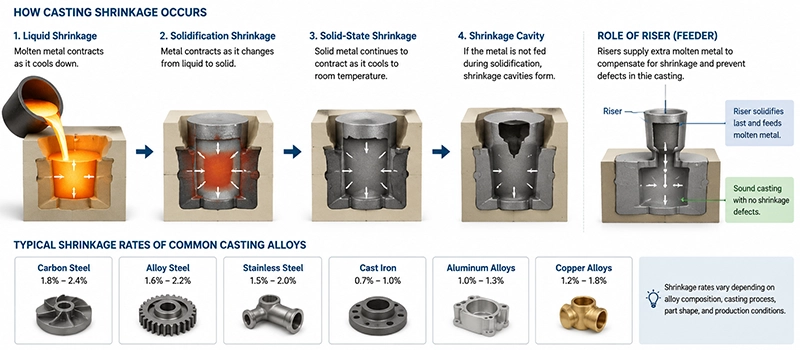
Understanding the casting shrinkage of alloys is essential when designing patterns, molds, and tooling for metal castings. Every alloy contracts as it cools, but the amount of contraction varies depending on its chemical composition and metallurgical properties. Because of these differences, the casting shrinkage of alloys must always be considered before production begins to ensure the final casting meets the required dimensions.
There is no universal shrinkage value that applies to every material. Instead, each alloy has its own typical shrinkage range developed through industry standards and manufacturing experience. In addition, the actual casting shrinkage of alloys may vary depending on the casting process, mold material, cooling conditions, pouring temperature, and part geometry.
The following table provides typical casting shrinkage rates for many of the alloys commonly used in modern foundries. These values are intended as general engineering references and may vary according to specific manufacturing conditions.
Typical Casting Shrinkage Rates of Common Alloys
| Alloy | Typical Shrinkage Rate |
|---|---|
| Carbon Steel | 2.0% – 2.6% |
| Low Alloy Steel | 2.0% – 2.5% |
| High Alloy Steel | 2.0% – 2.4% |
| Stainless Steel 304 | 2.0% – 2.3% |
| Stainless Steel 304L | 2.0% – 2.3% |
| Stainless Steel 316 | 2.0% – 2.3% |
| Stainless Steel 316L | 2.0% – 2.3% |
| Stainless Steel 410 | 1.9% – 2.2% |
| Stainless Steel 420 | 1.9% – 2.2% |
| 17-4 PH Stainless Steel | 2.0% – 2.3% |
| Duplex Stainless Steel | 2.0% – 2.3% |
| Gray Cast Iron | 0.8% – 1.3% |
| Ductile Iron | 1.0% – 1.8% |
| Malleable Iron | 1.0% – 1.6% |
| Aluminum Alloys | 1.2% – 1.8% |
| ADC12 Aluminum Alloy | 1.0% – 1.4% |
| A356 Aluminum Alloy | 1.2% – 1.5% |
| Brass | 1.3% – 1.8% |
| Bronze | 1.5% – 2.0% |
| Copper | 1.8% – 2.1% |
| Zinc Alloys | 0.7% – 1.3% |
| Magnesium Alloys | 1.2% – 1.6% |
| Nickel Alloys | 2.0% – 2.5% |
| Cobalt Alloys | 2.0% – 2.4% |
Why Do Shrinkage Rates Differ?
The casting shrinkage of alloys differs because every metal has its own chemical composition, crystal structure, melting temperature, and coefficient of thermal expansion. These material characteristics determine how much volume is lost as the alloy cools from a molten state to room temperature.
For example, steel alloys generally experience greater casting shrinkage of alloys than cast irons, while aluminum alloys typically shrink less than stainless steels. Even alloys within the same material family can exhibit slight differences due to variations in alloying elements and manufacturing conditions.
Using Casting Shrinkage Data in Production
Foundries use casting shrinkage of alloys data primarily during pattern and tooling design. Engineers calculate the appropriate shrinkage allowance before production so that the finished casting reaches the specified dimensions after cooling and solidification.
Although standard shrinkage values provide an excellent starting point, experienced foundries often adjust shrinkage allowances based on their own production data, casting process, component geometry, and material behavior. This practical approach helps improve dimensional accuracy, reduce machining requirements, and achieve consistent casting quality across different production batches.
Factors That Affect Casting Shrinkage
Although every alloy has a typical shrinkage range, the actual casting shrinkage of alloys is influenced by much more than material selection alone. Even when using the same alloy, shrinkage behavior can vary depending on production conditions, casting design, and process parameters. Understanding these factors allows foundries to better predict shrinkage and manufacture castings with improved dimensional accuracy and consistency.
Alloy Composition
The chemical composition of an alloy is one of the most significant factors affecting casting shrinkage of alloys. Different alloying elements influence melting temperature, solidification behavior, and thermal expansion, resulting in different shrinkage characteristics.
For example, stainless steels generally exhibit higher shrinkage than gray cast iron, while aluminum alloys typically experience lower shrinkage than carbon steels. Even small variations in alloy composition can lead to measurable differences in shrinkage behavior.
Casting Geometry
The shape and complexity of a casting also influence how the alloy shrinks during cooling. Components with irregular geometries, large cross-sections, or isolated heavy areas tend to cool unevenly, which can result in localized shrinkage.
Designing castings with balanced geometry helps promote more uniform solidification throughout the component.
Wall Thickness
Wall thickness has a direct effect on cooling speed. Thin sections cool rapidly, while thicker sections retain heat for a longer period. When a casting contains large variations in wall thickness, different areas cool at different rates, increasing the likelihood of uneven contraction.
Maintaining relatively uniform wall thickness is a common engineering practice for improving dimensional stability.
Mold Material
Different mold materials remove heat from molten metal at different rates. Sand molds cool more slowly than ceramic or metal molds, affecting the solidification process and the final casting shrinkage of alloys.
The selection of mold material is therefore an important consideration when establishing appropriate shrinkage allowances.
Pouring Temperature
Molten metal must be poured within an appropriate temperature range. If the pouring temperature is too high, the alloy contains additional heat energy and requires more time to cool, which may increase overall shrinkage.
Conversely, pouring at excessively low temperatures may affect mold filling and casting quality. Maintaining proper pouring temperatures helps improve both dimensional accuracy and production consistency.
Cooling Rate
The rate at which a casting cools significantly affects its final dimensions. Rapid cooling and slow cooling produce different solidification characteristics, leading to variations in the casting shrinkage of alloys.
Controlling cooling conditions throughout the production process helps foundries achieve more predictable shrinkage behavior.
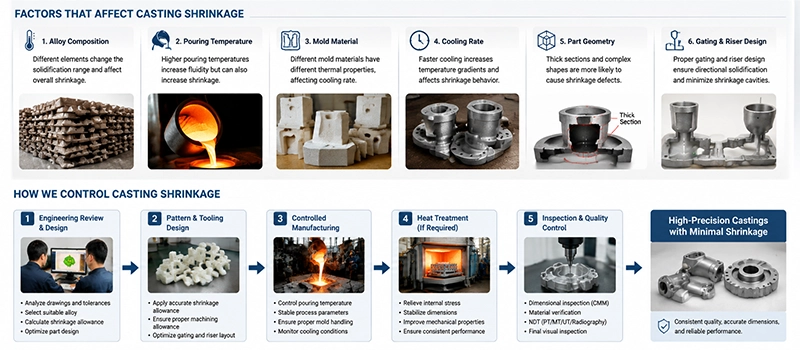
Feeding System Design
The gating and feeding system plays an essential role in compensating for volume reduction during solidification. Properly designed runners, gates, and risers ensure that molten metal continues to feed the casting as shrinkage occurs.
An optimized feeding system helps maintain casting integrity and contributes to consistent dimensional accuracy.
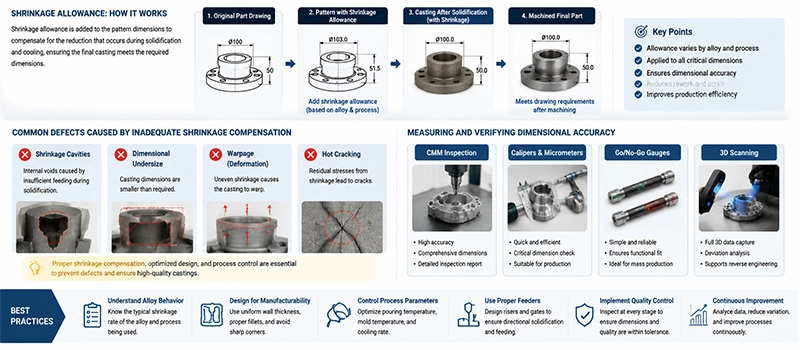
Pattern Shrinkage Allowance
Before production begins, foundries incorporate a shrinkage allowance into the pattern design based on the expected casting shrinkage of alloys. The pattern is intentionally made larger than the desired finished casting so that the final dimensions match the engineering drawing after cooling.
Accurate shrinkage allowances are determined through a combination of material data, engineering calculations, and production experience.
Manufacturing Experience
Although industry reference values provide a useful starting point, experienced foundries understand that actual casting shrinkage of alloys often requires practical adjustments. Production history, process optimization, equipment capabilities, and engineering expertise all contribute to more accurate shrinkage prediction.
By combining theoretical calculations with real manufacturing experience, foundries can achieve higher dimensional consistency, reduce production variation, and improve the overall quality of finished castings.
How to Reduce Casting Shrinkage
Although the casting shrinkage of alloys cannot be completely eliminated, it can be accurately predicted and effectively controlled through proper engineering design and manufacturing practices. Modern foundries use a combination of material knowledge, tooling design, process optimization, and production experience to minimize the impact of shrinkage on casting quality and dimensional accuracy.
Select the Appropriate Alloy
Every alloy has unique shrinkage characteristics. Choosing the right material for a specific application is the first step in controlling the casting shrinkage of alloys. Engineers evaluate factors such as mechanical properties, corrosion resistance, dimensional requirements, and manufacturing feasibility before selecting the most suitable alloy.
Understanding the expected shrinkage behavior of each material allows foundries to establish accurate shrinkage allowances during the early stages of product development.
Design Proper Shrinkage Allowances
Patterns used in casting are intentionally manufactured larger than the finished component to compensate for the expected casting shrinkage of alloys. Determining the correct shrinkage allowance requires consideration of the alloy type, casting dimensions, mold material, and production process.
Accurate pattern design helps ensure that the final casting achieves the required dimensions after cooling and solidification.
Optimize Casting Design
Product design has a significant influence on shrinkage behavior. Components with relatively uniform wall thicknesses generally cool more evenly than those containing abrupt thickness changes or large isolated sections.
During the engineering review stage, designers often optimize part geometry to encourage more balanced cooling and improve dimensional consistency without affecting product performance.
Improve Gating and Feeding Systems
A well-designed gating and feeding system plays an important role in compensating for the natural casting shrinkage of alloys. Proper runner, gate, and riser design allows molten metal to continue feeding the casting as solidification progresses, helping maintain dimensional stability throughout the cooling process.
Optimizing metal flow also contributes to more consistent production quality across different casting batches.
Control Pouring and Cooling Conditions
Stable production parameters are essential for achieving predictable shrinkage. Foundries carefully control pouring temperature, mold temperature, and cooling conditions to maintain consistent manufacturing results.
By reducing unnecessary process variation, manufacturers are able to achieve more reliable control over the casting shrinkage of alloys while improving repeatability from one production run to another.
Apply Simulation and Engineering Analysis
Many modern foundries use casting simulation software during product development to evaluate metal flow, solidification behavior, and expected shrinkage before production begins.
Simulation allows engineers to identify potential problem areas early in the design stage, optimize tooling, and improve overall manufacturing efficiency before the first casting is produced.
Work with an Experienced Foundry
Controlling the casting shrinkage of alloys requires more than theoretical calculations. It depends on practical manufacturing experience, process optimization, and continuous quality improvement developed through years of production.
An experienced foundry understands how different alloys behave under various manufacturing conditions and can make appropriate adjustments based on actual production data. This combination of engineering expertise and production knowledge helps achieve consistent dimensional accuracy, reliable product quality, and efficient manufacturing for a wide variety of custom casting projects.
How Dalian Zhongsheng Controls Casting Shrinkage
At Dalian Zhongsheng Metal Product Co., Ltd., controlling the casting shrinkage of alloys begins long before production starts. Rather than relying solely on standard shrinkage values, we combine engineering analysis, manufacturing experience, and strict process control to ensure every casting achieves the required dimensional accuracy and quality. By integrating shrinkage management into every stage of production, we help customers reduce machining allowances, improve product consistency, and minimize manufacturing risks.
Engineering Review Before Production
Every project begins with a detailed engineering review. Our technical team evaluates customer drawings, material specifications, wall thickness, tolerances, and structural features to determine the most appropriate manufacturing solution.
By identifying potential shrinkage concerns during the design stage, we can optimize the production plan before tooling is manufactured, helping to improve both casting quality and dimensional accuracy.
Optimized Pattern and Tooling Design
Accurate pattern design is essential for compensating for the casting shrinkage of alloys. Based on the selected alloy and manufacturing process, our engineers apply appropriate shrinkage allowances when developing tooling.
This ensures that components reach the specified dimensions after solidification and cooling while reducing the need for excessive machining or dimensional corrections.
Strict Process Control
Consistent production conditions are critical for predictable shrinkage behavior. Throughout the casting process, key manufacturing parameters are carefully controlled, including:
- Material selection
- Melting temperature
- Pouring temperature
- Mold preparation
- Cooling conditions
Maintaining stable production parameters allows us to achieve more consistent casting shrinkage of alloys across different production batches.
Advanced Quality Inspection
Dimensional verification is performed throughout the manufacturing process to confirm that castings meet customer specifications.
Depending on project requirements, inspection methods may include:
- Dimensional measurement
- Coordinate Measuring Machine (CMM) inspection
- Material verification
- Visual inspection
- Non-destructive testing (NDT)
These inspection procedures help verify that shrinkage has been properly controlled before products are delivered to customers.
Continuous Process Improvement
Every production project provides valuable manufacturing data. Our engineering and production teams continuously analyze casting performance and production results to refine process parameters and improve shrinkage control.
This ongoing optimization enables us to achieve greater manufacturing consistency while supporting increasingly demanding customer requirements.
Experience Makes the Difference
Although reference shrinkage values are widely available, successfully controlling the casting shrinkage of alloys depends on practical foundry experience. Every casting presents unique challenges based on its material, geometry, and production requirements.
With years of experience in precision investment casting, Dalian Zhongsheng Metal Product Co., Ltd. has developed the expertise to accurately predict and manage alloy shrinkage for a wide variety of custom metal components. By combining engineering knowledge, advanced manufacturing processes, and comprehensive quality control, we deliver castings that consistently meet customer expectations for precision, reliability, and performance.
Conclusion
Casting shrinkage of alloys is an unavoidable characteristic of the metal casting process, but it can be accurately predicted and effectively controlled through proper engineering, tooling design, and manufacturing expertise. Understanding how different alloys behave during solidification allows manufacturers to improve dimensional accuracy, reduce production risks, and produce high-quality cast components.
Whether you are designing a new product or sourcing custom alloy castings, working with an experienced foundry can make a significant difference in the final result. At Dalian Zhongsheng Metal Product Co., Ltd., we combine precision investment casting, comprehensive quality control, and professional engineering support to help customers achieve reliable, consistent, and cost-effective casting solutions for a wide range of industrial applications.