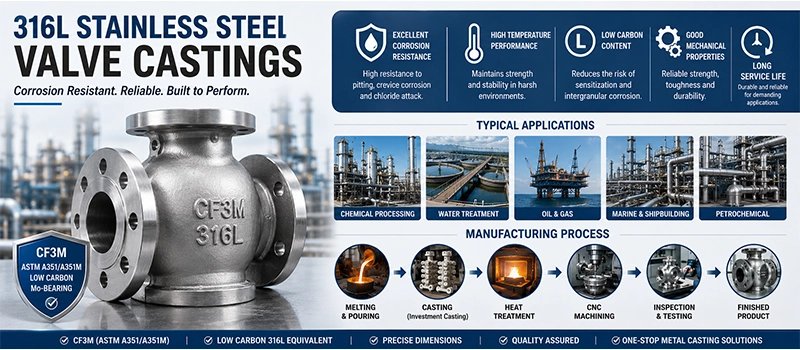
NDT in investment casting plays a critical role in ensuring the reliability and quality of precision metal components. Although investment casting can achieve excellent dimensional accuracy and surface finish, potential internal or surface defects may still occur during manufacturing. Non-destructive testing methods help identify these issues without damaging the finished casting, making them an essential part of quality control for high-performance components. This guide explains the common NDT methods used in investment casting and their importance in modern manufacturing.
What Is NDT in Investment Casting?
NDT in investment casting refers to the application of non-destructive testing methods to evaluate the quality, integrity, and reliability of investment cast components without causing any damage to the finished parts. Unlike destructive testing, which requires cutting, breaking, or permanently altering a sample, NDT allows manufacturers to inspect actual production components while keeping them suitable for their intended applications.
Investment casting is widely used for manufacturing precision components with complex geometries, tight tolerances, and high-performance requirements. The process can produce excellent surface finishes and dimensional accuracy, but like any metal manufacturing method, it may still experience potential issues during melting, mold filling, solidification, and cooling. NDT provides an effective way to identify these potential problems before components are delivered to customers.
The main purpose of NDT in investment casting is to verify that castings meet specific quality requirements. Depending on the application and material, NDT methods can be used to detect surface cracks, internal porosity, shrinkage cavities, inclusions, and other discontinuities that may affect the performance of the component.
Different NDT techniques are selected based on factors such as casting material, component structure, defect location, and industry requirements. For example, surface inspection methods are commonly used to identify visible or near-surface defects, while advanced inspection methods can evaluate internal areas that cannot be examined through visual inspection alone.
For precision investment castings used in industries such as automotive, aerospace, energy, mining, and industrial equipment, NDT is an important part of the manufacturing process. It provides additional confidence that components can perform reliably under demanding operating conditions while helping manufacturers maintain consistent quality standards.
By integrating NDT into investment casting quality control, manufacturers can improve product reliability, reduce the risk of field failures, and provide customers with cast components that meet strict technical specifications.
Why Is NDT Important for Investment Castings?
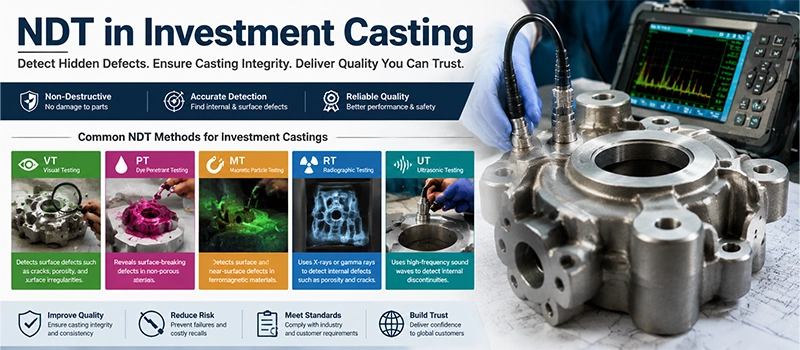
NDT in investment casting is an essential quality control process because it helps manufacturers verify the structural integrity and reliability of precision cast components. Although investment casting is known for producing parts with excellent accuracy and surface quality, the complexity of the process means that certain defects may still occur during melting, mold filling, solidification, and cooling. NDT provides a reliable method to identify these potential issues without affecting the usability of the casting.
Ensuring Product Reliability
Investment castings are often used in applications where component failure can result in serious performance issues. Industries such as automotive, energy, industrial machinery, and aerospace require metal parts that can withstand pressure, vibration, heat, and mechanical stress.
NDT in investment casting helps confirm that components are free from critical defects that could reduce their service life. By identifying potential problems before delivery, manufacturers can improve product reliability and help customers avoid unexpected failures during operation.
Detecting Hidden Defects
Some casting defects cannot be identified through visual inspection alone. Internal discontinuities such as porosity, shrinkage cavities, and inclusions may exist beneath the surface while the external appearance of the casting remains acceptable.
Through appropriate NDT methods, manufacturers can examine both surface and internal areas of investment castings. This allows quality teams to detect hidden problems and take corrective action before the components enter final applications.
Meeting Industry Standards and Customer Requirements
Many industries require investment castings to meet strict quality standards and inspection requirements. Depending on the application, customers may specify certain NDT procedures, acceptance criteria, or inspection documentation before approving a supplier.
By implementing NDT in investment casting, manufacturers can provide objective quality verification and demonstrate that their products meet technical specifications. This is especially important for components used in safety-critical or high-performance applications.
Improving Manufacturing Processes
NDT is not only used for final product inspection. The information collected during testing can also help manufacturers improve their casting processes.
When inspection results identify repeated issues, engineers can analyze possible causes related to tooling design, material selection, melting conditions, or solidification control. This continuous improvement approach helps reduce defects, improve production consistency, and enhance overall manufacturing efficiency.
Reducing Costs and Production Risks
Identifying defects at an early stage can significantly reduce unnecessary costs. Without proper inspection, defective castings may reach later production stages or even final applications, resulting in additional machining costs, production delays, or product failures.
NDT in investment casting provides an effective quality assurance method that helps manufacturers detect potential problems before they become more expensive issues. By combining inspection technology with experienced engineering judgment, foundries can deliver more reliable investment cast components while maintaining efficient production processes.
Common NDT Methods Used in Investment Casting
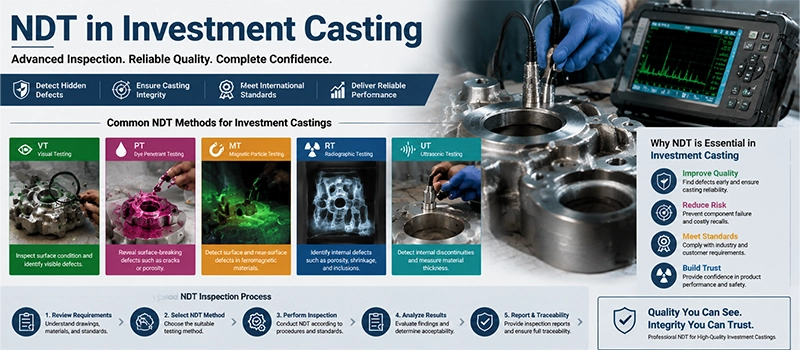
NDT in investment casting includes several inspection methods designed to identify different types of defects without damaging the finished components. Since investment castings are often used for precision and high-performance applications, selecting the appropriate testing method is essential for verifying product quality.
Different NDT methods provide different types of information. Some techniques focus on detecting surface defects, while others are designed to examine internal structures that cannot be seen from the outside. The most suitable inspection method depends on factors such as casting material, component design, defect type, and customer requirements.
Visual Testing (VT)
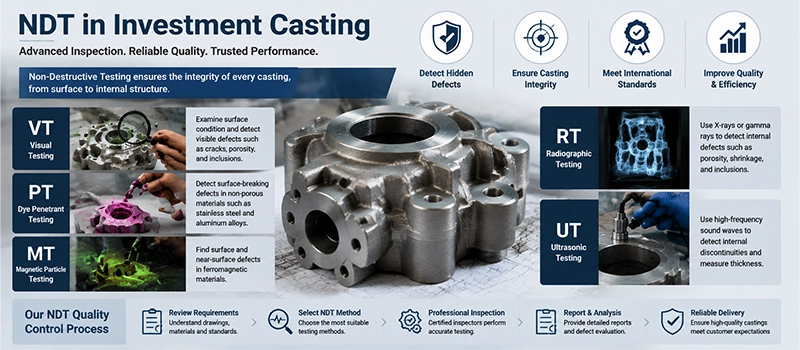
Visual testing is one of the most basic and widely used inspection methods in investment casting. It involves carefully examining the surface of a casting to identify visible defects such as cracks, surface irregularities, misruns, cold shuts, or incomplete finishing.
Although visual inspection cannot detect internal defects, it remains an important first step in the NDT in investment casting process. It allows inspectors to quickly evaluate overall casting appearance and identify obvious quality issues before more advanced testing methods are applied.
Experienced inspectors often use magnification tools, lighting equipment, and reference standards to improve inspection accuracy and ensure consistent evaluation.
Dye Penetrant Testing (PT)
Dye penetrant testing, also known as liquid penetrant testing, is commonly used for detecting surface-breaking defects in investment castings. This method is particularly suitable for non-porous materials such as stainless steel, aluminum alloys, and other non-ferromagnetic metals.
During PT inspection, a special liquid penetrant is applied to the casting surface. The penetrant enters small cracks or surface discontinuities through capillary action. After removing excess penetrant and applying a developer, defects become visible through color contrast or fluorescent indications.
PT is widely used in NDT in investment casting because it can detect very small surface cracks that may not be visible during normal visual inspection.
Magnetic Particle Testing (MT)
Magnetic particle testing is another surface inspection method used to detect cracks and near-surface defects. This method is mainly applied to ferromagnetic materials such as carbon steel and certain alloy steels.
During MT inspection, the casting is magnetized and magnetic particles are applied to the surface. Areas with discontinuities create magnetic field changes, causing the particles to gather around defect locations and form visible indications.
Compared with visual inspection, MT provides higher sensitivity for detecting small surface and slightly subsurface defects. However, because it requires magnetic materials, it is not suitable for most stainless steel grades.
Radiographic Testing (RT)
Radiographic testing uses X-rays or gamma rays to examine the internal structure of investment castings. It is one of the most effective NDT methods for identifying internal defects that cannot be detected through surface inspection.
RT can reveal issues such as:
- Internal porosity
- Shrinkage cavities
- Inclusions
- Internal cracks
- Lack of fusion areas
For critical investment castings used in demanding applications, radiographic testing provides valuable information about internal quality and helps ensure that components meet strict performance requirements.
Ultrasonic Testing (UT)
Ultrasonic testing uses high-frequency sound waves to detect internal discontinuities within metal components. When sound waves encounter a defect, the reflected signals can be analyzed to determine the location and size of the internal issue.
UT is especially useful for thicker investment castings where internal quality evaluation is required. It can detect defects such as internal cracks, voids, and discontinuities while providing detailed information about the condition of the material.
Dimensional Inspection and CMM Testing
Although dimensional inspection is not traditionally classified as NDT, it is an important part of investment casting quality control. Precision components require accurate verification to ensure that final dimensions match engineering drawings.
Coordinate Measuring Machine (CMM) inspection uses advanced measuring equipment to verify critical dimensions, tolerances, and geometric accuracy. Combined with other NDT in investment casting methods, dimensional inspection provides a complete evaluation of both structural quality and manufacturing accuracy.
Common Defects Detected by NDT in Investment Casting
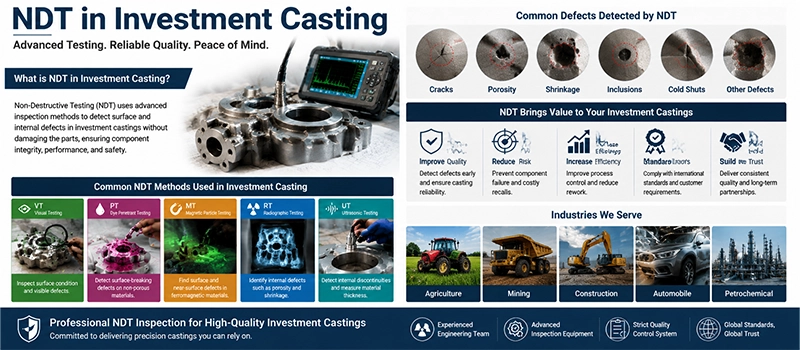
NDT in investment casting plays an important role in identifying defects that may affect the strength, durability, and performance of precision cast components. Although investment casting is capable of producing high-quality parts with excellent accuracy and surface finish, defects may still occur due to factors such as material behavior, mold filling conditions, solidification patterns, and cooling processes.
By applying suitable NDT methods, manufacturers can detect these issues before components are delivered to customers. Different inspection techniques are used to identify different types of defects, depending on whether the problem occurs on the surface, near the surface, or inside the casting.
Cracks
Cracks are one of the most critical defects that can occur in investment castings. They may develop during solidification, cooling, heat treatment, or later processing stages due to internal stress or improper process control.
Surface cracks can often be detected through dye penetrant testing or magnetic particle testing, while internal cracks may require radiographic testing or ultrasonic testing for identification.
Because cracks can significantly reduce the mechanical strength and service life of a component, detecting them through NDT in investment casting is essential for applications requiring high reliability.
Porosity
Porosity refers to small voids or gas pockets that form inside a casting. These defects may occur when gas becomes trapped in the molten metal during pouring or solidification.
Although small amounts of porosity may not always affect performance, excessive porosity can reduce material strength, pressure resistance, and fatigue performance. Radiographic testing and ultrasonic testing are commonly used to detect internal porosity that cannot be observed through surface inspection.
Shrinkage Cavities
Shrinkage cavities occur when molten metal cannot fully compensate for volume reduction during solidification. These defects are usually found in thicker sections or areas where cooling is uneven.
NDT methods such as radiographic testing help identify shrinkage cavities by revealing internal areas where the metal has not completely filled or solidified properly.
Inclusions
Inclusions are unwanted non-metallic materials trapped inside the casting during the manufacturing process. They may come from impurities in raw materials, slag, mold materials, or reactions during melting.
Internal inclusions can negatively affect mechanical properties and may become starting points for cracks under stress. Radiographic inspection and metallurgical analysis are often used to evaluate these defects.
Misruns and Cold Shuts
Misruns occur when molten metal fails to completely fill the mold cavity before solidifying. Cold shuts happen when two streams of molten metal meet but fail to fuse properly.
These defects usually appear on the surface of the casting and may affect the overall integrity of the component. Visual testing is commonly used for initial detection, while additional inspection methods may be applied depending on the severity and application requirements.
Surface Defects
Surface defects include rough areas, small cracks, incomplete filling, and irregular surface conditions. Although some surface imperfections may only affect appearance, others can influence functionality or become potential failure points.
Visual testing and dye penetrant testing are frequently used to evaluate surface quality during the NDT in investment casting process.
Dimensional Variations
While dimensional deviation is not a traditional casting defect, it is an important quality concern for precision investment castings. Incorrect process control, improper shrinkage allowance, or tooling issues may cause finished components to exceed specified tolerances.
Dimensional inspection and CMM measurement help verify that castings meet customer drawings and technical requirements.
How to Choose the Right NDT Method for Investment Castings
Selecting the appropriate NDT in investment casting method depends on several factors, including casting material, component structure, defect type, application requirements, and customer specifications. Since different inspection technologies have different detection capabilities, choosing the right method ensures that potential defects are identified efficiently while avoiding unnecessary testing costs.
A professional foundry typically evaluates the purpose of inspection first. Some components may only require surface defect detection, while others used in critical applications may require comprehensive internal inspection. The correct NDT approach helps achieve a balance between product reliability, inspection efficiency, and manufacturing cost.
Consider the Casting Material
Material selection is one of the most important factors when choosing an NDT method. Different metals respond differently to inspection technologies.
For example, dye penetrant testing is widely used for stainless steel investment castings because it can identify very small surface cracks on non-porous materials. Magnetic particle testing, however, is mainly suitable for ferromagnetic materials such as carbon steel and certain alloy steels.
Understanding the material characteristics helps manufacturers select an inspection method that provides accurate and reliable results.
Consider Defect Location
The location of potential defects also determines which NDT method should be applied.
Surface defects such as cracks and discontinuities can usually be detected through:
- Visual Testing (VT)
- Dye Penetrant Testing (PT)
- Magnetic Particle Testing (MT)
Internal defects such as:
- Porosity
- Shrinkage cavities
- Internal cracks
- Inclusions
often require:
- Radiographic Testing (RT)
- Ultrasonic Testing (UT)
Choosing the correct method based on defect location improves the effectiveness of the NDT in investment casting process.
Consider Component Design and Size
The geometry and size of an investment casting can influence inspection requirements. Components with complex structures, internal passages, thick sections, or critical load-bearing areas may require more advanced inspection methods.
For example, radiographic testing is often selected when internal quality verification is necessary, while ultrasonic testing may be preferred for evaluating larger or thicker metal sections.
Consider Application Requirements
The final application of the casting plays an important role in determining inspection requirements. Components used in general industrial equipment may require standard inspection procedures, while parts used in demanding environments may require more comprehensive testing.
Industries such as aerospace, energy, automotive, and heavy machinery often have strict quality requirements and may specify particular NDT methods before accepting investment castings.
NDT Method Comparison for Investment Casting
| NDT Method | Main Detection Capability | Suitable Applications |
|---|---|---|
| Visual Testing (VT) | Surface appearance and visible defects | General quality inspection |
| Dye Penetrant Testing (PT) | Surface cracks and small openings | Stainless steel and non-porous castings |
| Magnetic Particle Testing (MT) | Surface and near-surface defects | Ferromagnetic steel castings |
| Radiographic Testing (RT) | Internal defects and voids | Critical investment castings |
| Ultrasonic Testing (UT) | Internal discontinuities | Thick sections and structural components |
| CMM Inspection | Dimensional accuracy | Precision components requiring tight tolerances |
Combining Multiple NDT Methods
In many cases, a single inspection method is not sufficient to fully evaluate an investment casting. Combining different NDT techniques provides a more complete understanding of casting quality.
For example, a stainless steel investment casting may undergo visual inspection for surface quality, dye penetrant testing for surface cracks, radiographic testing for internal defects, and dimensional inspection for accuracy.
By selecting the appropriate combination of inspection methods, manufacturers can achieve comprehensive quality verification while ensuring that the final components meet customer expectations and industry requirements.
NDT Standards for Investment Casting
NDT in investment casting is often performed according to internationally recognized standards and customer-specific requirements. These standards define inspection procedures, acceptance criteria, and testing methods to ensure that investment castings meet the expected quality levels for different applications.
For manufacturers and buyers, following appropriate NDT standards provides a clear reference for evaluating casting quality. It also helps ensure that inspection results are consistent, reliable, and accepted across different markets.
ASTM Standards for NDT Inspection
ASTM International develops widely recognized technical standards for materials, manufacturing processes, and inspection methods. Many investment casting projects use ASTM guidelines to define testing procedures and quality requirements.
Common ASTM-related inspection standards may cover:
- Dye penetrant testing procedures
- Radiographic examination requirements
- Magnetic particle inspection methods
- Material and casting specifications
Following recognized ASTM standards helps manufacturers establish consistent inspection processes and provides customers with confidence in product quality.
ASME Inspection Requirements
For components used in pressure-related or safety-critical applications, ASME standards are often referenced to define acceptable quality levels and inspection procedures.
ASME requirements may involve specific criteria for:
- Internal casting integrity
- Surface defect limitations
- Inspection documentation
- Acceptance requirements
Investment castings used in demanding applications may require additional NDT verification to ensure they can withstand operating conditions.
ISO Quality Management Standards
ISO standards provide internationally recognized frameworks for quality management systems and manufacturing control. Although ISO standards do not replace specific NDT procedures, they help manufacturers establish consistent processes for production, inspection, documentation, and continuous improvement.
A well-managed quality system supports reliable NDT in investment casting by ensuring that inspection procedures are properly controlled and consistently applied.
Customer-Specific Inspection Requirements
In addition to international standards, many customers provide their own inspection requirements based on product application and industry expectations.
These requirements may include:
- Specific NDT methods
- Inspection frequency
- Acceptance criteria
- Required inspection reports
- Third-party verification
Experienced foundries must be able to adapt inspection procedures according to different project specifications while maintaining stable manufacturing quality.
Inspection Documentation and Traceability
Proper documentation is an important part of NDT in investment casting. Inspection records provide evidence that castings have been tested according to the agreed requirements.
Depending on customer needs, documentation may include:
- NDT inspection reports
- Dimensional inspection reports
- Material certificates
- Testing records
- Quality certificates
Maintaining complete inspection records improves product traceability and helps customers verify casting quality throughout the supply chain.
By following recognized standards and maintaining controlled inspection procedures, manufacturers can ensure that NDT in investment casting provides meaningful quality verification rather than simply acting as a final inspection step. This systematic approach helps deliver reliable investment cast components that meet the expectations of global industrial customers.
How Dalian Zhongsheng Ensures Quality Through NDT Inspection
At Dalian Zhongsheng Metal Product Co., Ltd., NDT in investment casting is an important part of our quality assurance system. For precision metal components, quality cannot rely only on appearance inspection or dimensional measurement. A casting may look perfect on the surface while still containing internal defects that could affect performance during actual operation. Therefore, a professional NDT process is essential for verifying casting reliability before shipment.
Our approach to NDT in investment casting focuses on defect prevention, process improvement, and consistent quality control. By combining advanced inspection methods with experienced engineering judgment, we help customers receive investment castings that meet their technical requirements and application standards.
Engineering Evaluation Before NDT Inspection
Effective NDT in investment casting begins before the inspection stage. Our engineering team reviews customer drawings, material specifications, casting structures, and application requirements to determine suitable inspection procedures.
Different components require different levels of inspection. Factors such as material type, wall thickness, component complexity, and working environment influence the selection of NDT methods. Through early engineering evaluation, we can establish an inspection plan that provides reliable quality verification while maintaining production efficiency.
Comprehensive Inspection Methods for Investment Castings
Dalian Zhongsheng Metal Product Co., Ltd. applies appropriate inspection methods according to project requirements. Our NDT in investment casting process may include:
- Visual Testing (VT) for surface condition evaluation
- Dye Penetrant Testing (PT) for detecting surface cracks and discontinuities
- Magnetic Particle Testing (MT) for ferromagnetic materials
- Radiographic Testing (RT) for internal defect detection
- Ultrasonic Testing (UT) for internal structural evaluation
By selecting the appropriate combination of inspection methods, we can evaluate both surface quality and internal integrity of investment cast components.
Quality Control for Stainless Steel Investment Castings
Stainless steel investment castings are widely used in applications requiring corrosion resistance, strength, and long service life. However, stainless steel components may still require strict inspection due to demanding operating conditions.
Through NDT in investment casting, potential issues such as surface cracks, internal porosity, and shrinkage-related defects can be identified before delivery. This helps ensure that stainless steel castings maintain reliable performance in industrial applications.
Inspection Combined with Dimensional Verification
NDT in investment casting is not limited to defect detection. For precision components, dimensional accuracy is equally important.
In addition to non-destructive testing, we perform dimensional inspections to verify that castings meet customer drawings and tolerance requirements. Combining structural inspection with dimensional verification provides a more complete quality evaluation for finished investment castings.
Quality Documentation and Traceability
Reliable inspection requires accurate documentation. According to customer requirements, inspection records can include testing reports, material certificates, dimensional inspection results, and other quality documents.
These records provide traceability throughout the manufacturing process and allow customers to verify that their investment castings have been produced and inspected according to agreed specifications.
Continuous Improvement Through Inspection Data
NDT in investment casting is not only a final checking procedure but also an important tool for improving manufacturing processes. Inspection results help engineers identify potential production issues and optimize casting parameters, tooling design, and process control.
At Dalian Zhongsheng Metal Product Co., Ltd., we continuously improve our manufacturing and inspection procedures to enhance casting consistency, reduce quality risks, and provide customers with reliable investment casting solutions.
By integrating professional engineering support, strict quality management, and effective NDT in investment casting procedures, Dalian Zhongsheng Metal Product Co., Ltd. helps customers achieve precision cast components with dependable performance and long-term reliability.
Why Choose Dalian Zhongsheng for Investment Casting Services?
Choosing the right supplier for investment casting requires more than evaluating production capability alone. For precision components, customers need a manufacturing partner that understands material behavior, casting processes, quality requirements, and inspection procedures. A reliable supplier should be able to provide consistent quality, technical support, and effective quality control throughout the entire production process.
At Dalian Zhongsheng Metal Product Co., Ltd., we combine investment casting expertise with comprehensive inspection capabilities to provide dependable metal manufacturing solutions for customers worldwide. Through professional engineering support and strict quality management, we help customers achieve high-quality investment castings that meet demanding application requirements.
Professional Experience in Investment Casting
Dalian Zhongsheng Metal Product Co., Ltd. has extensive experience in manufacturing custom investment castings for various industrial applications. Our team understands the challenges involved in producing precision components, including material selection, casting design, dimensional control, and defect prevention.
For projects requiring NDT in investment casting, our engineers evaluate product requirements carefully and recommend suitable inspection procedures based on component characteristics and application conditions. This ensures that inspection methods are matched with actual quality requirements rather than applying unnecessary testing processes.
Complete Manufacturing Capabilities
A successful investment casting project often requires more than casting production alone. To provide customers with complete solutions, we offer integrated manufacturing services including:
- Investment casting
- CNC machining
- Heat treatment
- Surface finishing
- Dimensional inspection
- Custom manufacturing
This one-stop manufacturing capability helps reduce supply chain complexity while improving communication and production efficiency.
Focus on Quality Control
Quality control is integrated throughout every stage of production. From raw material verification and process monitoring to final inspection, each step is managed according to customer specifications.
Our NDT in investment casting procedures provide additional verification of casting integrity, helping identify potential surface and internal defects before products are delivered. Combined with dimensional inspection and material testing, our quality control system supports consistent production results.
Custom Solutions for Different Applications
Every casting project has unique requirements. Material selection, component geometry, operating environment, and inspection standards may vary significantly between applications.
Our engineering team works closely with customers to understand their technical requirements and develop suitable manufacturing solutions. Whether customers require stainless steel investment castings, alloy steel components, or other custom metal parts, we provide production support based on specific project needs.
Reliable Global Manufacturing Partner
Dalian Zhongsheng Metal Product Co., Ltd. serves customers in international markets with experience in export manufacturing, quality documentation, and global supply chain requirements.
We understand that customers need more than competitive pricing. They also require reliable delivery, consistent quality, professional communication, and technical support throughout the project. By combining manufacturing experience with effective NDT in investment casting procedures, we help customers reduce sourcing risks and build long-term cooperation.
Commitment to Continuous Improvement
Manufacturing quality depends on continuous improvement. We regularly evaluate production processes, inspection results, and customer feedback to improve our capabilities.
Through ongoing optimization of casting technology, quality management, and inspection procedures, Dalian Zhongsheng Metal Product Co., Ltd. continues to provide reliable investment casting solutions for industries that require precision, durability, and consistent performance.

Conclusion
NDT in investment casting is an essential quality control method for ensuring the reliability, integrity, and performance of precision cast components. By applying suitable inspection technologies, manufacturers can identify potential defects, improve production consistency, and provide customers with greater confidence in casting quality.
For investment casting projects that require strict quality control, choosing a supplier with professional engineering experience and effective inspection procedures is critical. Dalian Zhongsheng Metal Product Co., Ltd. combines precision investment casting capabilities with comprehensive quality management to deliver reliable metal components for demanding industrial applications.