Are your titanium components failing under load, wearing out too fast, or not responding to heat treatment as expected? Do surface cracks, galling, or unpredictable machining behavior keep disrupting your production line? These issues often trace back to a single overlooked factor—the hardness of titanium.
As noted in the ASM Handbook on Materials Engineering, “Titanium’s mechanical properties, particularly hardness, are not static—they are profoundly influenced by processing conditions, alloy composition, and thermal exposure.” This means hardness is not just a material property—it’s a direct result of how titanium is manufactured and deployed.
Understanding the hardness of titanium—and how it responds to welding, machining, forming, and service exposure—is essential for avoiding premature failure, costly rework, and suboptimal performance. In this article, we break down how hardness affects every stage of titanium’s lifecycle—from selection to inspection—so you can design and source with confidence.
What Is the Hardness of Titanium?
Understanding the Basics
The hardness of titanium depends heavily on its alloy composition and heat treatment. Pure titanium is relatively soft, typically measuring around 70 to 80 on the Rockwell B scale. However, common titanium alloys such as Grade 5 (Ti-6Al-4V) can reach Rockwell C values of 36 or higher, comparable to hardened steels.
Hardness is distinct from strength. It specifically refers to a material’s resistance to localized deformation, including scratching and indentation.
Hardness Testing Standards
Most industrial measurements for titanium hardness rely on Rockwell and Vickers tests. ASTM E18 and E384 define the procedures used in these methods. These standards are commonly required in aerospace and medical manufacturing.
Hardness Ranges by Grade
Commercially Pure Titanium Grades
Grade 1 through Grade 4 titanium shows lower hardness values, usually Rockwell B 70 to 90. These grades offer excellent ductility but are less resistant to wear. They are used in applications where formability is more important than surface durability.
Titanium Alloy Grades
Grade 5 (Ti-6Al-4V) shows Vickers hardness in the range of 330 to 380, or Rockwell C 35 to 40. Grade 23, a lower-oxygen variant used in biomedical applications, maintains similar hardness but with tighter property controls.
These alloyed grades are selected when higher hardness of titanium is necessary, such as in rotating components, structural fasteners, or cutting instruments.
Manufacturing Impact of Hardness
Increased hardness improves wear resistance but complicates machining. Harder grades like Grade 5 require lower cutting speeds, high-pressure coolant, and advanced tooling to maintain dimensional accuracy and tool life.
Softer titanium grades, while easier to machine or form, can deform during clamping or under residual stress, affecting downstream quality.
How Titanium Hardness Affects Manufacturing
Machining Behavior
Titanium’s low thermal conductivity and high hardness in alloyed grades cause rapid tool wear. Harder grades such as Ti-6Al-4V generate more heat at the cutting edge, requiring high-performance tooling and strict process control. Feed rates must be adjusted to avoid built-up edge and maintain surface integrity.
For softer grades like commercially pure titanium, machining is easier but may still cause issues due to springback and galling. Workholding and lubrication become critical in maintaining part precision.
Forming and Shaping
Higher hardness values reduce cold formability. Grade 5, for example, is generally unsuitable for deep drawing or complex bending without elevated temperature. In contrast, lower hardness grades like Grade 2 or Grade 3 can be formed at room temperature with less risk of cracking.
Hot forming is often used to overcome the limits imposed by the hardness of titanium, especially in aerospace structural parts where geometry is complex and dimensional control is critical.
Welding and Joining
Titanium hardness also influences weld behavior. Higher-hardness alloys are more prone to cracking in the heat-affected zone due to microstructural changes. Shielding gas purity and interpass temperature must be tightly controlled.
Lower-hardness titanium grades typically weld more easily, but surface contamination can still compromise joint quality. Post-weld hardness checks are used to validate heat input and prevent embrittlement.
Where Titanium Hardness Helps and Where It Fails
Benefits in Service Environments
The hardness of titanium contributes to several critical advantages in real-world applications. In chemical plants and marine environments, titanium’s surface hardness combined with its natural passivation layer offers strong resistance to erosion and pitting.
In aerospace, harder titanium alloys such as Grade 5 deliver a balance of strength-to-weight ratio and surface durability. Components like turbine blades, fasteners, and structural panels benefit from hardness levels that resist mechanical wear without excessive mass.
In medical applications, titanium’s moderate hardness prevents excessive wear in implants while avoiding abrasive damage to adjacent tissue or bone. This is one reason Grade 23 titanium is preferred in orthopedic and dental systems.

Application Limits and Risk Zones
Hardness alone does not guarantee performance. In high-abrasion settings, such as in mining or heavy tooling, titanium often underperforms compared to tool steels or wear-resistant alloys. While titanium has respectable hardness, it lacks the bulk modulus and edge stability required in cutting, shearing, or surface-impact conditions.
Also, titanium’s tendency to gall under friction can limit its use in sliding or threaded assemblies without surface treatments or lubrication. In such cases, hardness becomes a liability if the surface cannot support repeated motion without cold welding or material transfer.
Case Example: Aerospace Fasteners
Aerospace fasteners made from high-hardness titanium alloys offer corrosion resistance and mechanical stability at reduced weight. However, improper coating or over-tightening can result in thread seizure due to galling, especially in titanium-on-titanium contacts. Understanding how hardness interacts with surface treatment is critical for assembly success.
Comparing Titanium Hardness to Other Metals
Titanium vs Steel
Most tool steels and alloy steels exceed titanium in hardness. For example, hardened 4140 steel or H13 tool steel can reach Rockwell C values above 50, while titanium alloys like Grade 5 typically reach Rockwell C 36 to 40. While titanium offers a better strength-to-weight ratio and corrosion resistance, it does not match steel in edge retention or surface hardness under high-contact loads.
However, titanium maintains its hardness better at elevated temperatures. In aerospace and turbine applications, this thermal stability gives titanium an advantage where steels may lose hardness due to tempering effects.
Titanium vs Aluminum
Titanium is significantly harder than aluminum in almost all grades. Common aluminum alloys like 6061-T6 measure around Rockwell B 60 to 100, whereas even commercially pure titanium starts around B70. This difference makes titanium more suitable for wear-sensitive applications, though aluminum remains easier to machine and form.
Despite its higher hardness, titanium does not replace aluminum in large-volume, cost-sensitive parts due to price and processing difficulty. Engineers must weigh hardness against weight, cost, and structural demands.
Titanium vs Nickel Alloys
Nickel-based superalloys such as Inconel 718 or Monel 400 may have comparable or higher hardness than titanium, especially after heat treatment. However, titanium typically offers better weight reduction and similar corrosion resistance.
Where high-temperature strength and hardness are primary concerns, nickel alloys may outperform titanium. In weight-sensitive systems, titanium’s moderate hardness and lower density make it more efficient.
Surface Treatments That Alter Titanium Hardness
Heat Treatment Effects
Heat treatment can significantly alter the hardness of titanium alloys. For example, solution treating and aging Grade 5 titanium increases hardness by promoting the precipitation of fine alpha and beta phases. Post-heat treatment, the material can reach Rockwell C values near 40.
Commercially pure grades do not respond well to heat treatment for hardness increases. Their soft microstructure limits achievable surface hardness, making them more dependent on mechanical or chemical treatments for wear performance.
Surface Hardening Techniques
Titanium’s poor response to conventional hardening makes surface treatments essential where higher hardness is required. Common methods include:
- Nitriding: Creates a hard titanium nitride layer, increasing surface hardness above 800 HV while maintaining core toughness.
- Oxygen diffusion hardening: Increases hardness at the surface by controlled oxygen absorption, often used in aerospace parts.
- PVD coatings: Thin films of hard ceramics improve wear resistance without affecting part dimensions.
These treatments enhance the surface without significantly affecting the bulk properties of the titanium part.
Trade-Offs and Manufacturing Considerations
Surface treatments improve the functional hardness of titanium but introduce manufacturing complexity. Nitriding, for example, requires vacuum systems and tightly controlled cycles. Improper surface preparation can lead to spalling or delamination, especially on geometrically complex parts.
In high-precision assemblies, the added surface hardness may reduce galling but can also affect thread fit or press-fit tolerances. Engineers must consider post-treatment inspection methods and dimensional stability during design.
Service Life and Wear Resistance Tied to Hardness of Titanium
Performance Under Long-Term Load and Friction
The hardness of titanium plays a central role in how components perform over time—especially in service conditions involving sliding contact, abrasive media, or cyclic loading. Titanium’s relatively moderate hardness, compared to tool steels or hard nickel alloys, limits its resistance to adhesive wear and surface deformation unless it is properly alloyed or treated.
For rotating assemblies such as aerospace shafts, joint bushings, or valve stems, the hardness of titanium determines how long the part can maintain dimensional stability under friction. Even with its excellent strength-to-weight ratio, inadequate hardness in these cases leads to galling, micro-wear, or fretting fatigue. These failure modes emerge even faster when the hardness of titanium falls below application-specific thresholds.
Correlation Between Hardness and Wear Rate
Studies consistently show that as the hardness of titanium increases—either through alloying or surface treatment—its wear rate under dry or boundary-lubricated conditions decreases. For instance, untreated Grade 5 titanium may exhibit rapid wear in a dry sliding contact, but after nitriding or oxygen diffusion hardening, wear resistance can increase by an order of magnitude.
That said, increasing the hardness of titanium without attention to the underlying substrate often introduces brittleness or poor load distribution. This is why surface hardness improvements are usually paired with bulk mechanical testing and fatigue validation to confirm durability.
Choosing Hardness Levels Based on Service Needs
The required hardness of titanium must align with the specific failure risks of the application. In biomedical implants, a moderate surface hardness is selected to reduce abrasive damage to adjacent tissue. In contrast, aerospace or marine assemblies may require higher surface hardness to extend service life and resist corrosion-erosion damage under turbulent flow or contact vibration.
Designers should avoid applying a one-size-fits-all hardness specification. Instead, the hardness of titanium should be tailored using precise treatments, alloy selection, and part geometry—ensuring it meets both manufacturing feasibility and service-life expectations.
Heat Exposure and Its Effect on the Hardness of Titanium
Thermal Stability of Hardness in High-Temperature Applications
One of the defining traits of the hardness of titanium is how it responds to elevated temperatures. Unlike many steels and aluminum alloys, titanium retains a greater proportion of its original hardness when exposed to sustained heat. This thermal stability makes titanium a material of choice in environments where mechanical loading combines with high-temperature stress—such as jet engine components, exhaust systems, and heat exchangers.
For example, titanium alloys like Ti-6Al-4V maintain effective hardness up to 400°C, while superplastic forming grades may sustain load-bearing surface hardness at even higher temperatures during short thermal cycles. This ability to retain hardness allows the material to resist softening, creep, and plastic deformation, preserving component geometry under thermal cycling.
Over-Aging and Hardness Reduction Risk
However, improper exposure to heat—either during service or processing—can degrade the hardness of titanium. Over-aging, or holding the material at elevated temperatures for extended durations, can lead to coarsening of the alpha and beta phases. This reduces dislocation barriers, lowers microhardness, and compromises surface wear resistance.
In high-performance systems, post-service inspection of the hardness of titanium is used to evaluate whether heat damage has occurred. A decrease in expected hardness may indicate loss of phase integrity, localized overheating, or subcritical annealing during maintenance welding or component failure.
Heat Treatment and Controlled Hardness Optimization
On the processing side, controlled heat treatment allows manufacturers to fine-tune the hardness of titanium for a specific application. Aging treatments following solution heat treatment can elevate the hardness of titanium by as much as 20–30% in alloys like Ti-6Al-4V, without introducing excessive brittleness.
However, titanium’s low thermal conductivity demands precise control over heating rates, soak times, and quenching procedures. Inconsistent heat distribution can cause hardness variation across a single part, leading to uneven wear, distortion, or mechanical imbalance.
Therefore, understanding how heat exposure influences the hardness of titanium is essential not only for end-use reliability but also for establishing robust manufacturing and heat treatment protocols.
Machining Challenges Caused by the Hardness of Titanium
Influence on Tool Wear and Machinability
The hardness of titanium is one of the primary factors that complicate machining operations. While titanium is not as hard as many tool steels, its combination of moderate hardness and low thermal conductivity causes intense heat to concentrate at the cutting zone. This results in rapid tool wear, shortened tool life, and potential dimensional inaccuracy, especially in tight-tolerance components.
Harder titanium alloys—such as Ti-6Al-4V after aging or beta-rich grades—intensify this issue. As the hardness of titanium increases, cutting forces rise and thermal stress at the tool edge becomes more severe. Uncoated carbide tools may wear out within minutes when machining aged or surface-treated titanium without optimized speeds, feeds, and coolant strategies.
Even for commercially pure titanium, higher hardness due to cold work or partial heat treatment can introduce non-uniform cutting resistance, which leads to chatter, inconsistent chip formation, and degraded surface finish.
Hardness Variation Within the Same Workpiece
Inconsistent hardness of titanium across a single part is another machining concern. If a component has undergone uneven aging, partial hardening, or surface oxidation, the tool may encounter shifting hardness zones. This can cause sudden tool deflection, poor surface integrity, or even insert failure mid-operation.
This issue is particularly problematic in aerospace and medical manufacturing, where complex geometries and multi-axis machining are common. Predictable and uniform hardness of titanium is essential for maintaining dimensional accuracy, reducing cycle times, and ensuring toolpath reliability.
Machining Strategy Adjustments Based on Hardness
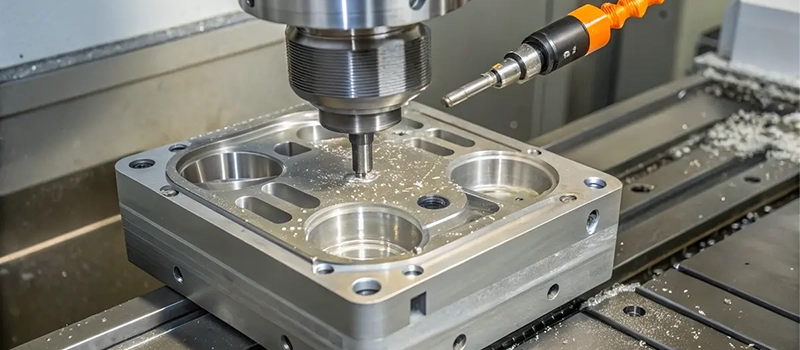
To address the machining challenges introduced by the hardness of titanium, shops often adjust their strategies by:
- Using specialized carbide tools with thermal-resistant coatings such as TiAlN.
- Reducing cutting speeds and increasing feed rates to limit heat buildup.
- Applying high-pressure coolant systems to evacuate chips and cool the tool–workpiece interface.
- Performing finish cuts in low-hardness states before final heat treatment when part geometry allows.
Understanding the hardness of titanium is not just about material selection—it is fundamental to process planning, tool choice, and cost estimation in precision manufacturing. A mismatch between expected and actual hardness can lead to scrapped parts, broken tools, and missed tolerances.
Welding Impact on the Hardness of Titanium
Heat-Affected Zone (HAZ) Hardness Fluctuations
Welding titanium presents unique challenges, and one of the most critical considerations is how the welding process alters the hardness of titanium in the heat-affected zone (HAZ). Titanium’s low thermal conductivity and high chemical reactivity mean that any welding method—TIG, laser, or electron beam—can cause localized structural changes, leading to both hardness increase and decrease depending on cooling rate and shielding effectiveness.
In alpha-beta alloys such as Ti-6Al-4V, improper welding conditions may cause coarsening of microstructure in the HAZ, reducing the hardness of titanium and lowering fatigue resistance. Conversely, rapid cooling can trap residual stresses or create brittle alpha-case regions, temporarily elevating surface hardness but increasing the risk of cracking or delamination.
The exact impact on hardness depends on weld parameters like heat input, travel speed, and interpass temperature. Even when using inert gas shielding, contamination with oxygen, nitrogen, or hydrogen can severely alter the surface composition, increasing hardness at the surface but weakening the underlying structure.
Post-Weld Heat Treatment Considerations
To stabilize the hardness of titanium after welding, post-weld heat treatment (PWHT) is often required—especially for components subject to fatigue, impact loading, or pressure cycling. For example, stress-relief annealing at 540–650°C can reduce hardness gradients and restore a uniform alpha-beta phase distribution in alloys like Grade 5.
However, this also means that any mechanical or surface properties gained from prior heat treatment may be lost or altered. Manufacturers must choose between retaining weld hardness and restoring balanced properties across the weldment.
Welded joints are particularly sensitive in aerospace, marine, and pressure vessel applications. Here, hardness testing across the weld bead and HAZ is used as part of quality assurance. Abrupt changes in the hardness of titanium can signal improper shielding, poor filler compatibility, or incorrect thermal profiles—all of which can lead to in-service failure.
Weld Repair and Requalification Risk
When repairing titanium parts, welding-induced hardness variation must be revalidated. Rewelded regions may differ in hardness from both the original material and previous repair passes. Without proper post-weld processing, this inconsistency can lead to premature wear or breakage during service.
For critical industries, hardness requalification after welding is non-negotiable. It ensures that the structural integrity of the titanium component is maintained and that the weld zone’s hardness aligns with the intended performance envelope.
Conclusion
The hardness of titanium is a critical property that directly influences its suitability for machining, forming, wear resistance, and long-term service performance. However, hardness must be evaluated alongside microstructure, manufacturing processes, and application demands. Over-reliance on hardness alone can lead to design or production missteps. For optimal results, material selection should always balance hardness with toughness, corrosion resistance, and process compatibility.