Is the dimensional accuracy of sand casting really sufficient? Is die casting economically viable for medium-sized production runs? And how can manufacturers ensure that cast components consistently meet the requirements for strength, low porosity, and regulatory compliance?
These concerns are justified. In a report by the European Committee for Standardization (CEN), it states: “For safety-critical aluminum components with structural functions, the use of gravity casting processes with controlled solidification is clearly recommended – especially in production runs requiring consistent dimensional accuracy.” This statement explicitly refers to processes such as permanent mold aluminum casting.
The solution lies exactly here: Permanent mold aluminum casting offers repeatable dimensional precision, a homogeneous microstructure, and cost-effective series production. Today, the process is considered a standard in many industries for technical components where precision, strength, and process reliability are equally essential.
What is Permanent Mold Aluminum Casting?
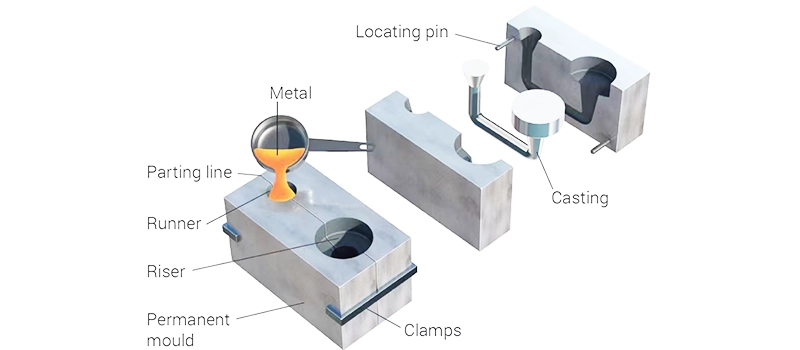
Permanent mold aluminum casting, also known as gravity die casting, is a process used to manufacture precise aluminum components using reusable metal molds. Unlike sand casting, this method employs permanent molds made of steel or cast iron, resulting in consistently high dimensional accuracy and surface quality.
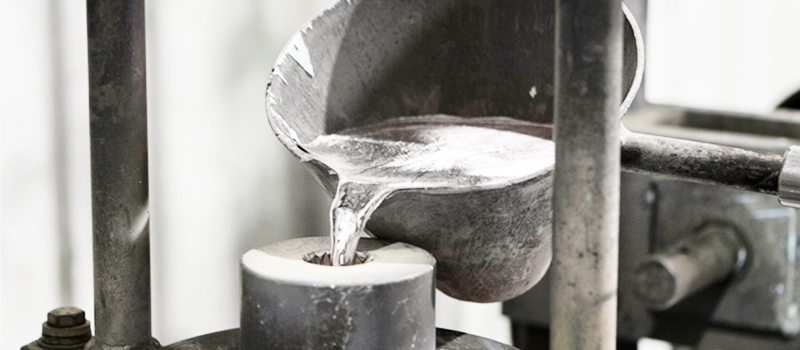
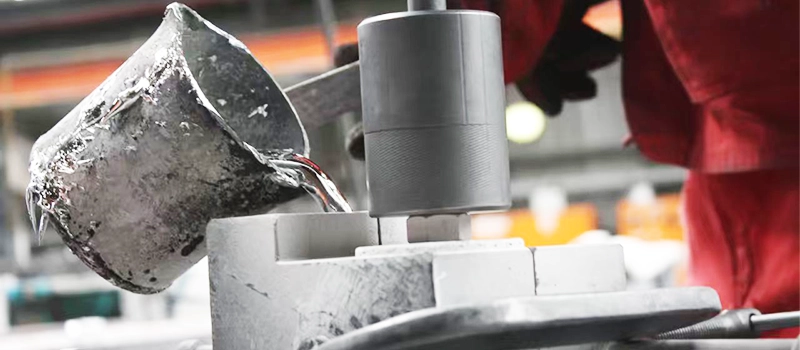
Molten aluminum is poured by gravity into the preheated mold and cooled in a controlled manner. This produces a dense microstructure with improved mechanical properties. Permanent mold aluminum casting is particularly suitable for medium to large production runs where repeatability, strength, and cost efficiency are essential.
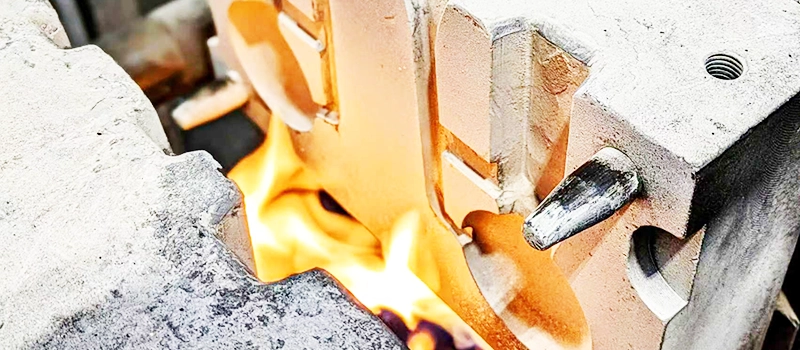
This process is widely used in industries such as automotive, mechanical engineering, and agricultural technology. It combines industrial-scale cost efficiency with high casting quality—while minimizing material waste and reducing the need for post-processing.
Why Choose Permanent Mold Over Sand or Die Casting
Technical Comparison with Sand Casting
Sand casting uses disposable molds made of sand that are destroyed after each casting. This leads to variations in dimensional accuracy and surface quality. In contrast, permanent mold aluminum casting uses reusable metal molds. These molds allow for consistent results across many casting cycles. The resulting surfaces are also smoother, reducing the need for rework and enabling more precise tolerances.
Advantages Over Die Casting
In die casting, aluminum is injected into the mold under high pressure, requiring complex machinery and high energy input. Permanent mold aluminum casting, on the other hand, relies on gravity. This reduces air entrapment and porosity, results in a denser microstructure, and extends the life of the mold. In addition, lower thermal stresses occur, which leads to more stable and reliable parts.
Economic Considerations
Although the initial investment in a metal mold is higher than in sand casting, the cost per part decreases as production volumes increase. Permanent mold aluminum casting reduces scrap, saves on rework, and ensures consistently high quality. Compared to die casting, tooling costs are also significantly lower.
When Is Permanent Mold Casting the Right Choice?
This process is particularly suitable for medium to large production runs where accuracy and repeatability are crucial. Typical applications include mechanical components in machinery, structural parts in vehicle construction, and durable assemblies in agricultural equipment. Where sand casting is too imprecise and die casting too expensive, permanent mold aluminum casting offers an ideal middle ground.
Design Advantages and Dimensional Accuracy in Focus
Dimensional Accuracy as a Cornerstone of Series Production
A key feature of permanent mold aluminum casting is its high dimensional accuracy, achieved through the use of precisely manufactured metal molds. Unlike disposable sand molds, the geometries of permanent molds remain intact over time, which greatly simplifies the production of complex and dimensionally critical components. Especially for tolerance classes according to ISO 8062-3, this process enables repeatable results—even across long production runs.
Homogeneous Structure and Reduced Porosity
The controlled solidification of the aluminum in the permanent mold leads to a dense and fine-grained microstructure. The risk of shrinkage cavities, gas pores, or structural defects is significantly reduced. This structural integrity directly enhances the mechanical properties: higher tensile strength, improved fatigue resistance, and more stable material homogeneity are typical outcomes of the process.
Surface Quality as an Advantage in Post-Processing
An often underestimated benefit is the high-quality surface finish achieved through permanent mold aluminum casting. Smooth mold walls and even cooling result in finer cast surfaces, making them ideal for visible parts or components requiring coating. At the same time, the effort needed for mechanical post-processing is reduced, accelerating the production process and lowering overall costs.
These design advantages make permanent mold aluminum casting a preferred process for components where precise fit, structural durability, and consistent quality are essential—regardless of the application area.
Advantages of the Permanent Mold Process for Aluminum Casting
Technical Benefits in Industrial Applications
Compared to other casting methods, permanent mold aluminum casting offers a wide range of technical advantages, especially for series production and demanding components. One of its key strengths is high dimensional accuracy. The use of precisely manufactured metal molds ensures consistent form stability over many casting cycles. This significantly reduces post-processing efforts and allows even tightly toleranced parts to be produced efficiently.
The mechanical properties of cast parts produced using the permanent mold process are significantly improved over those made by sand casting. Controlled cooling within the metal mold results in a finer, denser microstructure with greater strength. These parts demonstrate higher load-bearing capacity and improved structural integrity—critical in safety-relevant applications.
Surface quality is also clearly superior to that of sand casting. The smooth surfaces of the mold cavity produce clean, finely structured cast surfaces, which greatly facilitate galvanic or mechanical finishing. Additionally, material waste is reduced thanks to minimal flash and lower rejection rates.
Process Stability and Repeatability
Another key advantage lies in process reliability. Due to consistent mold geometry and a reproducible casting process, components can be produced with minimal variation in quality and dimensional accuracy. This increases planning reliability in series production and supports accurate scheduling and volume management, particularly in time-sensitive industrial supply chains.
The process also offers operational advantages. Permanent mold aluminum casting requires less complex equipment than die casting and places less thermal stress on the molds. As a result, tool life is extended and ongoing maintenance costs are reduced.
Reduced Defect Rates and Higher Yield
Typical casting defects—such as shrinkage cavities, warping, or gas inclusions—are significantly minimized with the permanent mold process. Gravity-fed casting ensures uniform solidification and reduces internal stresses. This leads to a higher rate of first-pass yield and increases production output per shift.
For manufacturing companies, this translates into higher quality with less effort—a strategic advantage in highly competitive markets.
Typical Applications in Industry
Widespread Use of Permanent Mold Aluminum Casting in Key Sectors
Permanent mold aluminum casting is widely used across numerous industrial sectors where reliability, precision, and suitability for series production are essential. This casting method has become well established in industries with mechanical or structural demands, as it enables consistent quality combined with cost-effective manufacturing.
In the automotive industry, permanent mold aluminum casting is used for components that require high dimensional accuracy and load-bearing capacity—such as engine housings, transmission parts, and suspension components. The uniform structure and low porosity of these cast parts contribute to mechanical safety and meet the strict quality standards of vehicle manufacturers.
Permanent mold aluminum casting has also become indispensable in mechanical and plant engineering. It is commonly used for housing components, brackets, and connectors that must deliver long-term functionality through high structural integrity and dimensional precision. The repeatability of the casting process additionally allows for standardized spare part production.
In the agricultural and construction machinery sectors, manufacturers benefit from the robust structure achieved through permanent mold aluminum casting. Components such as supports, mounts, and pivot parts must not only be precisely manufactured but also withstand shock loads and harsh environmental conditions—requirements that this process reliably meets.
Permanent mold aluminum casting is also used in the petrochemical industry, where components are exposed to high temperatures and corrosive environments. In these cases, the fine microstructure and precisely cast surfaces ensure reliable performance over extended operating periods.
Standardization and Series Production as a Competitive Advantage
Another benefit lies in scalability. Thanks to its repeatable quality, permanent mold aluminum casting is ideally suited for medium to large production runs. Companies operating with long-term supply contracts or just-in-time manufacturing benefit from the process stability and low rejection rates.
The broad range of applications, combined with economic efficiency, makes permanent mold aluminum casting a key manufacturing technology in modern industrial sectors. It is not only a technical solution but also a strategic tool for reducing production costs and improving product quality.
Suitable Aluminum Alloys for Permanent Mold Casting
Material Selection as the Key to Component Quality
Choosing the right alloy is a critical factor in permanent mold aluminum casting, as it directly influences the mechanical properties, castability, and corrosion resistance of the final product. Not all aluminum alloys are equally suited for this process. Materials are required that ensure good mold filling while also offering sufficient strength and dimensional stability.
Alloys based on aluminum-silicon (AlSi) are typically used. These are known for their excellent casting properties, low shrinkage tendency, and good thermal conductivity. The most commonly used grades include AlSi10Mg, AlSi12, and AlSi7Mg. These alloys offer a balanced combination of strength, ductility, and corrosion resistance—an interaction that has proven itself in many industrial applications.
For more highly stressed components requiring increased strength, alloys with magnesium or copper additives are suitable. For example, AlCu4TiMg offers enhanced strength characteristics but is more challenging in terms of castability. However, permanent mold aluminum casting enables controlled cooling, making even these alloys viable for reproducible production.
Requirements for Metallurgical Composition
Depending on the intended application, additional properties must be considered—such as weldability, anodizing capability, or resistance to thermal stress. The chemical composition of the alloy affects not only the quality of the casting but also the later machinability and service life of the part. Therefore, close coordination between design, material selection, and casting process is especially important.
Permanent mold aluminum casting offers the flexibility to apply various alloys selectively and to maximize their advantages through precise process control. This allows for material-specific production that meets both functional and economic requirements.
Permanent Mold Aluminum Casting as an Industrial Standard for Precision and Repeatability
In modern metal manufacturing, permanent mold aluminum casting plays a central role in the reliable production of dimensionally accurate and mechanically durable components. The process combines high dimensional precision with low porosity and cost-effective series production—qualities in high demand across nearly all industrial sectors.
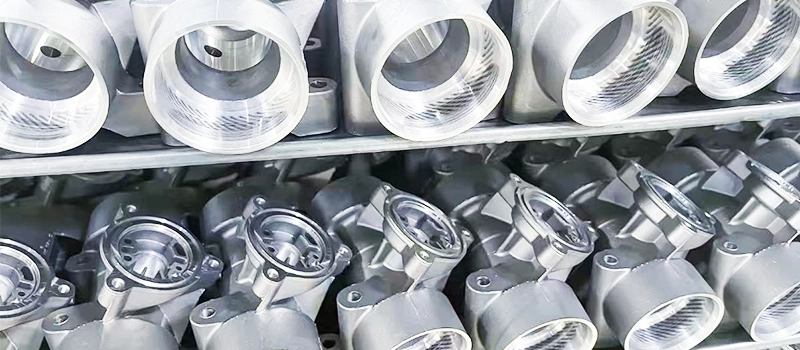
Compared to sand or die casting, permanent mold aluminum casting proves to be the more technically and economically balanced solution, particularly for medium to large production volumes. The ability to work with various aluminum alloys further expands its range of applications.
Future-Proofing Through Stable Processes and Standards Compliance
As global requirements for quality, repeatability, and certification continue to increase, permanent mold aluminum casting will remain a vital manufacturing technology. Compliance with standards such as EN 1706 and CE-relevant directives also ensures regulatory compatibility within the European market.
Companies focused on predictable production, minimal rework, and consistent product quality will benefit from investing in this process in the long term. Permanent mold aluminum casting is therefore not just a technical production method—it is a strategic asset in industrial competition.
Conclusion
Permanent mold aluminum casting offers a compelling combination of technical precision, economic efficiency, and high material quality. With clear advantages over sand and die casting, it is particularly well-suited for applications where repeatability, dimensional accuracy, and process reliability are essential.
Thanks to its ability to process a wide range of aluminum alloys with stable and controlled methods, the process opens up a broad spectrum of applications across nearly all industrial sectors. For those seeking a reliable, series-capable, and standards-compliant manufacturing technology, permanent mold aluminum casting is a future-proof choice.