“Laser cutting is not just about precision—it’s about unlocking the next level of manufacturing efficiency.”
— International Journal of Advanced Manufacturing Technology
In today’s competitive fabrication industry, sheet metal laser cutting has emerged as the powerful tool for delivering unmatched precision, speed, and design flexibility. Backed by advanced CNC systems and fiber laser technology, it enables manufacturers to achieve higher output with lower material waste—while meeting the exacting standards of global markets.
The Basics of Laser Cutting Technology
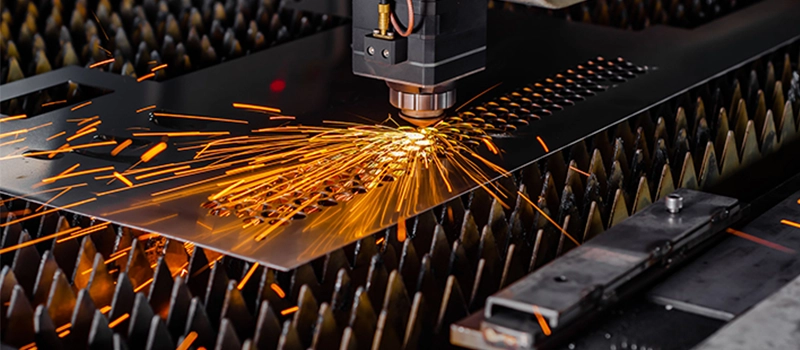
Laser cutting is a precise, non-contact method of cutting materials—most commonly used in sheet metal fabrication. It works by focusing a high-powered laser beam onto a defined spot on the material, generating intense heat that melts, burns, or vaporizes the metal. A high-pressure assist gas (such as nitrogen or oxygen) then blows the molten material away, resulting in a clean cut.
This entire process is controlled by CNC (Computer Numerical Control) systems, which guide the laser head along a pre-programmed path. The input is usually a CAD file containing the desired geometry of the part. The laser beam itself is generated by either a CO₂ laser or a fiber laser, each with unique operating characteristics (which we’ll explore in detail later).
A typical laser cutting system consists of three main components:
- Laser Source – Generates the laser beam.
- Cutting Head – Focuses the laser and directs it onto the material.
- Motion System – Moves the cutting head precisely based on digital instructions.
Laser cutting is known for producing extremely narrow kerfs (cut lines), high cutting speeds, and excellent repeatability. It’s widely used in industries requiring fine detail and dimensional accuracy—such as electronics, automotive, and machinery manufacturing.
The technology represents the foundation of modern sheet metal processing. Before discussing its advantages or applications, it’s important to understand this basic working principle: a focused laser beam, guided by precise digital control, makes it possible to cut metal cleanly and efficiently without physical contact.
Advantages of Laser Cutting Over Traditional Methods
Superior Precision and Edge Quality
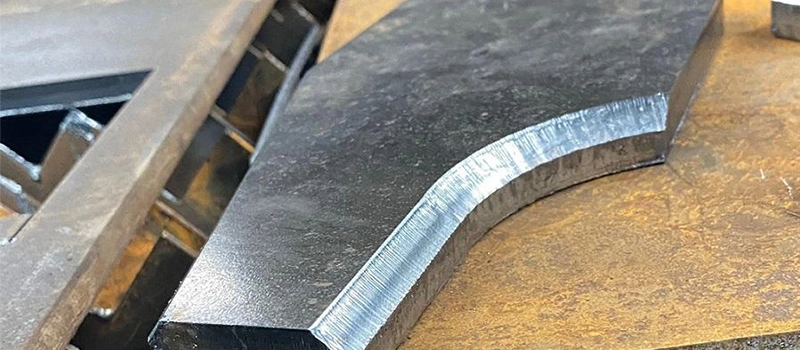
Sheet metal laser cutting is known for its superior precision. The laser beam delivers an incredibly fine focus, producing extremely narrow kerf widths and tight tolerances. This enables precise cutting of sheet metal components with minimal deviation. Unlike traditional cutting tools, sheet metal laser cutting leaves clean, burr-free edges that often require no additional finishing.
Whether you’re dealing with intricate cutouts or detailed contours, sheet metal laser cutting maintains consistent quality. Traditional cutting methods like sawing or punching struggle to match this level of accuracy, especially on thin or delicate materials.
Faster Cutting Speeds and Improved Productivity
Speed is a major advantage of sheet metal laser cutting. Compared to mechanical cutting or plasma methods, laser cutting processes sheet metal much faster—especially when working with thin or medium-gauge materials. There’s no need to change tools between cuts, which reduces downtime and increases output.
The efficiency of sheet metal laser cutting makes it ideal for high-volume production runs. Faster cutting cycles translate into shorter lead times and better delivery performance, making it a powerful tool in time-sensitive projects.
Non-Contact Cutting Reduces Material Distortion
Because sheet metal laser cutting is a non-contact process, there’s no physical force applied to the metal. This means no mechanical stress, no blade pressure, and no tool drag—just clean, thermally separated cuts. This is especially beneficial when cutting thin sheet metal, where deformation is a common issue in mechanical methods.
By eliminating physical contact, sheet metal laser cutting preserves the flatness and structural integrity of each part. This contributes directly to higher assembly precision and fewer rejected parts.
High Versatility in Designs and Cutting Profiles
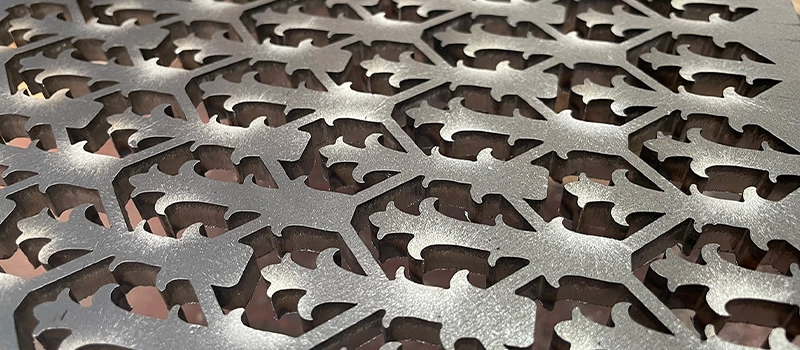
Sheet metal laser cutting excels in its versatility. It can easily produce complex geometries, sharp angles, small holes, and fine features in a single operation. With a digital CAD file, design changes can be implemented instantly—no need for new tooling or manual adjustments.
This flexibility makes sheet metal laser cutting ideal for both custom and standard parts. Whether you need unique brackets, perforated panels, or structural components, laser cutting delivers precision without sacrificing speed.
Greater Material Efficiency and Reduced Waste
Another benefit of sheet metal laser cutting is optimized material usage. With the help of advanced nesting software, part layouts are automatically arranged to maximize the usable surface of each sheet. This reduces offcuts and minimizes scrap, which lowers material costs significantly over time.
Traditional cutting methods often require larger clearances between parts due to tool movement constraints. In contrast, sheet metal laser cutting minimizes spacing while maintaining accuracy.
Low Maintenance and Higher Uptime
Sheet metal laser cutting systems are designed for reliability. They require less maintenance compared to mechanical cutting machines—no blades to replace, no physical wear, and no frequent recalibration. This reduces downtime and keeps production running smoothly.
Over time, the reduced maintenance workload translates into lower operational costs and higher machine availability. With fewer interruptions, sheet metal laser cutting becomes a dependable foundation for streamlined manufacturing.
Key Applications of Sheet Metal Laser Cutting
Industrial Manufacturing and Equipment Components
Sheet metal laser cutting plays a vital role in industrial manufacturing, especially in the production of mechanical equipment parts. Because of its ability to handle high-strength metals with precision, sheet metal laser cutting is widely used for components such as brackets, housings, frames, and base plates. These parts often require tight tolerances, consistent quality, and fast production—making laser cutting the most efficient choice.
Whether for one-off parts or batch production, sheet metal laser cutting ensures repeatable accuracy and reduces the need for manual adjustments, which is critical for industrial machinery manufacturers.
Automotive Parts and Structural Assemblies
In the automotive industry, sheet metal laser cutting is essential for cutting structural and cosmetic parts. Applications include car body panels, battery trays, suspension brackets, seat components, and more. The process provides clean edges and minimal thermal distortion, which are critical when cutting safety-related parts or components that need to be welded.
Because designs change frequently in automotive prototyping and EV development, the flexibility of sheet metal laser cutting allows rapid adaptation to new part specifications without retooling delays.
Construction, Architecture, and Decorative Metalwork
Sheet metal laser cutting is also used extensively in architectural metalwork, thanks to its precision and ability to produce intricate shapes. From ventilation grilles and cladding panels to decorative screens and signage, the process enables designers and builders to realize complex designs that are difficult or impossible to produce using mechanical cutting methods.
Its clean finish and customization capabilities make sheet metal laser cutting an attractive choice for both functional and aesthetic applications in commercial and residential buildings.
Electrical Enclosures and Electronics
In electronics and electrical equipment manufacturing, sheet metal laser cutting is used to fabricate control boxes, enclosures, back panels, and mounting plates. These components often include multiple cutouts for ports, connectors, and fasteners that must be placed with high precision.
Laser cutting ensures perfect alignment and dimensional accuracy, reducing the chance of assembly issues or component mismatch. This is especially valuable in high-volume production environments where quality consistency is essential.
Aerospace and Defense Applications
Due to the strict quality standards in aerospace and defense, sheet metal laser cutting is ideal for producing lightweight, high-precision components. The process is used for cutting aluminum, titanium, and stainless steel parts in structural assemblies, control panels, and shielding elements.
The non-contact nature of sheet metal laser cutting helps maintain material integrity, and the ability to cut complex contours supports the advanced designs typical in these industries.
Agricultural and Heavy Equipment
Large-scale farming and construction equipment often require durable metal parts like covers, flanges, plates, and reinforcement brackets. Sheet metal laser cutting is capable of handling thick sheets and producing consistent cuts, which is critical in maintaining long-term mechanical performance.
Laser cutting supports both high-volume runs and on-demand parts replacement, making it suitable for OEMs and aftermarket suppliers alike.
Understanding Different Types of Lasers Used in Cutting
CO₂ Lasers
CO₂ lasers were among the earliest technologies used in sheet metal laser cutting. They operate by exciting a gas mixture (typically carbon dioxide, nitrogen, and helium) to produce a high-powered infrared beam. These lasers are well-suited for cutting non-metal materials and metals up to medium thickness, such as stainless steel and aluminum.
However, when it comes to thin sheet metal or high-speed precision cutting, CO₂ lasers are gradually being replaced. They require more maintenance, have higher power consumption, and tend to be slower than their newer counterparts.
Despite these limitations, CO₂ laser systems are still used in specific applications where surface finish or cutting non-metallic materials (like wood or acrylic) is required alongside metal.
Fiber Lasers
Fiber lasers have rapidly become the dominant technology in sheet metal laser cutting. They generate a laser beam through a fiber-optic cable using a solid-state source, offering higher electrical efficiency and superior beam quality.
One of the most significant advantages of fiber lasers in sheet metal laser cutting is their ability to cut reflective materials—such as copper, brass, and aluminum—without damaging the machine. They also deliver faster cutting speeds, lower operating costs, and require far less maintenance than CO₂ systems.
Fiber lasers are ideal for high-volume industrial environments that demand precision, consistency, and versatility. Their compact size and energy efficiency make them a smart investment for modern metal fabrication shops.
Comparison: Fiber vs. CO₂ in Sheet Metal Laser Cutting
When comparing both types for sheet metal laser cutting, the advantages of fiber lasers are clear:
| Feature | Fiber Laser | CO₂ Laser |
|---|---|---|
| Efficiency | High | Moderate |
| Maintenance | Low | High |
| Operating Cost | Lower | Higher |
| Cutting Speed | Faster | Slower |
| Reflective Material Cutting | Yes | Limited |
| Suitable for Metal Cutting | Excellent | Moderate |
In most modern sheet metal laser cutting operations, fiber lasers are the standard due to their overall performance, especially for cutting steel, aluminum, and copper with high accuracy and speed.
Factors Influencing Laser Cutting Quality
Laser Power and Beam Focus
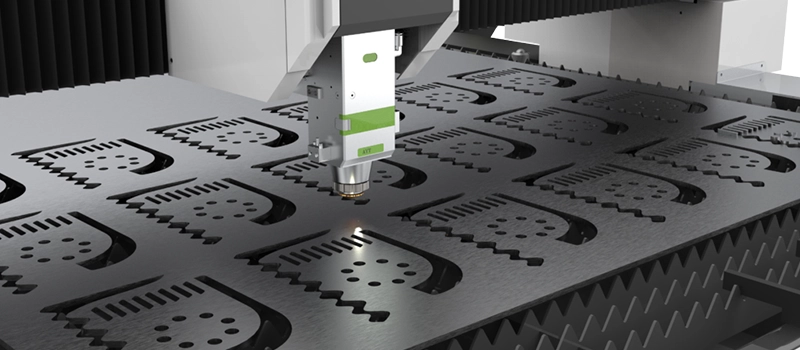
One of the most important variables in sheet metal laser cutting is the laser’s power output. Higher power levels allow faster cutting of thicker materials, while lower power offers better precision for thin sheets. However, raw power alone doesn’t guarantee quality—beam focus is just as critical.
A well-focused beam ensures the laser energy is concentrated into a small, intense point, allowing clean cuts with minimal heat-affected zones (HAZ). Improper focusing leads to wider kerfs, rough edges, and inconsistent cuts.
Cutting Speed and Feed Rate
The speed at which the laser moves across the metal sheet directly affects cut quality. If the speed is too fast, the laser may not fully penetrate the material, resulting in incomplete or jagged cuts. If it’s too slow, excessive heat may build up, causing material deformation or dross formation on the cut edge.
Optimizing cutting speed is essential in sheet metal laser cutting, especially for high-precision applications. CNC control systems help maintain the correct speed for each material thickness and type.
Assist Gas Type and Pressure
In sheet metal laser cutting, assist gases play a dual role: they remove molten material from the kerf and protect the cut edge from oxidation. Common gases include oxygen, nitrogen, and air.
- Oxygen is often used for carbon steel to enhance the cutting reaction, increasing speed.
- Nitrogen is preferred for stainless steel and aluminum to achieve clean, oxidation-free edges.
- Compressed air can be used for cost savings on thinner sheets, though quality may vary.
Gas pressure must be carefully controlled. Too much pressure can blow molten metal onto the sheet surface; too little may leave slag or poor edge quality.
Material Type and Surface Condition
Different materials respond differently to laser energy. Reflective materials like aluminum or brass require more power and different wavelength handling, especially in fiber laser systems. Surface conditions also matter—dirty, oily, or rusty sheets can affect beam absorption and lead to inconsistent results.
Consistent quality in sheet metal laser cutting begins with properly prepared and clean material surfaces.
Thickness and Flatness of the Sheet
Thicker sheets require more energy and slower cutting speeds. However, even with sufficient power, uneven or warped sheets can cause focal misalignment, leading to variation in cut depth and quality.
Sheet flatness is crucial for sheet metal laser cutting, especially when aiming for consistent tolerances across production runs. Many advanced laser systems include height sensors or auto-focus heads to compensate for slight variations.
Machine Calibration and Operator Skill
Even the best sheet metal laser cutting system requires proper calibration and skilled operation. Focus distance, nozzle alignment, gas flow, and software settings all need to be fine-tuned regularly to maintain high-quality results.
Operators must understand how to adjust parameters based on material type, part design, and production requirements. Regular maintenance and system checks also help prevent degradation in cutting performance.
Materials Suitable for Laser Cutting
Carbon Steel
Carbon steel is one of the most commonly processed materials in sheet metal laser cutting. Its favorable thermal properties allow clean and consistent cuts with minimal slag. Depending on the laser power, carbon steel sheets can be cut up to 25mm or more in thickness.
This material is widely used in industrial equipment, automotive components, and structural applications due to its strength and cost-effectiveness. Laser cutting ensures tight tolerances and clean finishes, even for thicker gauges.
Stainless Steel
Stainless steel is another prime material for sheet metal laser cutting, especially in industries where corrosion resistance and surface finish are important. With nitrogen as the assist gas, laser cutting can produce smooth, oxide-free edges that require little to no post-processing.
Common applications include enclosures, kitchen equipment, architectural panels, and medical device components. Its reflective nature can pose challenges, but fiber laser systems handle it with high efficiency and precision.
Aluminum
Aluminum sheets are lightweight and corrosion-resistant, making them popular in aerospace, automotive, and electronics. While traditionally difficult to cut with CO₂ lasers due to reflectivity, fiber lasers now allow for fast and clean aluminum sheet metal laser cutting.
Because aluminum has high thermal conductivity, laser parameters must be carefully adjusted to avoid excess heat input and material warping. Still, its machinability and weight-to-strength ratio make it a top choice in modern fabrication.
Galvanized Steel
Galvanized steel, coated with a layer of zinc, is used extensively in HVAC, construction, and agricultural equipment. Sheet metal laser cutting is capable of processing galvanized materials effectively, though precautions must be taken to manage fumes and zinc vapor buildup during cutting.
Proper ventilation and assist gas selection are important to preserve both edge quality and operator safety.
Copper and Brass
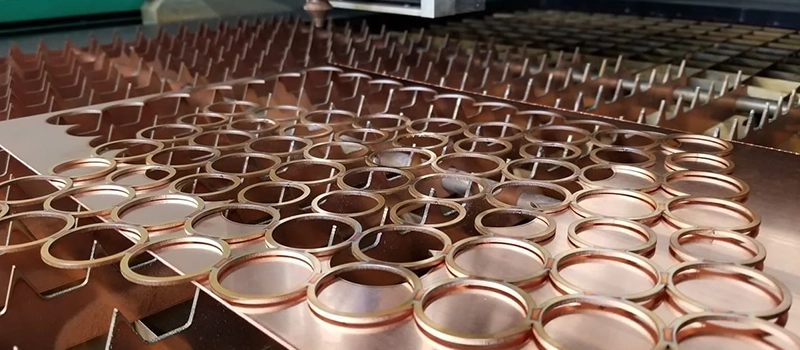
Copper and brass offer excellent electrical conductivity and are often used in electrical enclosures, busbars, and precision terminals. These materials are highly reflective and thermally conductive, which historically made them difficult to cut with lasers.
However, modern fiber laser systems have made sheet metal laser cutting of copper and brass not only possible but highly efficient. Specialized optics and wavelength control reduce the risk of back reflections and improve surface finish quality.
Titanium and Specialty Alloys
In high-performance industries such as aerospace and medical device manufacturing, sheet metal laser cutting is used for processing titanium and specialty alloys. These materials are expensive and require tight tolerances, making laser cutting ideal due to its precision and low waste.
Although cutting speed may be slower, the non-contact process minimizes contamination and maintains the material’s mechanical properties.
Conclusion
Sheet metal laser cutting combines precision, speed, and flexibility in a way that traditional methods can’t match. Its wide material compatibility, low waste, and consistent quality make it an essential tool for modern fabrication.