Ductility and malleability directly determine whether a material can be formed without cracking, tearing, or unexpected failure. Why do some metals bend smoothly while others fracture under the same process? Why do forming defects appear even when material strength meets specification? Why do manufacturing yields drop when shape complexity increases? These problems often result from misunderstanding how ductility and malleability behave during processing.
According to materials engineering references and manufacturing standards ductility and malleability describe different aspects of plastic deformation. One governs how a material stretches under tensile stress, while the other controls how it deforms under compressive loading. Confusing the two leads to incorrect material selection and unstable forming processes.
In manufacturing, understanding ductility and malleability is essential for choosing materials, designing forming operations, and preventing defects. These properties influence not only whether a part can be made, but how consistently it can be produced at scale.
What Ductility and Malleability Mean in Manufacturing
Definition of Ductility in Forming Processes
Ductility describes a material’s ability to undergo plastic deformation under tensile stress without fracturing. In manufacturing processes, this property determines how much a material can be stretched, drawn, or elongated before cracks initiate. Operations such as deep drawing, stretching, and tensile bending rely directly on adequate ductility to maintain part integrity.
From a production standpoint, insufficient ductility leads to necking, tearing, or unexpected fracture during forming. These failures often occur even when strength requirements are met, because tensile deformation capacity is controlled by microstructure, strain hardening behavior, and processing history rather than strength alone.
Definition of Malleability in Shaping Operations
Malleability refers to a material’s ability to deform plastically under compressive stress without cracking. This property governs performance in processes such as forging, rolling, stamping, and flattening, where material is reshaped primarily through compression rather than tension.
In manufacturing, malleability determines how well a material flows under compressive loads and fills dies or molds. Materials with low malleability tend to crack at edges or corners during compression-based operations, limiting achievable geometry and increasing scrap rates.
Why These Properties Are Often Confused
Ductility and malleability are frequently grouped together because both describe plastic deformation. However, they apply to different stress conditions and influence different manufacturing outcomes. A material may exhibit good malleability in forging but poor ductility in tensile forming, or vice versa.
Confusing these properties leads to incorrect material selection and process design. In manufacturing, understanding which deformation mode dominates a given operation is essential. Matching ductility and malleability to the correct forming method reduces defects, improves yield, and stabilizes production.

How Ductility and Malleability Affect Manufacturing Behavior
Tensile Deformation Versus Compressive Deformation
In manufacturing, the type of stress applied during processing determines whether ductility or malleability is the controlling factor. Tensile deformation dominates processes such as stretching, drawing, and bending over tight radii. In these cases, ductility limits how much strain the material can tolerate before localized thinning or fracture occurs.
Compressive deformation governs processes such as forging, rolling, and stamping. Here, malleability controls how smoothly the material flows under load and how well it fills tooling features. A material may perform well under compression but fail quickly when subjected to tensile strain, which is why understanding the dominant stress state is essential for process selection.
Plastic Flow and Shape Retention
Both ductility and malleability influence how material flows plastically and whether the final shape remains stable after forming. Materials with sufficient deformation capacity allow strain to distribute evenly, reducing localized stress concentrations. This leads to more uniform thickness, better surface quality, and fewer forming defects.
Poor plastic flow results in uneven deformation, causing issues such as wrinkling, thinning, or cracking. In manufacturing, these problems often appear late in the process, making them costly to correct. Controlling deformation behavior through proper material selection and process design improves both shape accuracy and repeatability.
Relationship with Yield Strength and Work Hardening
Yield strength and work hardening behavior directly affect how ductility and malleability manifest during processing. Materials with high yield strength resist initial deformation, increasing forming forces and tooling stress. As deformation continues, rapid work hardening can quickly exhaust available ductility, leading to premature failure.
From a manufacturing perspective, materials with balanced yield strength and controlled work hardening are easier to form consistently. Understanding how these properties interact helps engineers set realistic forming limits, select appropriate processing routes, and avoid unnecessary scrap.
Role of Ductility and Malleability in Metal Forming
Bending, Drawing, and Stretching Operations
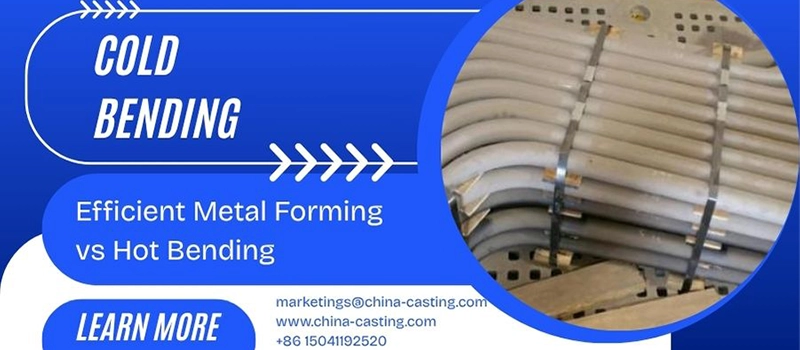
In bending, drawing, and stretching operations, ductility is the primary factor controlling formability. These processes introduce tensile stress on the outer surfaces of the material, where cracking is most likely to initiate. Materials with limited ductility often fail at sharp bends, tight radii, or during deep drawing, even when compressive support is present elsewhere in the part.
From a manufacturing perspective, insufficient ductility leads to edge cracking, thinning, and reduced dimensional consistency. Process adjustments such as increasing bend radius, reducing draw depth, or applying intermediate annealing are commonly used to compensate when material ductility is marginal.
Forging, Rolling, and Compression Processes
Malleability governs performance in forging, rolling, and other compression-dominated processes. In these operations, the material must flow plastically under high compressive loads to fill tooling cavities and achieve the desired shape. High malleability allows deformation without cracking at corners or along edges.
Materials with poor malleability resist flow and concentrate stress, increasing the risk of surface cracking or internal defects. In manufacturing, controlling temperature and strain rate is often necessary to maintain sufficient malleability, especially when working with high-strength or alloyed materials.
Common Defects Caused by Insufficient Deformation Capacity
When ductility or malleability is inadequate, manufacturing defects become more frequent and severe. Typical issues include tearing during drawing, cracking at bends, laps in forging, and non-uniform thickness after rolling. These defects are rarely caused by a single factor and often reflect a mismatch between material behavior and process conditions.
Addressing these issues requires adjusting both material condition and process design. Selecting a material with appropriate deformation capacity, modifying forming parameters, or introducing heat treatment steps can significantly improve forming reliability and reduce scrap.
Manufacturing Factors That Influence Ductility and Malleability
Chemical Composition and Microstructure
Ductility and malleability are strongly influenced by chemical composition and the resulting microstructure. Alloying elements that increase strength often reduce ductility and malleability by restricting dislocation movement. In manufacturing, this trade-off becomes visible when higher-strength materials crack or tear during forming despite meeting mechanical specifications.
Grain size and phase distribution also play a critical role. Fine, uniform grains generally support better ductility and malleability, allowing deformation to spread evenly. Coarse or uneven microstructures concentrate strain and increase defect risk during forming operations.
Heat Treatment and Thermal History
Heat treatment directly alters ductility and malleability by changing microstructure and internal stress state. Annealing increases ductility and malleability by reducing dislocation density and relieving residual stress. This is why annealed material is commonly used for complex forming processes.
In manufacturing, improper heat treatment reduces forming reliability. Over-hardened or partially transformed structures limit ductility and malleability, leading to cracking during shaping. Consistent thermal control is therefore essential to maintain predictable deformation behavior.
Temperature and Strain Rate Effects
Ductility and malleability are not fixed properties; they change with temperature and strain rate. Elevated temperatures generally increase ductility and malleability by allowing easier dislocation movement, which is why hot forming is used for difficult-to-form materials.
Strain rate also matters. High deformation speeds reduce available ductility and malleability by limiting time for stress redistribution. In manufacturing, controlling forming speed and temperature helps align material behavior with process demands, improving stability and reducing defects.
Process Design and Control Considerations
Matching Forming Method to Material Behavior
Effective manufacturing begins by matching the forming method to the dominant deformation behavior of the material. Processes dominated by tensile strain require sufficient ductility, while compression-driven processes rely more heavily on malleability. Misalignment between material behavior and forming method is a common cause of cracking, tearing, and unstable production.
From a process design perspective, understanding whether tension or compression controls deformation allows engineers to choose appropriate forming routes. This alignment reduces reliance on corrective measures and improves first-pass yield.
Process Limits and Safety Margins
Every manufacturing process has practical deformation limits defined by ductility and malleability. Operating too close to these limits increases sensitivity to material variation, tooling wear, and minor process fluctuations. In production environments, this often leads to inconsistent quality and higher scrap rates.
Establishing safety margins below theoretical forming limits improves robustness. Conservative strain levels, controlled deformation paths, and validated process windows help ensure that normal variation does not push material behavior beyond acceptable bounds.

Reducing Scrap and Rework Through Property Control
Consistent control of ductility and malleability reduces scrap and rework more effectively than downstream inspection. This control is achieved through proper material specification, consistent heat treatment, and disciplined process parameters rather than post-process correction.
In manufacturing, stable deformation behavior translates directly into predictable output. By treating ductility and malleability as controllable process inputs rather than abstract material properties, manufacturers improve efficiency, reduce waste, and achieve more reliable production outcomes.
Conclusion
Ductility and malleability define how materials behave during manufacturing processes and determine whether forming operations remain stable or fail. Treating these properties as process-critical inputs, rather than abstract material data, improves formability, reduces defects, and increases production reliability.