“According to the World Steel Association, carbon steel accounts for nearly 90% of global steel usage.”
It’s strong, affordable, and easy to process. But one physical property often overlooked is density of carbon steel—and it holds more value than most realize.
Density of carbon steel is more than just a number. It directly affects strength, weight, shipping cost, and fabrication processes. For buyers, engineers, and manufacturers, understanding this property is essential for better decisions.
That’s why I wrote this guide—to unpack what density of carbon steel really means, why it varies, and how it impacts everything from part design to final delivery.
Whether you’re choosing materials for structural use, evaluating weight limits, or budgeting for freight, this knowledge helps you save time and avoid costly mistakes.
What is Density and Why It Matters?
Density is defined as the mass of a material per unit volume—typically expressed as grams per cubic centimeter (g/cm³) or kilograms per cubic meter (kg/m³). For metals like carbon steel, this number reflects how tightly atoms are packed together in the crystal lattice structure.
The density of carbon steel is typically 7.85 g/cm³ (or 7850 kg/m³). This figure seems simple, but in the world of material science and mechanical engineering, it influences nearly every downstream decision—from structural load calculations to transportation planning.
👉 Why does it matter?
Because in fabrication and design, even small differences in density can change:
- The weight of the final product
- The strength-to-weight ratio in structural use
- Shipping and logistics cost
- Machining parameters, like cutting speed and power
- Selection of welding techniques and filler materials
Let’s say you’re designing a steel part for industrial machinery. You must know not just its size and function—but its weight. That weight depends directly on density. A miscalculation could lead to an overloaded system, failed components, or an expensive redesign.

Density also plays a big role in simulation and CAD modeling. Finite Element Analysis (FEA), for example, uses mass density to calculate stress, thermal performance, and fatigue. If you enter the wrong density value, your simulation is no longer accurate—and that can lead to real-world failures.
For large-scale applications, like steel beams, pipeline systems, or automotive frames, material density becomes a factor in:
- Cost forecasting
- Material selection during procurement
- Total weight per unit shipped
That’s why engineers, designers, and procurement teams rely heavily on accurate density data for carbon steel when evaluating metal components.
In short, density is not just a textbook number. It’s a key property that links raw material to function, performance, and cost. And when it comes to carbon steel, understanding its density is your first step toward smarter design and better decisions.
The Composition of Carbon Steel
What Elements Affect Its Density?
As someone deeply involved in metal manufacturing, I’ve seen how the composition of carbon steel directly affects not just its mechanical performance, but also its density.
At its core, carbon steel is an alloy primarily made of two elements:
- Iron (Fe) – typically over 98% of the total weight
- Carbon (C) – ranging from 0.04% to 2.0%, depending on the grade
Other trace elements like manganese, silicon, phosphorus, and sulfur may also be present in small quantities.
The higher the carbon content, the denser the atomic structure tends to become—slightly increasing the overall density of carbon steel. But the change is subtle, usually within the range of 7.75 to 7.88 g/cm³.
🔹 Iron – The Base Element
Iron is naturally dense. It has a density of approximately 7.87 g/cm³, and since it makes up most of the alloy, it defines the baseline for carbon steel density.
🔹 Carbon – The Key Modifier
Carbon is less dense than iron. It forms solid solutions with iron and creates cementite (Fe₃C) or pearlite microstructures depending on the amount added.
- Low carbon steel (0.04%–0.25%) stays closer to iron’s density.
- High carbon steel (0.6%–1.0%) has slightly increased hardness and marginally higher density due to tighter atomic packing.
🔹 Other Elements
Small additions of manganese, silicon, or chromium (in alloyed variants) can shift density values slightly. These changes are important in high-performance or precision applications where every gram counts.
It’s also worth noting that carbon steel does not contain significant amounts of alloying metals like nickel or molybdenum, which are common in stainless steel and contribute to a higher density.
So, when we talk about the density of carbon steel, we’re really talking about how iron-carbon ratios and impurity levels influence mass per unit volume. These variations are crucial when choosing the right grade for a job.
In procurement and technical design, we always consult the material composition sheet or mill certificate to confirm exact density before approving a drawing or a quote.
Why? Because even a 1% variance in density can mean hundreds of kilos in shipping weight—or worse, a failed load-bearing calculation.
Understanding carbon steel’s composition is the foundation for making informed decisions—not just about what material to use, but how to use it efficiently.

Types of Carbon Steel and Their Density Variations
How Density of Carbon Steel Changes with Carbon Content
There are several types of carbon steel, and each has slight differences in properties—and yes, in density too. In my experience working with clients across industries, one of the most frequent questions is:
“Does the density of carbon steel change depending on the grade?”
The answer is: yes, but within a narrow range. Still, even small shifts in the density of carbon steel can impact part weight, machining effort, and shipping calculations.
🔸 Low Carbon Steel (Mild Steel)
Low carbon steel contains less than 0.25% carbon. It is the most widely used form of carbon steel due to its ductility, weldability, and cost-efficiency.
- Typical density of carbon steel (low carbon): 7.85 g/cm³
- Applications: structural beams, automotive panels, pipelines
- Characteristics: softer, easier to machine, lighter weight
In this range, the density of carbon steel is usually standard. However, depending on trace elements like manganese or silicon, you may find density values ranging from 7.83 to 7.85 g/cm³.
🔸 Medium Carbon Steel
This type contains 0.25% to 0.6% carbon, offering greater strength and wear resistance.
- Density of medium carbon steel: ~7.85–7.86 g/cm³
- Applications: crankshafts, railway tracks, gears
- Characteristics: harder than mild steel, more brittle, higher strength
Here, the density of carbon steel can be slightly higher due to the formation of denser microstructures like pearlite.
🔸 High Carbon Steel
High carbon steel contains 0.6% to 1.0% carbon and is known for its exceptional hardness.
- Density of high carbon steel: 7.86–7.88 g/cm³
- Applications: cutting tools, blades, springs
- Characteristics: very hard, low ductility, high tensile strength
While the density of carbon steel doesn’t change dramatically across these grades, in high-precision applications, even 0.01 g/cm³ makes a difference.
🔸 Plain Carbon Steel
Plain carbon steel refers to steel with no significant alloying elements—just iron and carbon.
- The density of plain carbon steel generally sits at 7.85 g/cm³, considered the standard reference.
When I provide quotations or technical specs, I always clarify whether the material is plain carbon steel or alloyed. That’s because the density of carbon steel can subtly shift with alloy content, which may mislead buyers expecting lower weight or machining time.
How Density Affects Carbon Steel Properties
The Real-World Impacts of Carbon Steel’s Mass Per Volume
When we talk about the density of carbon steel, we’re not just referring to a number on a datasheet. Density has a direct and measurable influence on how carbon steel behaves in real-world applications.
In my daily work with engineers and procurement teams, I often explain that even small changes in the density of carbon steel can lead to major differences in how a part performs, wears down, or reacts under stress.
🔸 1. Mechanical Strength-to-Weight Ratio
The density of carbon steel affects the strength-to-weight ratio, which is critical in structural applications.
- Low-density steel (slightly lower than 7.85 g/cm³) results in lighter components, making it ideal for mobile structures or transport-related designs.
- Conversely, higher-density carbon steel (closer to 7.88 g/cm³) is heavier and better suited for fixed, load-bearing roles.
When designing for bridges, cranes, or support frames, the density of carbon steel directly determines how much weight a structure can support without excessive mass.
🔸 2. Thermal Conductivity and Expansion
The density of carbon steel also affects how heat flows through the material. In high-carbon grades, the denser atomic structure can slow thermal transfer slightly, affecting how components respond in thermal cycling environments.
This is especially important in:
- Boiler manufacturing
- Automotive exhaust systems
- Precision dies and molds
A higher density of carbon steel also means a lower thermal expansion coefficient, helping parts maintain dimensional accuracy under heat.
🔸 3. Impact Resistance and Toughness
Carbon steel’s toughness—its ability to absorb energy without fracturing—is partly influenced by its density. Generally, low carbon steels are less dense but more ductile, meaning they can deform without breaking.
- Applications like automotive bumpers or protective casings benefit from lower-density, more flexible steels.
- Higher-density carbon steels, while harder, can be brittle under shock loading, which is a critical concern in cold environments.
Understanding the density of carbon steel helps match the right grade to the physical demands of a product’s operating environment.

🔸 4. Fatigue Resistance in Rotating or Vibrating Systems
In rotating equipment, mass becomes a performance factor. The density of carbon steel determines how much centrifugal force the part will generate, affecting:
- Bearing load
- Vibration control
- Service life under cyclic loading
Lower-density carbon steels reduce dynamic stress and vibration in moving parts like gears, shafts, and drive systems.
The Role of Density in Carbon Steel Applications
Why Density of Carbon Steel Determines Its Best Use Cases
Over the years, I’ve worked with a variety of industries—construction, agriculture, automotive, energy—and one thing remains consistent: selecting the right steel for an application often starts with understanding the density of carbon steel.
That’s because density isn’t just a material spec—it’s a performance indicator. Whether you’re designing a frame, a pipe system, or a machine part, the density of carbon steel affects:
- Total system weight
- Strength-to-mass ratio
- Load capacity
- Heat response
- Cost of production and transport
🔹 Structural Engineering
In construction, designers aim to balance load-bearing capacity with material weight. The density of carbon steel directly impacts this calculation.
For example, using low carbon steel in high-rise buildings reduces total mass, which is especially important for:
- Foundations
- Earthquake zones
- Long-span bridges
Engineers choose grades with optimized density to reduce dead loads without sacrificing structural integrity.
🔹 Automotive and Transport Equipment
In automotive design, weight equals fuel consumption. That’s why knowing the density of carbon steel is critical when selecting materials for:
- Car chassis and frames
- Suspension systems
- Brake components
Choosing a steel grade with slightly lower density allows manufacturers to cut weight while keeping parts affordable. The balance between strength and weight directly affects both performance and emissions.
🔹 Pipeline and Fluid Transport
In oil and gas or water supply systems, pipe density influences how easily a network can be handled, installed, or suspended.
- For overhead pipe systems, lower density carbon steel pipes reduce the structural load on hangers and supports.
- For buried pipelines, slightly denser steel provides better resistance to deformation from ground pressure.
This is why pipeline engineers always factor in the density of carbon steel pipe when evaluating system layout and supports.
🔹 Tooling and Cutting Equipment
High carbon steel, with its increased density, is favored for:
- Cutting blades
- Drill bits
- Springs
- Wear-resistant components
Here, density of carbon steel correlates with hardness and durability, allowing the material to maintain sharpness and resist deformation under intense mechanical stress.
🔹 Agricultural Machinery
Agricultural tools need a mix of strength, shock resistance, and manageability. Knowing the density of carbon steel helps optimize:
- Tillage blades
- Combine harvester components
- Tractor frames
Using carbon steel with the right density ensures these parts can survive constant vibration and impact without unnecessary weight.
The Role of Density in Manufacturing and Fabrication
How Density of Carbon Steel Affects Every Stage of Production
In the world of metal production, understanding the density of carbon steel isn’t just for material specification sheets — it’s essential for every step of the manufacturing process. From CNC machining to large-scale casting and welding, density influences:
- Process settings
- Tool life
- Material waste
- Transport efficiency
- Total project cost
Having worked in a metal fabrication environment for years, I can tell you: the density of carbon steel is baked into our calculations from the moment a drawing is received.
🔧 1. Machining and CNC Cutting
The density of carbon steel impacts how a material behaves under cutting forces. Heavier, denser steels put more load on tools, requiring:
- Slower cutting speeds
- More rigid fixturing
- Increased coolant flow
- Frequent tool changes
For example, when working with high carbon steel, its slightly higher density and hardness lead to shorter tool life and more heat generation.
That’s why machinists always check the grade and density of carbon steel before setting parameters like feed rate and spindle RPM.

🏗️ 2. Welding and Joining
Welding involves heat transfer, melting, and solidification. The density of carbon steel determines how much heat energy is needed to reach the melting point and how quickly the material cools.
- Higher-density carbon steels may retain heat longer, which can affect weld bead shape and penetration.
- In thick plate welding, density directly impacts preheat and post-weld heat treatment (PWHT) times.
Incorrect assumptions about carbon steel density during welding can lead to defects like:
- Cracking
- Incomplete fusion
- Distortion due to uneven thermal expansion
🧱 3. Casting and Foundry Work
In casting processes, knowing the density of carbon steel is crucial for mold design, filling, and shrinkage prediction.
- A steel’s density helps estimate volume-to-weight ratio, affecting mold cavity size.
- High-density grades flow differently and cool slower, which can impact surface quality and grain structure.
At our foundry, we use precise density data to simulate casting behavior with software before committing to production — saving time and reducing scrap rates.
🚚 4. Shipping and Logistics
This is where the density of carbon steel hits your budget the hardest.
- Heavier materials = higher freight cost
- Misjudging density in volume-based orders can lead to underquoted shipping fees or overloaded pallets
- In export documentation, density determines how many parts fit per crate or container
That’s why accurate weight calculation — driven by exact carbon steel density — is vital for planning LCL, FCL, or air freight shipments.
📐 5. Fabrication Tolerances and Assembly
In sheet metal forming, stamping, or press braking, density of carbon steel affects how the material stretches, compresses, and returns to shape.
- Denser steels typically spring back less during bending, making them ideal for precision press fits.
- Lighter grades may need over-bending compensation to hold final geometry.
During assembly, mismatched densities between parts can even cause stress points, especially in dynamic or rotating systems.
Comparing Carbon Steel Density with Other Materials
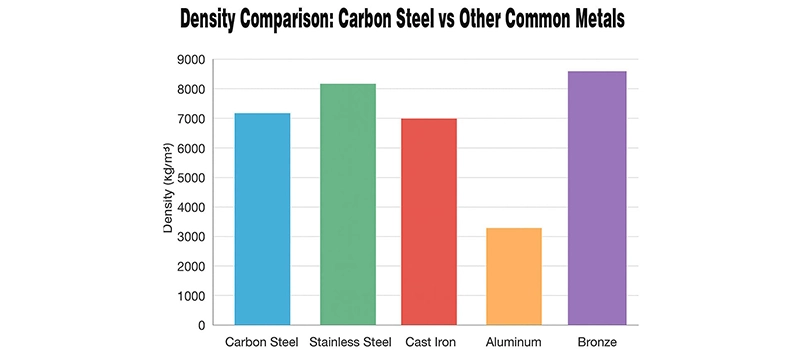
📊 Material Density Comparison Table
| Material | Density (g/cm³) | Density (kg/m³) | Notes |
|---|---|---|---|
| Low Carbon Steel | 7.85 | 7850 | High ductility, used in construction and automotive |
| Medium Carbon Steel | 7.85–7.86 | 7850–7860 | Balanced strength and toughness |
| High Carbon Steel | 7.86–7.88 | 7860–7880 | Very hard, wear-resistant, used for tools |
| Stainless Steel (304) | 7.90–8.00 | 7900–8000 | Higher density due to alloying elements like chromium and nickel |
| Aluminum | 2.70 | 2700 | Lightweight, but much lower strength than carbon steel |
| Copper | 8.96 | 8960 | Heavy and highly conductive, expensive |
| Titanium | 4.51 | 4510 | Lightweight, high strength, used in aerospace |
| Cast Iron | 7.00–7.30 | 7000–7300 | Lower density than carbon steel, brittle in nature |
| Brass | 8.40–8.70 | 8400–8700 | Used in fittings, has higher density than carbon steel |
Comparing Density Across Different Steel Alloys
📊 Steel Alloy Density Comparison Table
| Steel Type | Density (g/cm³) | Density (kg/m³) | Key Alloying Elements | Application Examples |
|---|---|---|---|---|
| Low Carbon Steel | 7.85 | 7850 | ~0.04–0.25% Carbon | Construction, pipes, automotive frames |
| Medium Carbon Steel | 7.85–7.86 | 7850–7860 | ~0.25–0.6% Carbon | Shafts, axles, gears |
| High Carbon Steel | 7.86–7.88 | 7860–7880 | ~0.6–1.0% Carbon | Cutting tools, springs |
| Stainless Steel (304) | 7.90–8.00 | 7900–8000 | Chromium (18–20%), Nickel (8–10.5%) | Food equipment, medical tools, corrosion areas |
| Stainless Steel (316) | 7.98 | 7980 | Chromium, Nickel, Molybdenum | Marine applications, chemical tanks |
| Tool Steel (D2) | 7.70–7.80 | 7700–7800 | Chromium, Vanadium | Dies, punches, shear blades |
| Alloy Steel (4140) | 7.85 | 7850 | Chromium, Manganese, Molybdenum | Aircraft parts, pressure vessels |
| Alloy Steel (4340) | 7.85–7.87 | 7850–7870 | Nickel, Chromium, Molybdenum | Gears, shafts under high stress |
| Maraging Steel (18Ni) | 8.00–8.10 | 8000–8100 | High Nickel (18%), Cobalt, Molybdenum | Aerospace structures, nuclear applications |
🧾 Conclusion
Understanding the density of carbon steel is more than just academic—it’s a fundamental tool for smarter design, efficient manufacturing, and accurate cost control.
Whether you’re selecting materials for structural frames, analyzing shipping weight, or simulating parts in CAD, the density of carbon steel affects every decision downstream.
I always recommend treating density not as a passive material property, but as an active design variable. When you master it, you don’t just build stronger parts—you build smarter systems.