“Material selection accounts for more than 50% of manufacturing cost and performance outcomes in precision engineering systems.”
— Journal of Manufacturing Processes, Elsevier
CNC machining materials are not simply raw inputs. They define machinability, tool wear rate, dimensional accuracy, and long-term mechanical performance. According to industry research from the International Journal of Advanced Manufacturing Technology, improper material selection can increase machining cost by over 30% due to tool failure and rework.
Choosing the right CNC machining materials is therefore not optional. It is strategic.
In this guide, I will break down material types, performance factors, and practical selection methods used in real production environments.
Types of Machining Materials
When discussing cnc machining materials, the first question I always ask is simple: what category does the material belong to? Material classification is the foundation of machining strategy. Different cnc machining materials respond differently to cutting forces, thermal loads, tool geometry, and coolant application. Without understanding the types of cnc machining materials, any machining decision becomes guesswork.
In modern manufacturing, cnc machining materials can generally be divided into five primary categories: ferrous metals, non-ferrous metals, superalloys, hard materials, and engineering plastics. Each group of cnc machining materials presents unique machinability characteristics, cost structures, and application scenarios. According to manufacturing data published in the Journal of Materials Processing Technology, material category alone can influence machining efficiency by more than 40%.
Understanding cnc machining materials begins with metals.
Ferrous CNC Machining Materials
Ferrous cnc machining materials contain iron as the primary element. These materials dominate industrial applications due to strength, availability, and cost-effectiveness. The most common ferrous cnc machining materials include carbon steel, alloy steel, stainless steel, and tool steel.
Steel material for general machining is typically low-carbon or medium-carbon steel. These cnc machining materials offer balanced machinability and mechanical strength. Their machinability rating often exceeds 60% compared to free-cutting steel benchmarks. For general structural components, shafts, housings, and brackets, steel material for general machining remains the most economical cnc machining material.
Alloy steels introduce elements such as chromium, molybdenum, or nickel to improve hardness and fatigue resistance. However, as hardness increases, machinability decreases. This directly affects tool wear and cutting speed.
Stainless steel, another important cnc machining material, offers corrosion resistance but presents challenges such as work hardening and poor thermal conductivity. Improper cutting parameters can lead to rapid tool degradation.
Ferrous cnc machining materials remain the backbone of construction, mining, automotive, and heavy equipment manufacturing.
Non-Ferrous CNC Machining Materials
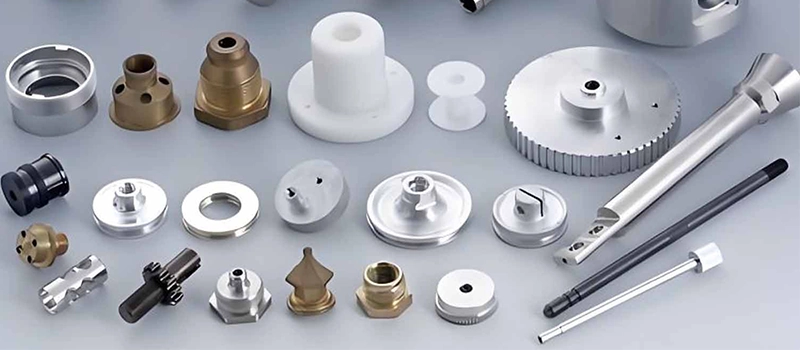
Non-ferrous cnc machining materials do not contain significant iron content. These materials include aluminum, copper, brass, magnesium, and titanium.
Aluminum is one of the most widely used cnc machining materials due to its excellent machinability. It allows high spindle speeds, low cutting forces, and superior surface finish. According to industry machining studies, aluminum alloys can achieve cutting speeds three times higher than carbon steel.
Copper and brass are also machinable materials frequently used in electrical and plumbing applications. Brass, in particular, is considered one of the easiest cnc machining materials due to its low friction and chip-breaking behavior.
Titanium, however, belongs to a more advanced category of cnc machining materials. While lightweight and strong, titanium has low thermal conductivity. Heat concentrates at the cutting edge, increasing tool wear. Machining titanium requires rigid setups, coated tools, and optimized coolant delivery.
Selecting non-ferrous cnc machining materials requires balancing cost, performance, and tool life.
Hard CNC Machining Materials and Machining Tungsten Carbide Material
Some cnc machining materials are classified as hard or ultra-hard materials. These include hardened tool steels, ceramics, and machining tungsten carbide material.
Machining tungsten carbide material is significantly more complex than machining standard steel material for general machining. Tungsten carbide typically exceeds 1500 HV in hardness. Conventional carbide tools cannot efficiently cut such cnc machining materials without rapid failure. Instead, diamond-coated tools or specialized grinding processes are required.
According to research in advanced machining technologies, machining tungsten carbide material can increase tool cost by up to 300% compared to standard cnc machining materials. However, tungsten carbide provides exceptional wear resistance and is widely used in cutting tools, mining components, and high-stress environments.
Hard cnc machining materials demand slower feed rates, higher rigidity, and precise thermal management.
Engineering Plastics as CNC Machining Materials
Not all cnc machining materials are metals. Engineering plastics represent an important segment of precision machining materials. Common machinable materials in this category include POM, nylon, PTFE, and polycarbonate.
These cnc machining materials offer low weight, chemical resistance, and electrical insulation. However, plastics behave differently during machining. They may deform due to heat buildup. Improper clamping pressure can distort dimensions.
Precision machining materials such as PEEK and UHMW are increasingly used in aerospace and medical applications. Their machinability depends heavily on temperature control and tool sharpness.
Engineering plastic cnc machining materials expand design possibilities while reducing weight and corrosion risk.
Factors to Consider When Choosing Machining Materials
When selecting cnc machining materials, I never look at price first. I look at performance requirements. Material selection in cnc machining materials is not random. It is a structured engineering decision that directly determines machining stability, tool life, production cost, and long-term product reliability.
Many companies make a critical mistake. They choose cnc machining materials based only on raw material price. This often leads to higher machining cost, longer cycle time, and increased scrap rate. The real cost of cnc machining materials is not the material price alone. It includes machinability, tool wear, tolerance control, and surface finish capability.
Choosing cnc machining materials requires evaluating five core factors: mechanical properties, machinability, thermal behavior, tolerance requirements, and total manufacturing cost.
Mechanical Properties of CNC Machining Materials
The mechanical properties of cnc machining materials determine whether the final component will survive real working conditions. Tensile strength, yield strength, hardness, impact resistance, and fatigue performance must align with application demands.
Steel material for general machining is often selected because it offers balanced strength and machinability. For structural parts, this category of cnc machining materials provides reliable load-bearing capacity at a reasonable machining cost.
However, if the application requires extreme wear resistance, machining tungsten carbide material or hardened tool steel may be necessary. These cnc machining materials provide superior hardness but significantly reduce machinability. This trade-off must be carefully calculated.
Precision machining materials used in aerospace or automotive systems require strict consistency in microstructure. Even small variations in cnc machining materials composition can affect fatigue life.
Material strength is important. But strength without machinability can destroy efficiency.
Machinability and Cutting Performance
Machinability is one of the most decisive factors when choosing cnc machining materials. It determines cutting speed, feed rate, tool life, chip control, and surface finish quality.
What materials can a CNC machine cut efficiently? Almost all machinable materials can technically be cut. But efficiency varies dramatically.
Aluminum-based cnc machining materials allow high spindle speed and low cutting resistance. Tool life is long. Production rate is high.
In contrast, machining tungsten carbide material demands extremely rigid machines, specialized cutting tools, and slower feed rates. Tool cost increases. Setup complexity increases. Cycle time increases.
Steel material for general machining often offers the best balance between machinability and mechanical strength. That is why it remains one of the most widely used cnc machining materials in industrial production.
When evaluating cnc machining materials, I always analyze:
- Chip formation behavior
- Tool wear rate
- Cutting temperature
- Surface roughness potential
- Vibration tendency
Machinability affects not just speed. It affects stability.
Thermal Properties and Heat Management
Heat generation during cutting is a critical issue when dealing with cnc machining materials. Every material reacts differently to thermal stress.
Materials with high thermal conductivity, such as aluminum, dissipate heat quickly. These cnc machining materials allow aggressive cutting strategies.
Materials with low thermal conductivity, such as titanium or machining tungsten carbide material, concentrate heat at the cutting edge. This accelerates tool wear and can cause thermal distortion.
Precision machining materials require tight dimensional tolerances. Thermal expansion of cnc machining materials must be considered. Even small temperature variations can affect dimensional accuracy.
If heat management is ignored during material selection, tolerance control becomes unstable.
CNC machining materials must match the thermal control capability of the production environment.
Tolerance and Surface Finish Requirements
Not all cnc machining materials can achieve the same dimensional accuracy or surface quality.
Soft machinable materials such as brass and aluminum can achieve excellent surface finish with minimal post-processing.
Hard cnc machining materials may require secondary grinding or polishing to meet precision standards.
When selecting cnc machining materials, I evaluate:
- Required tolerance level
- Surface roughness target
- Post-processing necessity
- Dimensional stability
Precision machining materials often require additional inspection and quality verification. The harder and more complex the cnc machining materials, the stricter the quality control system must be.
Choosing the wrong material can double finishing cost.
Total Manufacturing Cost of CNC Machining Materials
Many buyers focus only on material price per kilogram. This is a dangerous approach.
The real cost of cnc machining materials includes:
- Raw material price
- Tool consumption
- Machining time
- Scrap rate
- Energy consumption
- Inspection cost
For example, machining tungsten carbide material may cost several times more in tool wear compared to steel material for general machining. Although the raw material price may be justified by performance, the total machining cost must be calculated carefully.
Sometimes a slightly more expensive but highly machinable material reduces overall production cost.
CNC machining materials must be evaluated using total cost of ownership, not raw material price alone.
Risk Assessment and Production Stability
Stable production is more important than theoretical performance. Some cnc machining materials are difficult to source consistently. Others show high variation between batches.
Precision machining materials require strict traceability and chemical composition control. Variability in cnc machining materials can cause unexpected machining behavior.
I always assess:
- Supply chain stability
- Batch consistency
- Certification compliance
- Material test reports
Reliable cnc machining materials ensure stable delivery schedules and predictable machining performance.
Material selection is risk management.
Common Machining Processes and Their Material Requirements
When evaluating cnc machining materials, process compatibility is just as important as material properties. A material that performs well in turning may behave very differently in milling or drilling. CNC machining materials must always be selected together with the intended machining process. Ignoring process-material interaction leads to unstable production, tool failure, and dimensional inconsistency.
Different machining processes impose different mechanical loads, thermal stress, chip formation characteristics, and vibration patterns. Therefore, cnc machining materials cannot be evaluated in isolation. They must be evaluated within the context of the machining method.
CNC Turning and Material Requirements
CNC turning is primarily used for cylindrical components such as shafts, bushings, and threaded parts. In turning operations, cnc machining materials must withstand continuous cutting contact along a rotating axis.
Steel material for general machining performs exceptionally well in turning. It offers predictable chip formation and stable surface finish. That is why it remains one of the most popular cnc machining materials for lathe operations.
Aluminum-based cnc machining materials are also ideal for high-speed turning due to their low cutting resistance. They allow aggressive feed rates without excessive tool wear.
However, machining tungsten carbide material in turning operations presents significant challenges. The extreme hardness of such cnc machining materials requires diamond-coated tools and extremely rigid machine structures. Any vibration will immediately damage the cutting edge.
Turning operations demand cnc machining materials with:
- Stable chip breaking behavior
- Consistent hardness
- Low vibration sensitivity
- Manageable thermal expansion
If the cnc machining materials exhibit work hardening tendencies, such as certain stainless steels, tool wear increases rapidly.
Material-process alignment is critical in turning.
CNC Milling and Material Requirements
Milling is one of the most versatile machining processes. It involves intermittent cutting contact, which generates fluctuating cutting forces. CNC machining materials used in milling must tolerate dynamic load changes.
Aluminum remains one of the best cnc machining materials for milling. High spindle speeds and excellent chip evacuation make aluminum highly efficient in this process.
Steel material for general machining also performs well in milling, especially when surface finish requirements are moderate. Its machinability allows predictable feed and speed adjustments.
Hard cnc machining materials, including hardened tool steel or machining tungsten carbide material, create serious challenges during milling. Intermittent cutting increases impact stress on the cutting tool. Tool chipping becomes a major risk.
Precision machining materials used in aerospace applications often require 5-axis milling. In such cases, cnc machining materials must maintain structural integrity under multi-directional cutting loads.
For milling, ideal cnc machining materials should offer:
- Moderate hardness
- Controlled chip formation
- Good heat dissipation
- Low tendency toward work hardening
Improper selection of cnc machining materials in milling often results in vibration marks and inconsistent dimensional accuracy.
CNC Drilling and Hole-Making Materials
Drilling operations generate concentrated axial force and limited chip evacuation space. Therefore, cnc machining materials must allow effective chip removal.
Machinable materials such as low-carbon steel and aluminum are ideal for drilling. They produce manageable chips and reduce drill breakage.
When drilling stainless steel or high-strength cnc machining materials, chip evacuation becomes difficult. Heat accumulates inside the hole, increasing the risk of tool failure.
Machining tungsten carbide material in drilling applications often requires specialized equipment or pre-formed blanks due to extreme hardness.
Hole accuracy in precision machining materials depends heavily on material homogeneity. Any inclusion or inconsistency in cnc machining materials can deflect the drill path.
For drilling applications, cnc machining materials should provide:
- Stable microstructure
- Predictable chip size
- Reasonable hardness level
- Efficient coolant interaction
Hole-making failures are often caused not by machine issues, but by poor cnc machining materials selection.
Grinding and Hard Material Processing
Grinding is commonly used for finishing hardened cnc machining materials. It is especially relevant when machining tungsten carbide material or hardened tool steel.
Unlike cutting processes, grinding relies on abrasive removal. Therefore, cnc machining materials selected for grinding must tolerate high localized heat and abrasive interaction.
Hard precision machining materials often require grinding to achieve final tolerances. Surface integrity becomes critical.
Grinding operations demand cnc machining materials with:
- Structural uniformity
- Resistance to thermal cracking
- Stable dimensional behavior
Selecting inappropriate cnc machining materials for grinding may cause microcracks or residual stress.
Multi-Axis and High-Speed Machining Materials
Modern manufacturing increasingly relies on high-speed machining and multi-axis machining. In such environments, cnc machining materials must maintain dimensional stability under high spindle speeds and rapid tool movement.
Lightweight machinable materials such as aluminum and certain engineering plastics perform well under high-speed machining.
Steel material for general machining can also adapt to high-speed strategies when proper tooling is applied.
However, machining tungsten carbide material under high-speed conditions requires highly specialized setups.
High-speed machining increases thermal load. Therefore, cnc machining materials must dissipate heat efficiently to prevent deformation.
Selecting cnc machining materials without considering process speed leads to instability.
Advantages and Disadvantages of Different Machining Materials
Material selection is always a balance between performance, machinability, durability, and cost. No material is perfect. Every category offers advantages in certain conditions and limitations in others. Understanding these trade-offs is essential for engineering decision-making.
In real production environments, most problems are not caused by machines. They are caused by choosing a material that does not match the application or the machining process.
Ferrous Materials: Strength with Machining Trade-Offs
Ferrous metals, especially carbon steel and alloy steel, dominate industrial manufacturing. Steel material for general machining offers one of the best balances between strength and process efficiency.
Advantages:
- High mechanical strength
- Good structural stability
- Wide availability
- Cost-effective raw material pricing
- Compatible with most machining processes
Low and medium carbon steels provide predictable chip formation and stable cutting behavior. They are ideal for structural components, automotive parts, and industrial machinery.
However, as alloy content increases, machinability often decreases.
Disadvantages:
- Increased tool wear in high-strength grades
- Work hardening tendency in stainless steel
- Corrosion risk for non-treated carbon steel
- Higher cutting forces compared to aluminum
Stainless steel, although corrosion-resistant, presents significant machining challenges. Heat concentration and material hardening can reduce tool life dramatically if parameters are not optimized.
Ferrous materials are strong and reliable, but they demand proper process control.
Non-Ferrous Metals: Efficiency and Lightweight Benefits
Aluminum, brass, copper, and titanium fall into the non-ferrous category. Each serves different industrial needs.
Aluminum is widely preferred for its excellent machinability and lightweight properties.
Advantages of Aluminum:
- High cutting speed capability
- Low tool wear
- Excellent surface finish
- Good corrosion resistance
- Reduced overall component weight
These characteristics make aluminum ideal for aerospace, electronics, and automotive components where weight reduction is critical.
Brass is another highly machinable option. It produces clean chips and maintains dimensional accuracy with minimal effort.
However, non-ferrous metals also have limitations.
Disadvantages:
- Lower strength compared to alloy steels
- Deformation risk under high load
- Material cost fluctuations (especially copper and titanium)
- Titanium generates high cutting temperature
Titanium, while strong and corrosion-resistant, has poor thermal conductivity. Heat builds up around the cutting edge, increasing tooling costs.
Non-ferrous metals improve efficiency, but mechanical performance must always match application demands.
Hard Materials: Extreme Durability with High Cost
Hardened tool steels and tungsten carbide represent high-performance materials used in extreme environments.
Machining tungsten carbide material provides exceptional wear resistance and long service life in mining tools, cutting inserts, and heavy-duty applications.
Advantages:
- Outstanding hardness
- Superior abrasion resistance
- Long operational lifespan
- Stability under extreme stress
However, these benefits come at a price.
Disadvantages:
- Extremely difficult to machine
- High tooling cost
- Specialized equipment required
- Increased cycle time
- Higher rejection risk if improperly processed
Hard materials demand precision, rigidity, and experience. They are suitable for high-value components but are rarely economical for general applications.
Choosing such materials without clear necessity often increases manufacturing complexity.
Engineering Plastics: Lightweight and Corrosion-Free
Engineering plastics are increasingly used in precision applications.
Common options include POM, nylon, PTFE, and PEEK. These materials offer corrosion resistance, electrical insulation, and low weight.
Advantages:
- Easy to machine
- Low cutting force
- No corrosion
- Good chemical resistance
- Lightweight
They are often used in food processing, medical equipment, and electrical components.
However, plastics have structural limitations.
Disadvantages:
- Lower load-bearing capacity
- Thermal deformation risk
- Dimensional instability under heat
- Limited wear resistance
Clamping pressure and heat control must be carefully managed. Plastics can deform even during machining if parameters are not controlled.
Engineering polymers expand design flexibility but cannot replace metals in high-load applications.
The Role of Material Properties in Machining Performance
Material properties are not abstract laboratory data. They directly determine cutting force, tool wear, surface finish, vibration behavior, dimensional stability, and overall production efficiency. In machining, performance is never accidental. It is the result of how material characteristics interact with cutting mechanics.
Understanding material properties allows engineers to predict machining behavior before production even begins. This predictive capability reduces risk, improves planning accuracy, and prevents costly trial-and-error adjustments.
Hardness and Its Direct Impact on Tool Wear
Hardness is one of the most influential properties in machining. It determines resistance to plastic deformation and directly affects cutting force and tool wear rate.
As hardness increases, cutting resistance increases. This means:
- Higher spindle load
- Increased tool edge stress
- Shorter tool life
- Greater heat generation
For example, steel material for general machining typically offers moderate hardness, allowing balanced cutting speed and tool longevity. It provides predictable wear patterns and manageable cutting forces.
In contrast, machining tungsten carbide material involves extreme hardness levels. Traditional carbide tools are insufficient. Diamond or CBN tooling becomes necessary. Even with advanced tooling, cutting speed must be reduced to prevent premature failure.
However, hardness alone does not define machinability. Two materials with similar hardness can behave very differently depending on microstructure.
Hardness increases durability but reduces process flexibility.
Tensile Strength and Cutting Force Behavior
Tensile strength reflects how much stress a material can withstand before failure. In machining, higher tensile strength generally means higher cutting forces.
Materials with high tensile strength require:
- Increased spindle power
- Stronger fixturing
- Reduced feed rate
- Rigid machine structure
If machine rigidity is insufficient, high-strength materials cause vibration and dimensional deviation.
However, high tensile strength often correlates with better fatigue resistance in final components. This is why structural applications frequently rely on alloy steels despite increased machining complexity.
Balancing mechanical strength and machinability is a key engineering decision.
Thermal Conductivity and Heat Dissipation
Heat management plays a central role in machining performance. During cutting, friction between tool and material generates significant thermal energy.
Materials with high thermal conductivity, such as aluminum, dissipate heat quickly. This protects the cutting edge and maintains dimensional stability.
Materials with low thermal conductivity, such as titanium or hardened steels, retain heat near the cutting zone. This leads to:
- Rapid tool degradation
- Built-up edge formation
- Thermal expansion distortion
- Reduced surface quality
In extreme cases, excessive heat alters material microstructure near the machined surface.
Thermal behavior directly affects both productivity and final part accuracy.
Microstructure and Grain Composition
Microstructure refers to the internal arrangement of grains, phases, and inclusions inside a material. Even when two materials share identical chemical composition, differences in microstructure can drastically change machining performance.
Fine-grain materials often provide smoother surface finish and more consistent cutting behavior.
Coarse-grain structures may lead to irregular chip formation and surface tearing.
Inclusions, impurities, and uneven distribution of alloying elements can cause localized tool damage.
For precision components, microstructure stability is critical. Variability between material batches often leads to inconsistent machining results.
Material uniformity improves predictability.
Work Hardening and Its Machining Consequences
Certain materials, particularly austenitic stainless steels and some nickel alloys, exhibit work hardening behavior. This means the material becomes harder when deformed during cutting.
If feed rate is too low, the cutting tool rubs instead of cutting. This increases surface hardness and accelerates tool wear.
Work hardening materials require:
- Sharp cutting edges
- Proper feed rates
- Stable engagement
- Adequate cooling
Ignoring work hardening behavior often results in rapid tool failure and poor surface integrity.
Understanding deformation characteristics prevents unnecessary tooling cost.
Elastic Modulus and Vibration Stability
Elastic modulus measures stiffness. Materials with lower stiffness deform more easily under cutting forces.
Low modulus materials may:
- Deflect during machining
- Produce chatter vibration
- Reduce dimensional accuracy
Aluminum and certain plastics have lower stiffness compared to steel. While they are easy to cut, thin-walled components may require special fixturing to prevent deformation.
High modulus materials maintain shape under load but increase cutting resistance.
Machining stability depends not only on machine rigidity but also on material stiffness.
Surface Integrity and Residual Stress
Surface integrity includes surface roughness, microcracks, and residual stress distribution. Material properties strongly influence these outcomes.
Hard and brittle materials are prone to microcracking if cutting parameters are aggressive.
Ductile materials may form built-up edge, affecting surface finish consistency.
Residual stress induced during machining can impact fatigue life and corrosion resistance.
For high-precision components, especially in aerospace and automotive systems, surface integrity determines long-term reliability.
Material behavior under cutting stress must be predicted and controlled.
Dimensional Stability and Thermal Expansion
Thermal expansion coefficient determines how much a material expands when temperature increases.
In high-speed machining environments, temperature fluctuations are unavoidable.
Materials with high expansion rates may cause dimensional deviation, especially in tight-tolerance components.
Precision manufacturing requires understanding how material expansion interacts with machine calibration and environmental temperature.
Dimensional stability is often overlooked but critical in high-accuracy applications.
Conclusion: Making the Right Choice for Your Machining Needs
Selecting the right cnc machining materials is not simply a technical decision. It is a strategic manufacturing choice that determines cost, efficiency, durability, and long-term product performance.
Every material carries trade-offs. Strength affects machinability. Hardness influences tool life. Thermal behavior impacts dimensional stability. There is no universal solution — only the most suitable match between material properties, machining process, and application requirements.
The most successful machining projects are not built on expensive materials. They are built on informed decisions.
When material science aligns with machining strategy, performance becomes predictable, cost becomes controllable, and production becomes stable.
That is the real value of understanding machining materials.