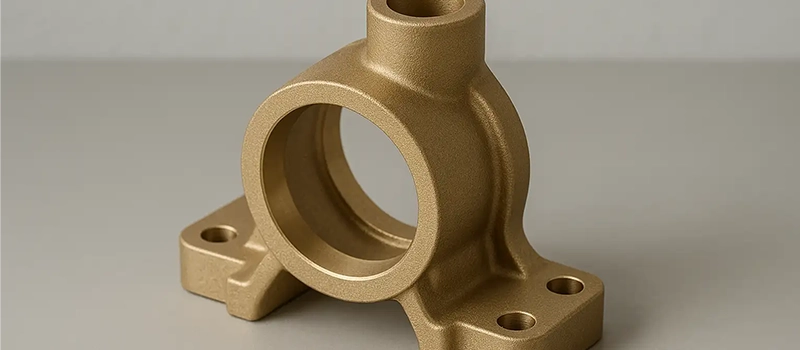
Brass casting remains essential in components that demand corrosion resistance, fine surface finish, and machinability. Yet casting failure rates remain high in design transitions and pressure zones.
As noted in the NADCA Product Standards Manual, improper gating and poor thermal control in brass casting frequently lead to porosity, shrinkage voids, and dimensional instability. Without a clear understanding of its casting behavior, engineers risk elevated scrap rates and unreliable service life.
This guide examines brass casting performance from a manufacturing-first perspective—linking alloy behavior to flow, shrinkage, cooling, and final part integrity—so engineers can design with confidence and minimize risk.
What Is Brass Casting
Alloy Types Used in Brass Casting
Brass casting refers to the process of shaping molten brass into a solid form using molds. In manufacturing, the most commonly used brass alloys for casting include C83600 (also known as red brass) and C85700 (manganese brass). These alloys are selected for their balance of fluidity, corrosion resistance, and machinability.
C83600 red brass is widely used due to its excellent casting properties and resistance to dezincification. Its high lead content improves machinability but can limit weldability. C85700 manganese brass, on the other hand, offers higher tensile strength and better performance in mechanical components but may require tighter process control due to its shrinkage behavior.
Casting Methods for Brass
Brass alloys are compatible with several casting methods. The choice of process influences part precision, surface quality, and tooling investment.
Sand Casting
Preferred for low-volume production or large components. Offers design flexibility but limited surface finish and dimensional accuracy.
Die Casting
Suitable for high-volume production of small to medium parts with consistent dimensions. Brass’s high melting point places thermal stress on dies, requiring premium die materials and maintenance planning.
Investment Casting
Enables high-precision parts with complex geometries. Commonly used when fine detail or minimal post-machining is needed, though cost and cycle time are higher than other methods.
Each method requires tailored gating, venting, and cooling design due to brass’s moderate shrinkage rate and potential for gas entrapment. Selection should always consider thermal conductivity, part geometry, and expected service conditions.
Brass Casting Behavior During Manufacturing
Shrinkage and Solidification
Brass casting exhibits a relatively high linear shrinkage rate, typically ranging from 1.5% to 2.0%, depending on alloy composition and casting conditions. This characteristic affects dimensional accuracy and must be considered early in the mold design phase.
Hot Tearing in Thick Sections
One of the most common defects in brass casting is hot tearing. This occurs in areas where thick cross-sections cool slowly or where metal flow is restricted. Solidification starts at the mold wall and progresses inward, and if sections cool unevenly, thermal stress accumulates, causing internal cracks.
To minimize this, parts should avoid isolated heavy masses. Smooth transitions and uniform wall thickness improve feeding and reduce stress gradients. If unavoidable, chills or risers must be strategically placed in gravity casting to aid directional solidification.
Thermal Conductivity and Cooling Effects
Brass alloys have relatively high thermal conductivity, which promotes rapid skin solidification against the mold wall. While this benefits cycle time and surface finish, it also traps gases and contributes to porosity in the interior if not vented properly.
Internal Porosity Risks
Due to fast surface cooling and slower core solidification, brass casting is prone to microporosity. In pressure zones or valve housings, this can result in internal leaks. Proper gating systems, turbulent flow reduction, and temperature control are necessary to avoid gas entrapment and shrinkage voids.
Use of vacuum-assist, metal degassing, or mold coatings may be required in precision castings. The designer must balance cooling rate with mold complexity to ensure sound internal structure.

Machinability and Surface Quality
Surface Finish vs Process Type
The surface finish of brass casting is strongly influenced by the chosen process. Sand casting typically yields a rougher surface finish, with Ra values around 6.3–12.5 μm. This limits its use in precision applications without secondary machining or finishing.
Die casting of brass produces significantly finer surfaces, typically in the range of 1.6–3.2 μm Ra, suitable for decorative components or sealing surfaces. However, it requires investment in durable tooling due to brass’s high casting temperature.
Investment Casting Detail Capabilities
Investment casting offers the best surface finish among common brass casting processes. Fine wax patterns and ceramic shells allow replication of small details and thin-walled geometries. Surface finishes as low as 1.6 μm Ra can be achieved, reducing or eliminating the need for machining in many cases.
Still, designers must account for shrinkage and potential ceramic inclusions during burnout. Sharp internal corners or unvented features may suffer incomplete fill or trapped gases.
Tool Wear and Chip Behavior
Brass casting alloys—especially leaded variants like C83600—are highly machinable. The lead content acts as a lubricant during cutting, reducing tool wear and allowing high-speed machining with minimal burr formation.
Effects of Silicon or Manganese Additions
In alloys like C85700, manganese or silicon additions improve strength but increase tool wear. These compositions produce harder chips and require carbide tools or coated inserts to maintain dimensional control and surface quality over longer production runs.
Coolant use should be minimized in some cases to avoid surface staining or oxidation, particularly on parts that will remain uncoated. Optimal cutting parameters are typically 150–300 m/min depending on tool material and alloy type.
Where Brass Casting Performs Well
Valves, Plumbing, Decorative Parts
Brass casting excels in environments requiring corrosion resistance, aesthetic appearance, and moderate mechanical strength. It is widely used for valves, fittings, and plumbing components due to its resistance to dezincification and ease of forming internal passageways.
Corrosion Resistance in Water Systems
C83600 and other leaded brasses maintain excellent corrosion resistance in potable water and low-pressure fluid systems. Brass casting is the industry standard for faucets, hose connections, and backflow preventers. Its resistance to tarnishing and scale buildup makes it a preferred material for wet service over long durations.
Designers must ensure that cast parts used in potable water systems meet local lead-content restrictions (e.g., NSF/ANSI 61 or EU RoHS). Where required, lead-free brass alternatives such as C87850 may be substituted, though with reduced machinability.

Excellent Detail Resolution
Brass casting supports thin-walled features and sharp edges, especially in die or investment casting processes. This makes it ideal for hardware components like lock bodies, door handles, and precision decorative elements.
Suitability for Patterned or Embossed Surfaces
Because brass flows well and retains detail, it is used extensively in architecture and hardware applications where surface design is visible. Raised lettering, logos, or geometric textures can be cast directly into the part without post-processing.
In these applications, tool wear is less of a concern, and cosmetic criteria dominate. The ability to polish and plate brass further extends its use into high-end aesthetic components.
Where Brass Casting Fails
Thermal Fatigue and Crack Zones
Brass casting performs poorly under repeated thermal cycling or localized overheating. The alloy’s relatively low melting range and poor high-temperature strength make it vulnerable to thermal fatigue cracking, especially in components exposed to cyclic heating or sudden thermal gradients.
Failure in Thick or Uneven Sections
In castings with large, uneven wall thicknesses, brass tends to form internal stresses due to uneven cooling. This mismatch leads to hot tears or delayed cracking during service, particularly in valves or housings subjected to mechanical loads combined with temperature variation.
Preventing this failure mode requires design strategies such as minimizing section changes, using fillets instead of sharp corners, and applying consistent wall thickness throughout the component.
Dimensional Instability Under Pressure
Although brass casting allows good detail reproduction, its internal soundness is sensitive to porosity. In pressure-bearing components, trapped gas or shrinkage voids may cause leakage or loss of dimensional stability under load.
Porosity from Improper Venting
Porosity arises when gases are not properly evacuated from the mold cavity. In pressure die casting, insufficient venting, poor gating design, or metal turbulence may trap air and cause microporosity. These defects remain hidden during machining but can manifest under hydraulic or pneumatic service conditions.
To avoid dimensional instability and failure, designers must account for internal inspection (e.g., X-ray, pressure testing), especially in castings intended for sealed systems or structural supports. High-integrity brass castings often require vacuum assist or process modification to meet quality standards.
Design Considerations and Quality Control
Draft, Wall Thickness, and Gating
Effective brass casting begins with geometry optimized for fluid flow and solidification behavior. Proper draft angles, consistent wall thickness, and controlled gating are essential for minimizing casting defects and dimensional variation.
Draft Angle Guidelines
For brass casting processes like sand or investment casting, a typical draft angle of 1.5° to 3° per side is recommended for vertical walls. This ensures clean release from the mold and prevents drag or distortion during ejection. Die casting may allow tighter draft due to smoother die surfaces, but high temperatures and alloy shrinkage still demand cautious design.
Wall Thickness Uniformity
Brass casting benefits from relatively uniform wall thickness across the part. Sudden transitions between thick and thin sections increase the risk of hot spots, shrinkage cavities, or incomplete fill. Optimal wall thickness depends on the process but generally ranges from 2.5 mm to 6 mm for structural reliability.
Gating and Riser Placement
In sand and investment casting, gating must promote laminar flow and fill the mold cavity without turbulence. Risers are required to compensate for solidification shrinkage and should be placed near hot spots. In die casting, gating must be designed to avoid air entrapment and minimize velocity-induced erosion of die surfaces.

Common Defects and Inspection Standards
Brass casting is vulnerable to a range of defects that affect both function and appearance. Understanding their causes and applying relevant inspection techniques is essential for quality assurance.
Porosity, Cold Shuts, and Misruns
Porosity is often due to trapped gas or inadequate feeding. Cold shuts occur when two flow fronts meet without fusing, typically due to low pour temperature or poor gating. Misruns result when the alloy fails to completely fill the mold before solidification begins. These defects compromise sealing, strength, or appearance, especially in precision parts.
Dimensional and Visual Inspection
Critical brass castings should undergo dimensional inspection using CMM or gauges, especially for mating surfaces and internal cavities. Visual inspection under proper lighting reveals surface flaws like blisters or inclusions. For pressure-bearing parts, pressure testing or radiographic inspection (X-ray) ensures internal soundness before machining or assembly.
In many applications, compliance with ASTM B584 or equivalent material standards ensures the alloy, properties, and casting method are within acceptable limits. Certification is often required in plumbing, gas control, and marine applications.
Surface Finishing Options for Brass Castings
Brass casting is often selected not just for its mechanical properties but also for its ability to receive and retain surface treatments. These finishes can enhance corrosion resistance, improve aesthetics, and prepare the part for specific service environments.
Chromate and Clear Coatings
Clear chromate coatings are commonly applied to brass castings used indoors or in low-corrosion environments. These transparent layers form a passive oxide film that slows oxidation while preserving the natural golden color of brass.
Decorative Protection Without Bulk
Unlike painting or plating, chromate does not significantly alter the dimensional characteristics of the part. It’s ideal for architectural hardware, hinges, and valve handles where dimensional integrity and appearance are both priorities. Application methods include immersion or spray, followed by ambient curing.
Chromate coatings may not meet all environmental regulations due to hexavalent chromium content, so alternative trivalent processes are being adopted in regulated markets.
Powder Coating and Paint Adhesion
For parts exposed to UV light, chemical exposure, or color-coded service applications, powder coating offers durable surface protection. Brass casting must be properly cleaned and etched before powder coating to ensure adhesion.
Surface Prep and Process Limitations
Typical surface preparation includes alkaline cleaning, abrasive blasting, and phosphating. Sharp edges or shallow engravings may be obscured during coating, so critical design features should account for buildup thickness—typically 60–120 microns.
Powder-coated brass is commonly used in industrial hardware, marine brackets, and outdoor control enclosures.

Polishing and Electroplating
Brass casting’s fine grain structure and surface consistency make it ideal for polishing and plating. Mechanical polishing can achieve high reflectivity, while electroplating adds both corrosion resistance and decorative appeal.
Common Plated Finishes
Nickel, chrome, and gold are standard plating materials for brass castings used in consumer, medical, and instrumentation applications. Plating can also provide wear protection in valve stems or sensor housings. Surface defects in the casting should be minimized, as plating will highlight rather than conceal imperfections.
Dimensional changes from plating are minimal but must be considered in press-fit or threaded parts. Pre-plate machining tolerances should include plating buildup.
Environmental and Regulatory Considerations
Brass casting is increasingly influenced by global environmental standards, especially regarding lead content, recycling practices, and compliance with material safety directives. Designers and procurement teams must evaluate both alloy composition and post-processing compatibility with regulatory frameworks.
Lead-Free Brass Alternatives
Conventional brass casting alloys like C83600 contain lead to enhance machinability. However, growing regulatory pressure has limited their use in potable water, food equipment, and consumer-facing hardware. Regulations such as:
- EU RoHS (Restriction of Hazardous Substances)
- U.S. Safe Drinking Water Act / NSF 61
- REACH (Registration, Evaluation, Authorisation and Restriction of Chemicals)
have forced manufacturers to shift toward low-lead or lead-free brass casting alloys.
Performance Trade-Offs
Lead-free brass such as C87850 or silicon brass variants offer reduced environmental risk but often come with machining penalties. Increased tool wear, chip adhesion, and dimensional instability may be observed without lead’s lubricating effect.
Die design, tool coatings, and modified cutting parameters must be adapted for these compliant alloys to maintain productivity and dimensional tolerance.
Recyclability and Material Reuse
Brass casting alloys are among the most recyclable non-ferrous metals. Foundries regularly use return scrap in melt charges without significant loss of performance, provided alloy segregation is strictly enforced.
Alloy Separation and Quality Control
Mixing leaded and non-leaded brass scraps compromises both mechanical properties and regulatory compliance. In foundries producing both alloy families, dedicated melt lines or strict batch tracking is essential. Spectrographic analysis is typically required before each pour to confirm alloy integrity.
Using certified recycled content is increasingly valued in green building (LEED) and sustainable manufacturing documentation. Many procurement specifications now request declaration of recycled brass content or Environmental Product Declarations (EPDs).
Comparison to Bronze Casting
While brass casting and bronze casting are both widely used in non-ferrous manufacturing, their behaviors, mechanical properties, and applications differ significantly. Choosing between them depends on the required wear resistance, cost, corrosion environment, and machinability.
Mechanical and Wear Behavior
Bronze casting generally provides superior wear resistance, especially in sliding or bearing applications. Alloys like C93200 (bearing bronze) or C95400 (aluminum bronze) outperform brass casting when parts are subjected to repeated friction or load-bearing rotation.
Frictional Applications
Bronze’s higher tin or aluminum content forms a lubricating oxide layer under motion. This makes it suitable for bushings, bearing inserts, or gears where long service life under stress is needed. Brass casting, in contrast, is more suitable for static or low-load mechanical parts.
In valve bodies or plumbing components, brass’s corrosion resistance and machinability make it more economical, even though it may wear faster under dynamic conditions.
Machinability and Cost
Brass casting has significantly better machinability than most bronze alloys. Its lower hardness and the lubricating effect of lead result in cleaner cuts, longer tool life, and reduced finishing time. This gives brass an edge in high-volume or tight-tolerance components requiring secondary machining.
Production Cost and Alloy Price
Brass casting is generally more cost-effective per kilogram than bronze, due to lower raw material costs and energy requirements in melting. Bronze alloys containing tin, nickel, or aluminum are often 10–30% more expensive, especially in global markets with volatile metal pricing.
For cost-sensitive applications where extreme wear is not a concern, brass casting is the more economical choice. Bronze is often selected when the performance criteria—particularly related to fatigue or sliding wear—justify the added expense.
Conclusion
Brass casting offers excellent formability, corrosion resistance, and machinability—making it a preferred solution for valves, fittings, and decorative components. However, it is not suitable for high-temperature service, cyclic stress, or structural load-bearing. Designers must align alloy choice and casting process with dimensional demands, fluid pressure, and regulatory constraints to ensure long-term performance and compliance.